
Skip to content
The Encyclopedia of Horology

Clock · Tall clock

Tall Clock by Benjamin Bagnall

Partially verified

This tall clock was made by Benjamin Bagnall (1689–1773), who is recognized as an early clockmaker in Boston, Massachusetts. The object is composed of walnut and white pine and measures approximately 87 inches high by 20.625 inches wide and 11.375 inches deep. It is held by The Metropolitan Museum of Art in The American Wing under accession number 10.125.388. The dial features an arched design consistent with the period of 1730–35 and is executed in the English manner. The case includes an ogee-moulded sarcophagus top, which is identified as a conjectural restoration informed by other known clock cases produced by Bagnall. The clock was a gift to the museum from Mrs. Russell Sage in 1909.

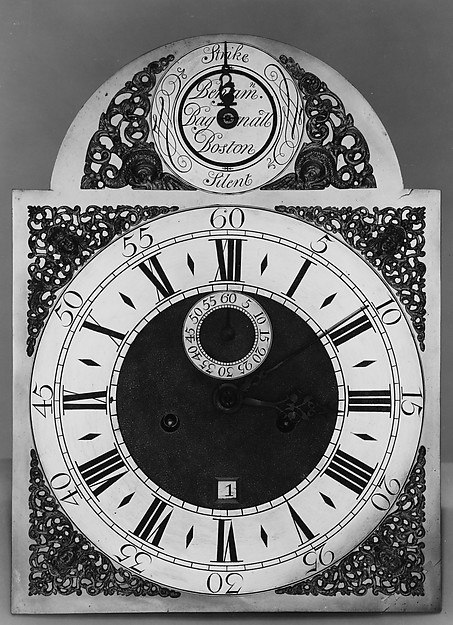
The arched dial of the tall clock, showing the strike/silent selector, signature of Benjamin Bagnall, the chapter ring, and a calendar aperture.
The arched dial of the tall clock, showing the strike/silent selector, signature of Benjamin Bagnall, the chapter ring, and a calendar aperture. — The Metropolitan Museum of Art, New York. Rights pending — permission not yet requested. Original source

Catalogue identity

Source
orbiscollectibles.com
Category
Clock · Tall clock
Maker / attribution
Benjamin Bagnall
Reference
Not recorded
Catalogue / lot identifier
10.125.388
Source-reported date
1725–40
Source-reported place
United States

Source-reported attribution and specifications are not independent authentication. A listing does not establish present ownership, current display, availability or permission to reproduce.

Object description

Construction and Design

The clock is crafted from walnut and white pine, standing at 87 inches in height. It features an arched dial of the type associated with the 1730–1735 period, designed in the English manner. A key feature of the clock is its ogee-moulded sarcophagus top, which the museum notes is a conjectural restoration. This construction choice was made by drawing upon other examples of clock cases attributed to Benjamin Bagnall.

The dial includes a strike/silent feature positioned within the arch, accompanied by the signature of the maker. The main chapter ring utilizes Roman numerals for the hours and includes a subsidiary seconds dial. Corner spandrels and engraving detail the dial plate, which is signed "Benjam. Bagnall Boston" in the arch area.

Evidence for this section
  • “Clocks known to have been produced by Bagnall possess dials executed in the English manner, and this example displays the arched type of 1730–35”
  • “the ogee-moulded sarcophagus top seen on this clock case represents a conjectural restoration, constructed on the basis of numerous examples of clock cases made by Bagnall”

Provenance and History

The object was gifted to The Metropolitan Museum of Art in 1909 by Mrs. Russell Sage. Prior to its inclusion in the museum collection, the clock was associated with Reverend Elisha Williams.

This period of ownership is placed between the years 1725 and 1739, aligning with the broader dating of the object's manufacture.

Evidence for this section
  • “Reverend Elisha Williams is reported to have been the owner of this clock.”
  • “It is considered probable that Williams acquired the clock between 1725 and 1739, during the period when he served as rector of Yale College.”

Museum Identification

The clock is documented as item 10.125.388 within The American Wing of The Metropolitan Museum of Art. The museum identifies Benjamin Bagnall as the primary maker of the object, noting his significance as an early clockmaker in Boston.

The provided measurements and materials are based on the museum's own documentation of the object. No additional catalogue numbers are provided in the current records, maintaining the focus on this individual specimen.

Evidence for this section
  • “The Metropolitan Museum of Art holds this object as 10.125.388.”
  • “Benjamin Bagnall was the first important clockmaker in Boston.”

Open research questions

  • What is the mechanical composition of the movement and is it original to this case?
  • Does the serial numbering or internal construction provide further insight into the specific date of manufacture within the 1725–1740 window?

Source evidence

Recorded claims and source quotations for Tall Clock by Benjamin Bagnall
FieldSource-reported valueSource quotation
MakerBenjamin Bagnall (1689–1773)“Benjamin Bagnall (1689–1773)”
Date1725–40“1725–40”
MaterialsWalnut, white pine“Walnut, white pine”
Dimensions87 x 20 5/8 x 11 3/8 in. (221 x 52.4 x 28.9 cm)“87 x 20 5/8 x 11 3/8 in. (221 x 52.4 x 28.9 cm)”
LocationBoston, Massachusetts“Benjamin Bagnall was the first important clockmaker in Boston.”
ProvenanceReverend Elisha Williams“Reverend Elisha Williams is reported to have been the owner of this clock.”
RestorationOgee-moulded sarcophagus top“the ogee-moulded sarcophagus top seen on this clock case represents a conjectural restoration”

Visible details

  • Dial features an arched top with a strike/silent selector
  • Central dial has a subsidiary seconds chapter ring
  • Dial corners feature decorative spandrel castings
  • Signature 'Benjam. Bagnall Boston' is engraved on the arch

Research qualifications

  • The ogee-moulded sarcophagus top is a conjectural restoration
  • The exact acquisition date by Reverend Elisha Williams remains a probability based on his tenure at Yale

Photograph identity and source facts were screened before import; rights clearance remains pending.

Consulted source

Tall Clock by Benjamin Bagnall, American, 1725–40

Reviewed 2026-11-02 · Record b50fe10f0e

Terms in this record

Glossary explanations for terms named in this object’s record.