
Skip to content
The Encyclopedia of Horology

Clock · Tall clock

Tall Clock by William Huston

Partially verified

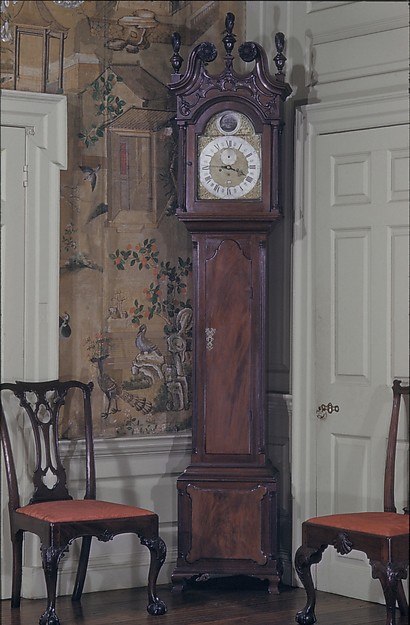
This tall clock, accessioned as 48.99 at The Metropolitan Museum of Art, was produced by American clockmaker William Huston (ca. 1730–1791) between 1767 and 1771. The object is a floor-standing timepiece constructed from a combination of mahogany, poplar, and cherry woods. Standing approximately 105 inches tall, the clock represents an example of American colonial-era cabinetmaking and horology. The Metropolitan Museum of Art acquired the piece through the Morris K. Jesup Fund in 1948. The clock is held within The American Wing of the museum.

Full view of the William Huston tall clock (accession 48.99) in a gallery setting with period furniture.
Full view of the William Huston tall clock (accession 48.99) in a gallery setting with period furniture. — The Metropolitan Museum of Art, New York. Rights pending — permission not yet requested. Original source

Catalogue identity

Source
orbiscollectibles.com
Category
Clock · Tall clock
Maker / attribution
William Huston
Reference
Not recorded
Catalogue / lot identifier
48.99
Source-reported date
1767–71
Source-reported place
United States

Source-reported attribution and specifications are not independent authentication. A listing does not establish present ownership, current display, availability or permission to reproduce.

Object description

Case Construction and Design

The tall clock case is constructed primarily from mahogany, with secondary woods identified as poplar and cherry. This includes a hood featuring a broken-scroll pediment and three flame finials.

Applied carvings adorn the case, providing decorative detail consistent with the specific style identified in the museum records. The tall proportions, measuring 105 inches in height, support a central waist door which provides access to the interior of the case and the pendulum mechanism.

Evidence for this section
  • “Mahogany, poplar, cherry”
  • “A classic Philadelphia Chippendale-style clock case is characterised by a broken-scroll pediment, applied carving, and flame finials.”

Horological Features and Attribution

The movement is attributed to William Huston, an American clockmaker active in the late 18th century. The dial, visible in the accompanying photographs, features engraved numerals and decorative spandrels.

The physical components of the clock, including the dial and the internal layout, form the basis for its attribution to Huston. Museum records categorize the clock within The American Wing, noting the collaboration of cabinetmaking and clockmaking workshops as a common feature for tall clocks of this era.

Evidence for this section
  • “Tall Clock made by William Huston (ca. 1730–1791)”
  • “Compare the signature on the dial or back plate, the movement layout and striking train, and the case style and materials”

Acquisition and Documentation

The Metropolitan Museum of Art acquired this tall clock in 1948. It is recorded under the accession number 48.99. The acquisition was facilitated by the Morris K. Jesup Fund.

The object is currently part of the museum's American collection. While documented as an example of American craft from the 1767–1771 period, museum notes advise that the historical assembly of such clocks often involved separate production of cases and movements.

Evidence for this section
  • “The Metropolitan Museum of Art holds this object as 48.99.”
  • “Credit line: Morris K. Jesup Fund, 1948.”
  • “movements and cases were frequently made by different workshops and were sometimes married later.”

Open research questions

  • What is the specific provenance of the clock prior to the 1948 acquisition by the Metropolitan Museum of Art?
  • Has the internal movement been examined to confirm it retains original components matching the period of the case?

Source evidence

Recorded claims and source quotations for Tall Clock by William Huston
FieldSource-reported valueSource quotation
MakerWilliam Huston (ca. 1730–1791)“William Huston (ca. 1730–1791)”
Date1767–71“1767–71”
MaterialsMahogany, poplar, cherry“Mahogany, poplar, cherry”
Dimensions105 x 22 x 11 3/4 in.“105 x 22 x 11 3/4 in. (266.7 x 55.9 x 29.8 cm)”
Credit lineMorris K. Jesup Fund, 1948“Morris K. Jesup Fund, 1948”
StylePhiladelphia Chippendale“classic Philadelphia Chippendale-style clock case”

Visible details

  • Broken-scroll pediment at the crest of the hood
  • Three flame finials
  • Engraved dial with decorative spandrels
  • Panelled waist door with central escutcheon

Research qualifications

  • The provenance of the individual components, specifically whether the movement and case were original to one another, is not confirmed by the source.
  • The wider historical context of the clock type versus this specific example is not independently verified.

Photograph identity and source facts were screened before import; rights clearance remains pending.

Consulted source

Tall Clock by William Huston, American, 1767–71

Reviewed 2026-11-02 · Record 6ffb3e240f

Terms in this record

Glossary explanations for terms named in this object’s record.