
Skip to content
The Encyclopedia of Horology

Clock · Tall clock

Tall Clock by Isaac Doolittle

Partially verified

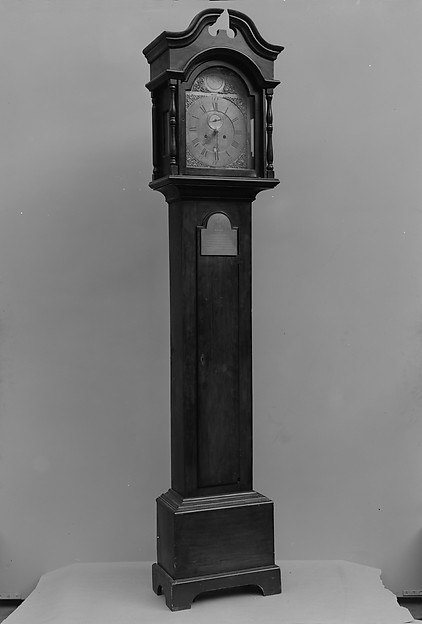
This tall clock, accessioned as 43.148 by The Metropolitan Museum of Art, was crafted in 1765 by Isaac Doolittle (1721–1800), a clockmaker and artisan based in New Haven, Connecticut. The clock is constructed from cherry wood and stands approximately 91 1/2 inches (232.4 cm) in height. Isaac Doolittle is noted for his work with various materials, including brass, iron, and silver, and he earned a reputation for producing some of the earliest brass-wheel hall clocks in the American colonies. This piece reflects his technical focus during the period prior to his later expansion into printing press manufacturing and military engineering. The object remains in the collection of the museum's American Wing, having entered via the bequest of Helena D. Swift in 1943.

Tall Clock by Isaac Doolittle, dated 1765, featuring a cherry wood case and brass-wheel movement.
Tall Clock by Isaac Doolittle, dated 1765, featuring a cherry wood case and brass-wheel movement. — The Metropolitan Museum of Art, New York. Rights pending — permission not yet requested. Original source

Catalogue identity

Source
orbiscollectibles.com
Category
Clock · Tall clock
Maker / attribution
Isaac Doolittle
Reference
Not recorded
Catalogue / lot identifier
43.148
Source-reported date
1765
Source-reported place
United States

Source-reported attribution and specifications are not independent authentication. A listing does not establish present ownership, current display, availability or permission to reproduce.

Object description

Case Construction

The clock is housed in a tall, floor-standing case constructed from cherry wood. The design incorporates a hood with an arched top, featuring decorative fretwork. The waist of the clock features a tall, rectangular door, providing access to the interior for pendulum and weight management. The base of the unit sits upon a plinth, supporting the total height of approximately 91.5 inches.

The proportions of the case include a width of 19.5 inches. The structure is consistent with mid-18th-century hall clocks, though the source notes that cases and movements were sometimes manufactured by separate workshops and occasionally married during the clock's history. The current state is attributed to the period of 1765.

Evidence for this section
  • “The museum records its materials as: Cherry.”
  • “Recorded dimensions: 91 1/2 x 19 1/2 in. (232.4 x 49.5 cm).”
  • “movements and cases were frequently made by different workshops and were sometimes married later.”

Movement and Dial

The dial features Roman numerals for the primary hour indications and a separate sub-dial for seconds. The movement is constructed with brass wheels, a component identified by the source as an area of specialization for the maker. The striking train is contained within the upper section of the clock, mounted behind the dial.

The technical assembly reflects the work of Isaac Doolittle, who was active in New Haven as a mechanic and clockmaker. His work is documented as utilizing both brass and iron, contributing to his output of early American hall clocks.

Evidence for this section
  • “Doolittle produced scientific instruments and became known for making and selling some of the earliest brass-wheel hall clocks in America.”
  • “Compare the signature on the dial or back plate, the movement layout and striking train, and the case style and materials”

Provenance and History

This clock is held by The Metropolitan Museum of Art as part of The American Wing collection. It was acquired as part of the bequest of Helena D. Swift in 1943. The museum records it under accession number 43.148.

Isaac Doolittle, the maker, was a prominent figure in 18th-century New Haven. His career spanned silversmithing, printing press manufacture, and the production of military engineering tools. This clock provides a representative look at his work in clockmaking during 1765, prior to his later diversification into other mechanical trades.

Evidence for this section
  • “The Metropolitan Museum of Art holds this object as 43.148.”
  • “Credit line: Bequest of Helena D. Swift, 1943.”
  • “Isaac Doolittle (1721–1800) was an early American clockmaker, inventor, artisan, and entrepreneur active in New Haven, Connecticut.”

Open research questions

  • Confirm if original signature is present on the dial plate.
  • Determine if internal movement components remain consistent with 1765 manufacturing methods.

Source evidence

Recorded claims and source quotations for Tall Clock by Isaac Doolittle
FieldSource-reported valueSource quotation
MakerIsaac Doolittle“Tall Clock made by Isaac Doolittle (1721–1800)”
Date1765“dated 1765”
MediumCherry“Cherry”
Dimensions91 1/2 x 19 1/2 in.“91 1/2 x 19 1/2 in. (232.4 x 49.5 cm)”
Museum Number43.148“43.148”
LocationNew Haven, Connecticut“Made in New Haven, Connecticut, United States”

Visible details

  • Arch-top hood with fretwork
  • Roman numeral dial with sub-seconds dial
  • Cherry wood case construction
  • Rectangular waist door

Research qualifications

  • Movement and case may have been produced by different workshops
  • Possibility of historical marriage of movement and case

Photograph identity and source facts were screened before import; rights clearance remains pending.

Consulted source

Tall Clock by Isaac Doolittle, American, 1765

Reviewed 2026-11-02 · Record 2ef6dd2398

Terms in this record

Glossary explanations for terms named in this object’s record.