
Skip to content
The Encyclopedia of Horology

Clock · Table clock

Table clock with alarm by Michael Wagner

Partially verified

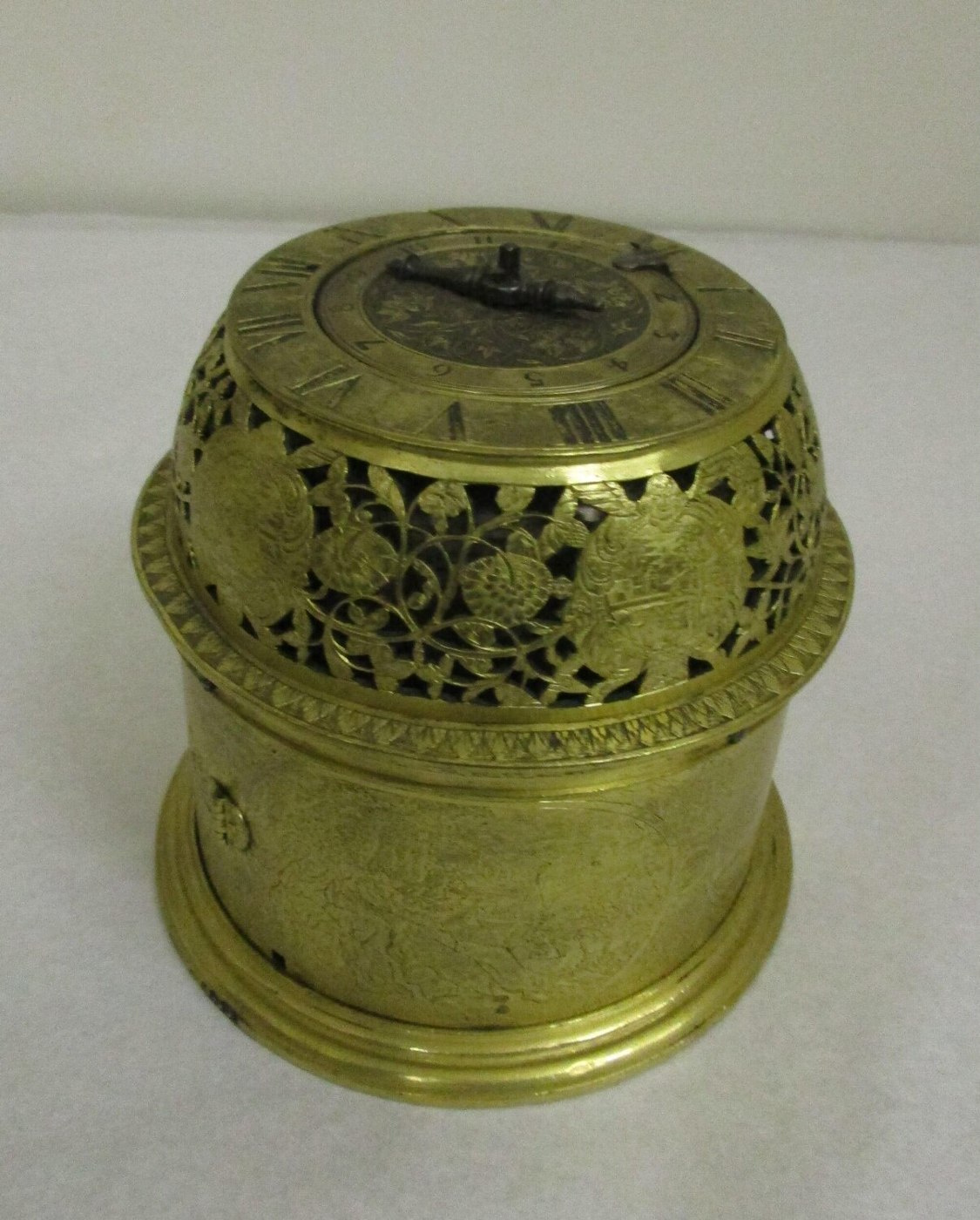
This cylindrical table clock, constructed of gilded brass with steel and iron components, dates to between 1680 and 1704. Attributed to the maker Michael Wagner, who worked in Breslau (present-day Wroclaw), the clock features a drum-shaped case engraved with four mythological scenes, including representations of Aeneas carrying Anchises, Atalanta and Meleager, and Venus and Adonis. The top of the clock features a flattened dome with engraved floral openwork and five cartouches depicting town views. It houses a horizontal dial with a chapter ring numbered I-XII, accompanied by a smaller central alarm disc. The internal mechanism includes a going train with a fusee and gut line, a verge escapement, and a small iron balance wheel, alongside an alarm train. The clock is currently held in the Victoria and Albert Museum collection, having been gifted by W.E. Miller in 1938.

A cylindrical table clock by Michael Wagner with engraved mythological scenes and a pierced dome dial cover.
A cylindrical table clock by Michael Wagner with engraved mythological scenes and a pierced dome dial cover. — Victoria and Albert Museum, London. Rights pending — permission not yet requested. Original source

Catalogue identity

Source
collections.vam.ac.uk
Category
Clock · Table clock
Maker / attribution
Michael Wagner
Reference
Not recorded
Catalogue / lot identifier
M.172-1938
Source-reported date
1680-1704
Source-reported place
Breslau (Wroclaw)

Source-reported attribution and specifications are not independent authentication. A listing does not establish present ownership, current display, availability or permission to reproduce.

Object description

Case and Dial Design

The table clock is housed in a cylindrical, gilded brass case adorned with intricate engraving. The body displays four distinct mythological scenes, featuring Aeneas carrying Anchises, Atalanta and Meleager, and Venus and Adonis. The removable base is finished with a moulded rim and a decorative wreath of rose boughs. A small door integrated into the side provides access to the fusee.

The dial is positioned horizontally beneath a flattened, pierced dome. This dome is decorated with floral openwork and five individual cartouches containing views of towns. The primary chapter ring is divided into Roman numerals I-XII, while the central alarm disc is marked with Arabic numerals 1-12 and operated by a steel hand.

Evidence for this section
  • “cylindrical case of gilded brass engraved with mythological scenes”
  • “Above a flattened dome of engraved floral openwork with five cartouches showing views of towns, supports the horizontal dial”
  • “The removable base of the case has a moulded rim and is engraved with a wreath of rose boughs.”

Movement and Mechanism

The interior contains a going train and an alarm train. The going train is built with brass wheels, a fusee with a gut line, and a verge escapement regulated by a small iron balance wheel. The clock cocks are described as finely pierced. The alarm train consists of a resting barrel and iron wheels.

The bottom-plate of the movement is identified as a later addition. This plate is decorated with engraved openwork, and the maker's signature, 'MICHAEL WAGNER JUN.BRESLAU', is engraved upon it. Additional markings include the letters G and W crudely engraved at the winding holes.

Evidence for this section
  • “The bottom-plate of the later movement is enriched with engraved openwork details”
  • “Going train with fusee, gut line, brass wheels, verge escapement and small iron balance-wheel.”
  • “The winding holes are crudely engraved G and W.”

Provenance and Identification

The clock is identified by the inscription 'MICHAEL WAGNER JUN.BRESLAU' on the bottom plate. Historical documentation notes that Michael Wagner was active as a maker in Breslau between 1681 and 1704.

The object is part of a larger collection of fourteen clocks and sundials donated to the museum by W.E. Miller in 1938. It currently carries the accession number M.172-1938.

Evidence for this section
  • “Michael Wagner is recorded as working in Breslau(Wroclaw) from 1681 when he married until 1704”
  • “This is one of group of fourteen sun dials and clocks given by W.E.Miller FSA in 1938.”
  • “Accession number: M.172-1938”

Open research questions

  • What is the nature of the fourth mythological scene on the case?
  • Does the later movement use original parts from a previous clock, or is it a complete replacement?

Source evidence

Recorded claims and source quotations for Table clock with alarm by Michael Wagner
FieldSource-reported valueSource quotation
MakerMichael Wagner“MICHAEL WAGNER JUN.BRESLAU”
Date1680-1704“1680-1704”
OriginBreslau (Wroclaw)“(Wroclaw) from 1681 when he married until 1704”
MaterialsGilded brass, steel, iron“gilded brass engraved with mythological scenes”
MovementGoing train with fusee and verge escapement“Going train with fusee, gut line, brass wheels, verge escapement and small iron balance-wheel.”

Visible details

  • Cylindrical case features engraved mythological scenes
  • Flattened dome dial cover features floral openwork and town views
  • Horizontal dial includes a central alarm setting disc with a steel pointer
  • Movement includes a fusee with gut line and a verge escapement

Research qualifications

  • The source indicates the movement is a later replacement
  • The specific identity of the fourth mythological scene remains unidentified

Photograph identity and source facts were screened before import; rights clearance remains pending.

Consulted source

Clock, Wagner, Michael, 1680-1704

Reviewed 2026-11-02 · Record 8690545bf7

Terms in this record

Glossary explanations for terms named in this object’s record.