
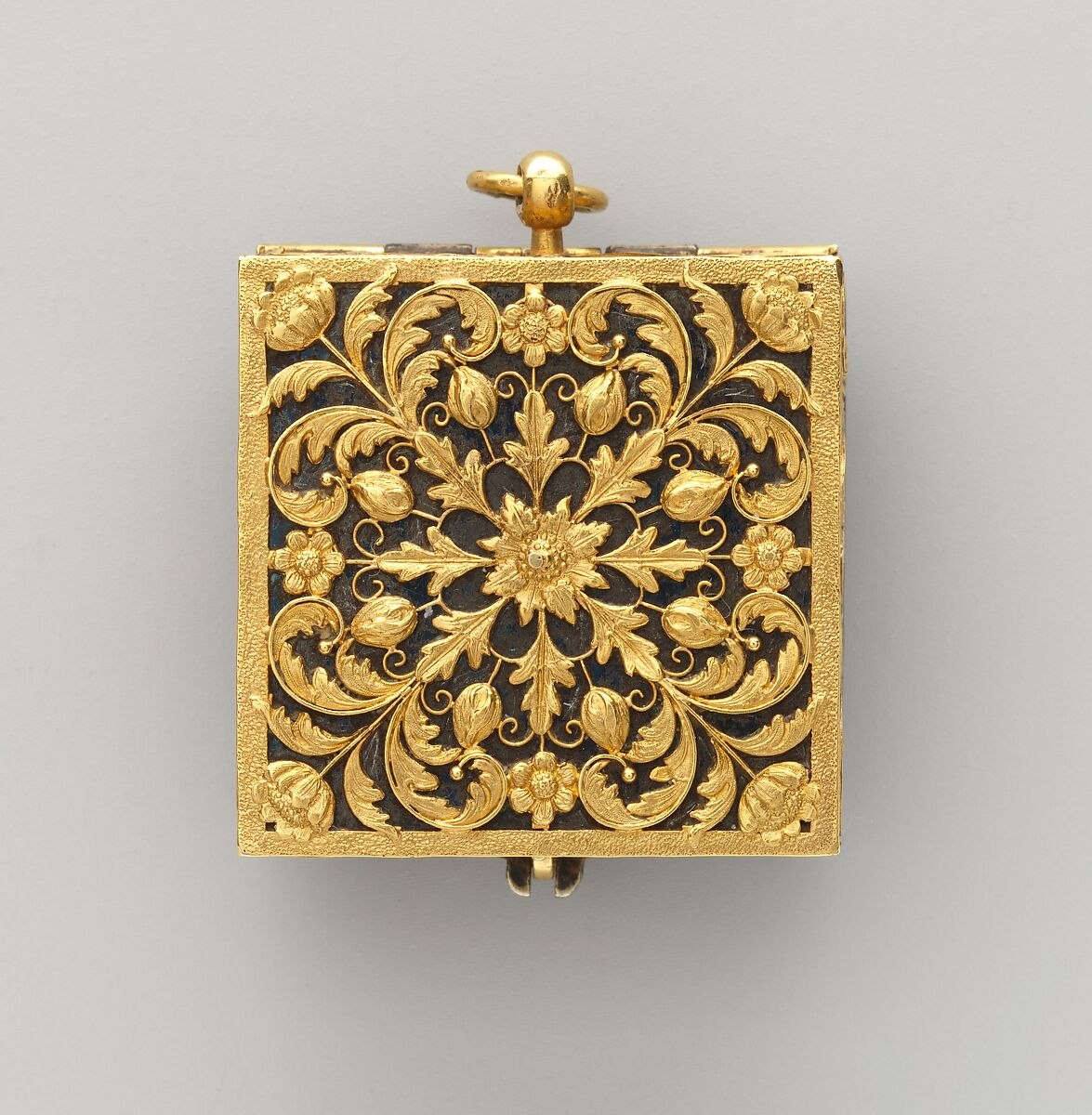
Movement Construction and Technical Challenges
The timepiece employs a square movement composed of two gilded-brass plates separated by four pinned baluster pillars. The mechanism is a spring-driven, chain-fusee design utilizing a four-wheel train and a crown-wheel verge escapement, featuring a steel balance wheel without a balance spring. Regulation is achieved through a worm-and-wheel system on the back plate, accompanied by blued-steel ornaments and a silver figure plate.
The small scale of this movement necessitated technical compromises, including reduced wheel and pinion sizes and limited gear ratios. To compensate, an additional wheel was integrated into the train. These constraints also required a smaller fusee with fewer turns, resulting in an estimated twice-daily winding requirement.
Evidence for this section
- “The movement of the Metropolitan’s watch consists of two square, gilded-brass plates that are held apart by four baluster pillars, which are pinned to the back plate.”
- “The watch is spring driven with a chain fusee and four wheels that end in a crown-wheel and verge escapement with a steel balance wheel.”
- “The duration of the watch (the maximum period between windings) will thus be lessened, resulting in a watch that needs winding twice a day.”