
Skip to content
The Encyclopedia of Horology

Clock · Horizontal table clock

South German Table Clock

Partially verified

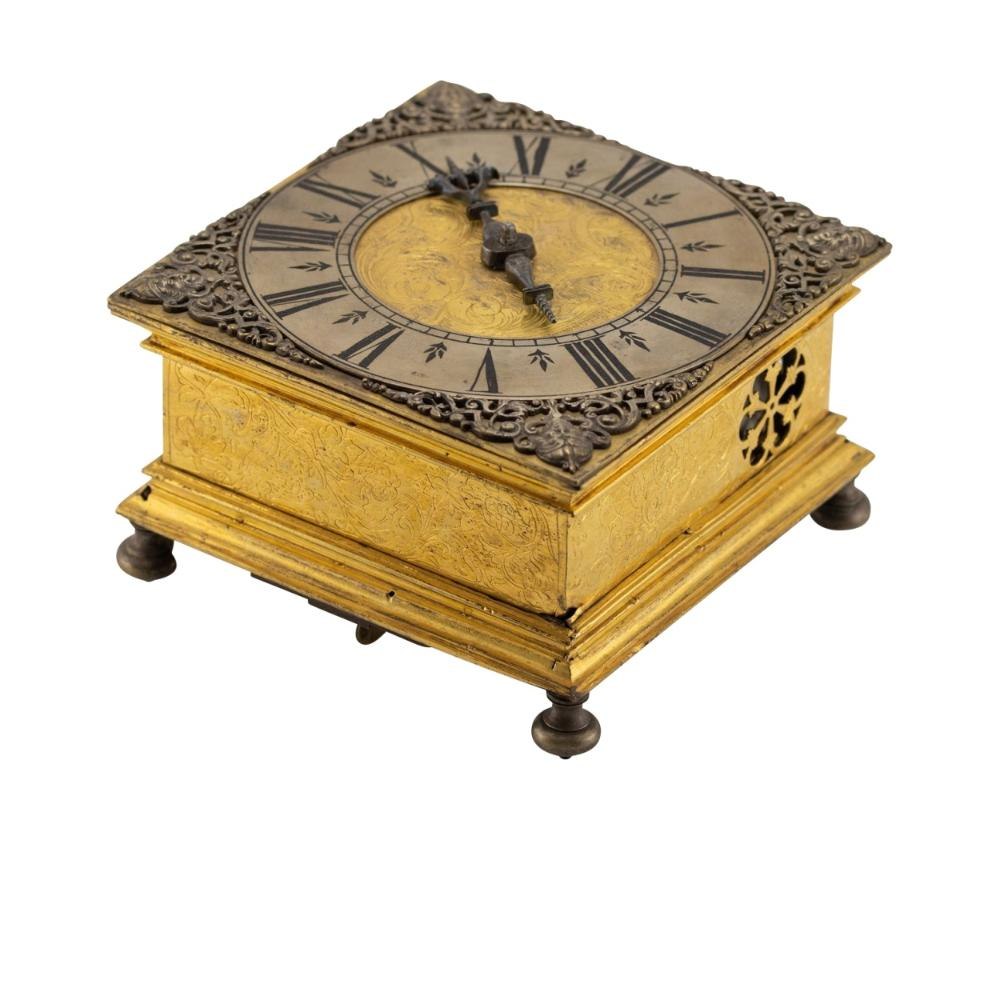
This horizontal square table clock is catalogued as South German with origin noted as Österreich, dated circa 1640. The moulded firegilt bronze case rests on turned baluster feet and features side panels engraved with floral and animal motifs alongside an openworked sound hole. Positioned horizontally on top, the dial comprises openworked corner spandrels with mascarons, an applied silvered chapter ring with radial Roman hours, an engraved gilt centre, and a single blued iron hand. According to the auction listing, it contains a square brass movement with fusee and chain, verge escapement, a large three-arm iron balance, and an hourly strike mechanism with one hammer, one bell, and a locking plate.

Elevated three-quarter view showing the top dial plate, single hand, engraved side panel, and pierced sound hole
Elevated three-quarter view showing the top dial plate, single hand, engraved side panel, and pierced sound hole — Auktionen Dr. Crott. Rights pending — permission not yet requested. Original source

Catalogue identity

Source
www.invaluable.com
Category
Clock · Horizontal table clock
Maker / attribution
Not established
Reference
Not recorded
Catalogue / lot identifier
236
Source-reported date
circa 1640
Country
Germany

Source-reported attribution and specifications are not independent authentication. A listing does not establish present ownership, current display, availability or permission to reproduce.

Object description

Case Construction and Aesthetic

The object is a square-form horizontal table clock, a design characteristic of the Renaissance and Baroque periods, featuring a dial positioned on the upper surface. It is supported by four turned baluster feet. The case is constructed of moulded firegilt bronze, with side panels decorated with engraved floral and animal motifs.

A functional, openworked sound hole is integrated into the side panel to facilitate the striking mechanism. The base plate is hinged and is described as being engraved on both its interior and exterior surfaces.

Evidence for this section
  • “Firegilt bronze case, moulded, side panels engraved with floral and animal motifs, sound hole, baluster feet”
  • “hinged base plate engraved on both the inside and outside”
  • “A horizontal table clock is a portable, flat timepiece from the Renaissance and Baroque periods (16th to 17th centuries), with its dial positioned horizontally on the upper surface and intended to be read from above.”

Dial Configuration

The upper dial is comprised of a firegilt bronze plate featuring openworked, decorated corner spandrels incorporating mascarons. The center is gilt and finished with floral engravings.

The chapter ring is applied to the bronze dial, finished in silver, and displays radial Roman hour numerals with associated fleur-de-lis half-hour markers. Time is indicated by a single blued iron hand.

Evidence for this section
  • “Bronze, firegilt, openworked, richly decorated corner spandrels with mascarons”
  • “applied silvered chapter ring with radial Roman hours, florally engraved and gilt centre, single blued iron hand”
  • “Silvered chapter ring with radial Roman hour numerals and fleur-de-lis half-hour markers”

Mechanical Specifications

The clock is powered by a square brass movement equipped with a chain and fusee system. The movement includes a verge escapement regulated by a large three-arm iron balance. The balance cock is openworked and engraved, depicting what the source identifies as mythical creatures.

The striking mechanism includes one barrel, one hammer, and one bell, regulated by a locking plate.

Evidence for this section
  • “Square brass movement, screwed-on silvered applications, chain/fusee, 1 hammer / 1 bell, 1 barrel for striking train, locking plate for strike mechanism, verge escapement”
  • “large three-arm iron balance, openworked and engraved balance cock with mythical creatures”

Open research questions

  • Does the engraving style on the side panels align with specific South German or Austrian workshop traditions of the 1640s?
  • Are there any maker's marks located on the internal brass movement or the inside of the base plate?

Source evidence

Recorded claims and source quotations for South German Table Clock
FieldSource-reported valueSource quotation
Case MaterialFiregilt bronze“Firegilt bronze case, moulded, side panels engraved with floral and animal motifs”
Dimensions90 x 140 x 140 mm“Dimensions 90 x 140 x 140 mm”
Movement MechanismSquare brass movement with fusee and verge escapement“Square brass movement, screwed-on silvered applications, chain/fusee, 1 hammer / 1 bell, 1 barrel for striking train, locking plate for strike mechanism, verge escapement”
Display ConfigurationSingle blued iron hand“single blued iron hand”
Attributed OriginSouth German / Austria“South German, one-handed, square cased table clock with hour strike”

Visible details

  • Square horizontal layout supported on four turned baluster feet
  • Openworked pierced fretwork sound hole visible on the right side panel
  • Silvered chapter ring with radial Roman hour numerals and fleur-de-lis half-hour markers
  • Cast and chased corner spandrel mounts surrounding the circular dial

Research qualifications

  • Origin is listed both as South German in the description and Österreich in the specifications
  • Internal movement, bell, and underside base plate are not visible in the provided photo

Photograph identity and source facts were screened before import; rights clearance remains pending.

Consulted source

At Auction: Anonymous - South German Table Clock

Reviewed 2026-10-25 · Record aeb227deed

Terms in this record

Glossary explanations for terms named in this object’s record.

Other horizontal table clock records