
Skip to content
The Encyclopedia of Horology

Pocket watch · Open-face pocket watch

Solid silver pocket watch with hunting scene decoration

Partially verified

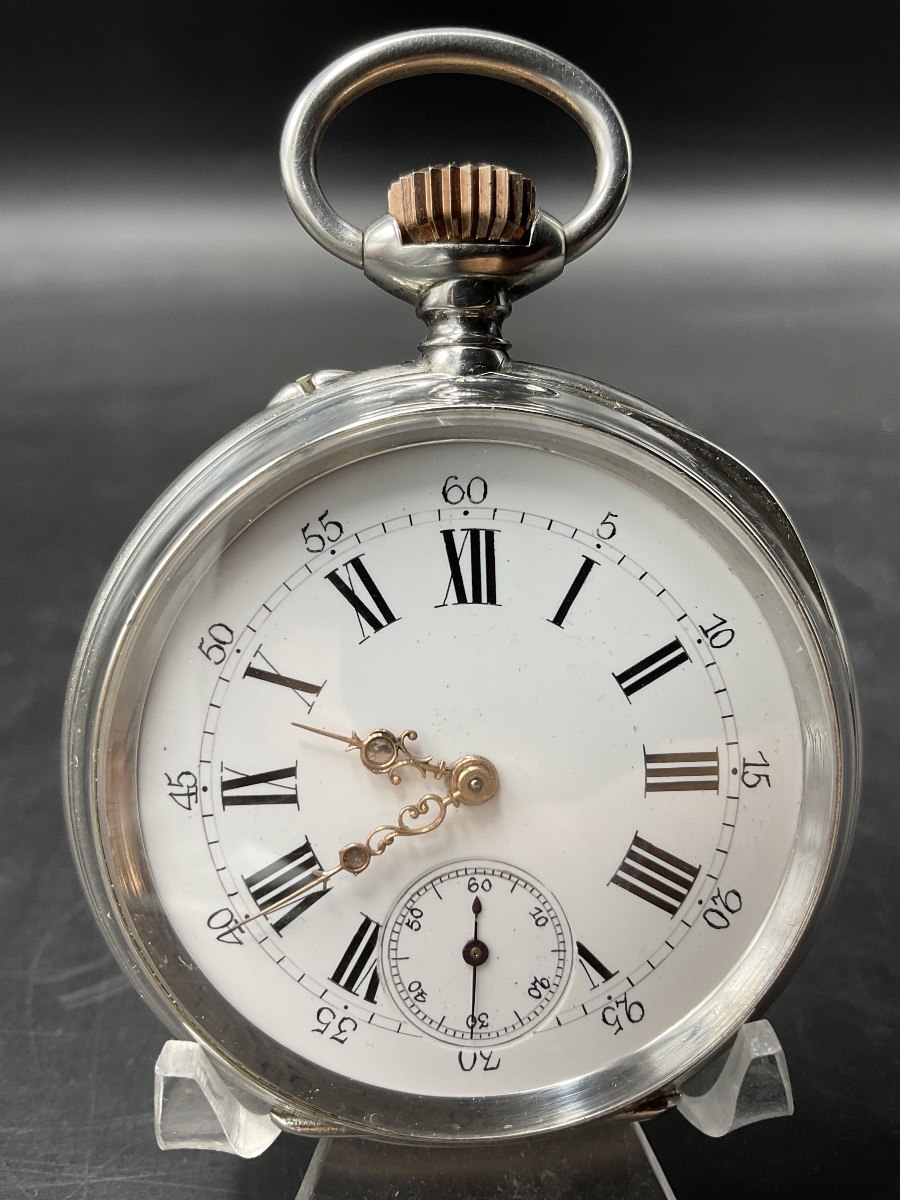
This antique pocket watch is dated by the seller to circa 1890–1900 and is housed in a 0.900 solid silver case marked with case number 1888. The white enamel dial features black Roman numerals for the hours, outer Arabic numerals along a railway minute track, decorative Louis XV-style hands, and a subsidiary seconds subdial at 6 o'clock. The source reports that the case back is chiseled and guilloché-decorated with a hare-hunting scene, and the movement features 17 jewels, a straight-line anchor escapement, and a Breguet balance spring.

Front view of the silver pocket watch displaying the white enamel dial on a stand
Front view of the silver pocket watch displaying the white enamel dial on a stand — Pineaud gil / Proantic. Rights pending — permission not yet requested. Original source

Catalogue identity

Source
www.proantic.com
Category
Pocket watch · Open-face pocket watch
Maker / attribution
Not established
Reference
1802386
Catalogue / lot identifier
Source URL identifies the listing
Source-reported date
circa 1890–1900
Country
Switzerland
Source-reported serial
1888

Source-reported attribution and specifications are not independent authentication. A listing does not establish present ownership, current display, availability or permission to reproduce.

Object description

Dial and External Features

The pocket watch displays a white enamel dial with black Roman numerals marking the hours, surrounded by a black-painted railway-style minute track with Arabic numerals for the five-minute increments. The time is indicated by gilded openwork hands in a Louis XV style, reported by the source to be set with rose-cut Rhine stones. At the 6 o'clock position, a subsidiary dial with Arabic numerals and a blued steel hand indicates the running seconds.

The dial is fitted beneath slightly domed and beveled mineral glass. External components noted in the listing include solid silver lugs, an open bow pendant, and a notched winding crown made of copper-plated metal. According to the seller, winding occurs via the pendant, while time setting is operated by pressing a small push button located next to the pendant and turning the mechanism clockwise.

Evidence for this section
  • “White enamel dial, Roman numerals for the hours and Arabic numerals for the minutes, black-painted railway-style minute track, Louis XV-style hands in gilded metal set with rose-cut Rhine stones.”
  • “Small seconds sub-dial at six o’clock, Arabic numerals for the seconds, black-painted railway-style minute track, and a blued steel seconds hand.”
  • “Solid silver lugs, notched winding crown in copper-plated metal, slightly domed and beveled mineral glass.”
  • “Winding via the pendant; the time is set by pressing the small push button located at the top left next to the head of the pendant and simultaneously turning the winding mechanism clockwise.”

Case Construction and Inscriptions

The case and dust cover are stamped with a rectangular Swiss fineness mark indicating 0.900 silver purity (expressed as 900/1000). Both the inner dust cover and the case back are engraved in intaglio with the number 1888. The name 'J. Geiger', identified by the seller as the watch's owner, is also engraved in intaglio on the case back.

The case back is described in the source as chiseled and guilloché-decorated with a hare-hunting scene featuring two hunters under a tree—one kneeling behind a wooden fence and vegetation firing at a chased hare, while the other holds a hunting trumpet with his rifle resting on the ground. A smooth solid silver dust cover bezel fitted with mineral glass protects the internal movement.

Evidence for this section
  • “Rectangular Swiss fineness mark with the numbers 0.900 engraved insideinside the hallmark in a rectangle, expressed as 900/1000 in thousandths for the purity of the solid silver in use in Switzerland, present on the case and the dust cover.”
  • “The number 1888 of the pocket watch case engraved in intaglio on the case back and the dust cover, and the name J. Geiger, the owner of the pocket watch, engraved in intaglio on the case back.”
  • “Case back, chiseled and guilloché, depicting a hare-hunting scene with two hunters under a tree; one is kneeling and hidden behind a wooden fence and vegetation, firing at the hare being chased by his dog, the other holding a hunting trumpet in his right hand and his rifle resting on the ground in his left hand.”
  • “Smooth bezel of the solid silver dust cover on a hinge and mineral glass protecting the movement of the pocket watch.”

Reported Movement and Technical Details

The movement is not visible in the provided primary image. The source listing documents a polished steel, guilloché-finished movement with 17 jewels, a straight-line anchor escapement, a compensated balance wheel, a Breguet balance spring, visible escape wheels, and an advance/retard regulation lever located above the balance wheel.

Technical descriptions are also reported as engraved on the chiseled and guilloché dust cover, listing a straight-line anchor, 17 jewels, a visible Breguet spiral, and a white balance wheel with four balance cock settings. A specific movement manufacturer is not recorded in the source, and the dating to the late 19th century (circa 1890–1900) reflects the dealer's catalog classification.

Evidence for this section
  • “Chiseled and guilloché-engraved dust cover with the inscriptions: straight-line anchor, 17 jewels, visible Breguet spiral, white balance wheel with four balance cock settings.”
  • “Guilloché movement in polished steel set with 17 jewels, featuring a straight-line anchor escapement, visible escape wheels, and a Breguet balance spring, compensated balance wheel, four jewel settings, ratchet screw, ratchet pawl, and a polished steel advance and retard lever located above the balance wheel.”
  • “Date: last quarter of the 19th century, circa 1890–1900.”

Open research questions

  • Are there any movement maker stamps or ébauche marks visible under the dial or movement bridges to identify the manufacturer?
  • Does the name 'J. Geiger' correspond to an identifiable owner, retailer, or engraver in regional Swiss or French trade directories of the late 19th century?
  • What specific official Swiss silver assay hallmarks accompany the 0.900 rectangle mark on the case?

Source evidence

Recorded claims and source quotations for Solid silver pocket watch with hunting scene decoration
FieldSource-reported valueSource quotation
Silver fineness0.900“Rectangular Swiss fineness mark with the numbers 0.900 engraved insideinside the hallmark in a rectangle, expressed as 900/1000 in thousandths for the purity of the solid silver in use in Switzerland”
Case number1888“The number 1888 of the pocket watch case engraved in intaglio on the case back and the dust cover”
Jewel count17 jewels“Guilloché movement in polished steel set with 17 jewels”
Gross weight114 gr“Gross weight: 114 gr.”
Diameter5.3 cm“Diameter: 5,3 cm.”
Height with bow7.5 cm“Height: avec la bélière : 7,5 cm.”
Case depth1.5 cm“Depth: 1,5 cm.”
Engraved owner nameJ. Geiger“and the name J. Geiger, the owner of the pocket watch, engraved in intaglio on the case back.”

Visible details

  • White enamel dial with Roman numeral hour indices and Arabic five-minute outer track markings
  • Gilded openwork Louis XV-style hands with inset rhinestones
  • Fluted copper-plated winding crown positioned beneath a silver bow pendant
  • Small seconds subsidiary dial at 6 o'clock with a blued steel hand

Research qualifications

  • The hunting scene engraving on the case back described by the seller is not visible in the provided front view
  • Movement details are obscured beneath the dial and internal dust cover in the primary image
  • Maker is unspecified; the source notes the engraved owner name 'J. Geiger' on the case

Photograph identity and source facts were screened before import; rights clearance remains pending.

Consulted source

Proantic: A Solid Silver Pocket Watch, Chiseled And Guilloché, Decorat

Reviewed 2026-10-21 · Record c93cbf4cb3

Terms in this record

Glossary explanations for terms named in this object’s record.