
Skip to content
The Encyclopedia of Horology

Pocket watch · Tulip-form watch

Senebier tulip-form watch

Partially verified

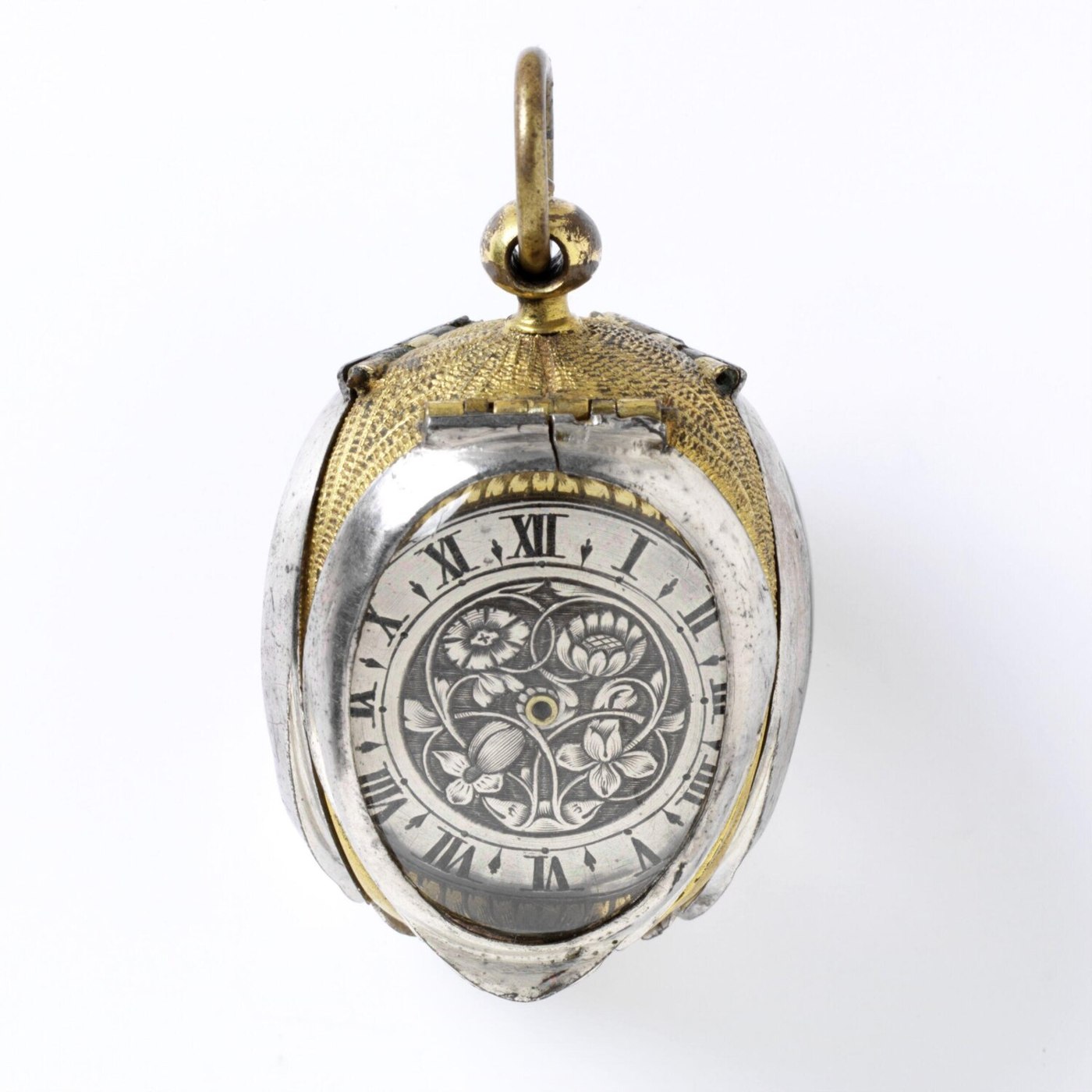
This watch, dating from 1635-50, is constructed in the form of a tulip flower bud. The casing is made of rock crystal mounted in bronze and silver gilt, featuring three oval openings, each protected by a hinged silver lid with an oval crystal window. The watch is signed 'Senebier' on both the top-plate and the engraved backplate of the movement. The silver dial displays Roman numeral hours with arrow-head markers at the half-hours and features floral engraving at the center. Internally, the watch utilizes oval brass movement plates with baluster pillars, a fusee with a gut line, and brass wheels. The movement is designed to hinge outward through one of the case openings. As recorded in the museum's documentation, several components including the hand, verge, balance, cock, and tangent-screw are currently missing from the mechanism.

Tulip-form watch with silver, gilt brass and rock crystal case.
Tulip-form watch with silver, gilt brass and rock crystal case. — Victoria and Albert Museum, London. Rights pending — permission not yet requested. Original source

Catalogue identity

Source
collections.vam.ac.uk
Category
Pocket watch · Tulip-form watch
Maker / attribution
Senebier
Reference
Not recorded
Catalogue / lot identifier
237-1853
Source-reported date
1635-50
Source-reported place
Switzerland (Geneva)

Source-reported attribution and specifications are not independent authentication. A listing does not establish present ownership, current display, availability or permission to reproduce.

Object description

Case and Dial

The watch is shaped as a tulip bud, utilizing a rock crystal body mounted within silver gilt and bronze supports. The design incorporates three distinct oval openings, each covered by a hinged silver lid that holds an oval crystal window. This configuration allows for the movement to hinge outwards through one of the openings for access.

The silver dial is marked with Roman numerals to indicate the hours, with additional arrow-head markers used for the half-hours. The center of the dial is decorated with floral engravings. The original hand for the watch is absent.

Evidence for this section
  • “Crystal case mounted in bronze and silver gilt with three oval openings, each covered by a hinged silver lid with oval crystal window.”
  • “The movement hinges outwards through one of the openings.”
  • “Silver dial. Roman numeral hours, with arrow-heads at the half-hours. Floral engraving in the dial centre.”

Movement and Construction

The internal mechanism is housed between oval brass movement plates and utilizes baluster pillars for structural support. Power is regulated by a fusee and gut line system. The movement includes brass wheels. The original mainspring assembly was equipped for a tangent-screw set-up, but the screw itself is no longer present.

Significant components of the escapement and timekeeping assembly are missing, specifically the verge, balance, and the balance cock. The movement is signed 'Senebier' on both the top-plate and the backplate, with the latter signature surrounded by engraved decoration.

Evidence for this section
  • “Oval brass movement plates, the backplate engraved 'Senebier', the signature surrounded by engraving. Baluster pillars. Fusee and gut line.”
  • “The verge, balance and cock all missing.”
  • “Mainspring formerly with tangent-screw set-up, but the screw now missing.”

Provenance and Documentation

The maker is identified as Senebier, a watchmaker who is recorded as having married in 1640.

Historical comparison is made to other watches of similar construction. A piece by Jean-Henry Ester, dated 1640-50, shares design characteristics regarding the case and the suspension loop formed of a looped stem.

Evidence for this section
  • “Bought for £15 and accessioned in 1853.”
  • “Abel Senebier was married in 1640.”
  • “A watch by Jean-Henry Ester, 1640-50, (1874,0718.37) in the British Museum has a similar case.”

Open research questions

  • What is the full identity of the maker beyond the marriage record of Abel Senebier?
  • Did the original tangent-screw mechanism vary significantly from later screw-regulated set-ups?

Source evidence

Recorded claims and source quotations for Senebier tulip-form watch
FieldSource-reported valueSource quotation
MakerSenebier“movement signed 'Senebier'”
Place of originGeneva, Switzerland“Geneva, Switzerland”
Accession number237-1853“237-1853”
MaterialsSilver, gilt brass, rock crystal“Silver, gilt brass and rock crystal watch”
Date1635-50“1635-50”
Dial decorationFloral engraving“Floral engraving in the dial centre.”
Movement typeFusee and gut line“Fusee and gut line.”

Visible details

  • Silver dial with Roman numerals
  • Gilt metal case elements with floral motif
  • Hinged silver lids with crystal windows
  • Suspension loop attached to the top

Research qualifications

  • Missing hand, verge, balance, cock, and tangent-screw
  • Exact year of manufacture is an estimate range

Photograph identity and source facts were screened before import; rights clearance remains pending.

Consulted source

Watch, Senebier, 1635-50

Reviewed 2026-11-02 · Record c6b498b226

Terms in this record

Glossary explanations for terms named in this object’s record.

Other tulip-form watch records