
Skip to content
The Encyclopedia of Horology

Clock · Skeleton timepiece

Regency brass skeleton timepiece to the design of Sir William Congreve

Partially verified

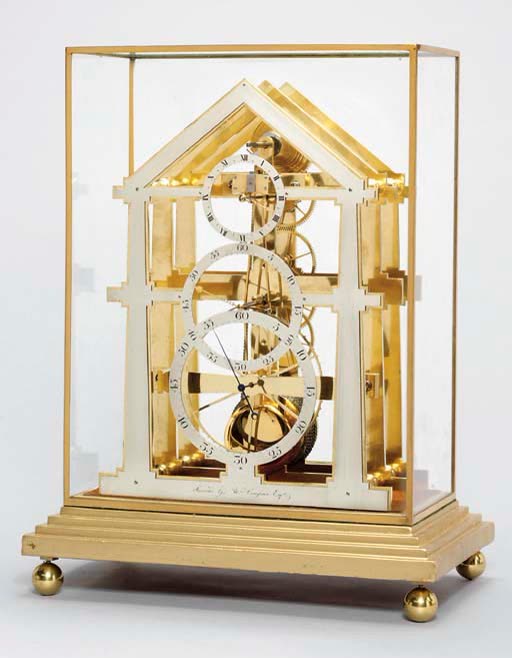
This Regency brass skeleton timepiece is built to the design of Sir William Congreve with an extreme detached escapement, dating to the first quarter of the 19th century. The clock features three architectural pedimented plates creating two sections connected by double-tapered columns. The front displays a silvered dial frame inscribed with an attribution to Congreve, supporting three chapter rings for hours, minutes, and seconds. The source reports an inverted chain fusee, high-count wheel train with six crossings, maintaining power, a wide-diameter escape wheel behind the seconds ring, and a pendulum suspended from a double knife edge. The clock is mounted on a stepped giltwood plinth with brass ball feet beneath a later brass-bound glass cover.

Front view of the brass skeleton timepiece under its glass case on a stepped giltwood plinth
Front view of the brass skeleton timepiece under its glass case on a stepped giltwood plinth — Christie's. Rights pending — permission not yet requested. Original source

Catalogue identity

Source
www.christies.com
Category
Clock · Skeleton timepiece
Maker / attribution
Sir William Congreve (designer)
Reference
Not recorded
Catalogue / lot identifier
65
Source-reported date
First quarter 19th Century
Country
United Kingdom

Source-reported attribution and specifications are not independent authentication. A listing does not establish present ownership, current display, availability or permission to reproduce.

Object description

Architectural Framework and Dial Configuration

The skeleton timepiece is built with three architectural brass plates forming two sections, each joined by four double-tapered columns. The front presentation incorporates an engraved silvered dial frame with a triangular pediment cresting, inscribed along the lower border 'Invented by W.m Congreve Esq.r'.

Indications are displayed across three silvered chapter rings arranged for hours, minutes, and seconds. The hour and minute chapter rings are fitted with pierced brass hands, while the seconds ring features a blued steel hand.

Evidence for this section
  • “With three architectural plates, forming two sections each joined by four double-tapered columns”
  • “inscribed along the lower border Invented by W.m Congreve Esq.r , three chapter rings for hours, minutes and seconds, the former two with pierced brass hands and the latter with blued steel hand”

Reported Movement and Escapement

The movement is catalogued with an inverted chain fusee, maintaining power, and a high-count wheel train featuring wheels with six crossings. It incorporates Sir William Congreve's patented 'extreme detached escapement' design (Patent 3164 of 1808), positioning a wide-diameter escape wheel directly behind the seconds ring.

Under this reported escapement mechanism, the pendulum operates under its own momentum to drive a countwheel that releases the train each minute to impulse the pendulum. The pendulum is catalogued as suspended from a double knife edge, though internal wheel counts and suspension components are not directly verifiable from the front exterior view.

Evidence for this section
  • “the movement with inverted chain fusee and high count train, maintaining power and wheels with six crossings, wide diameter escape wheel positioned behind the seconds ring, with pendulum suspended from a double knife edge”
  • “That same year he also took out a patent (3164) for the design of the present clock with its 'extreme detached escapement', whereby the pendulum under its own momentum drives a countwheel which releases the train each minute to impulse the pendulum.”

Case, Dimensions, and Provenance

The timepiece stands 21¼ inches (54 cm) high over its cover and is raised on a stepped giltwood plinth fitted with spherical brass ball feet. The enclosing brass-bound glass cover is catalogued as a later addition.

Auction documentation records that the clock previously belonged to The Time Museum collection (inventory no. 1144) and was sold at Sotheby's New York on 19 June 2002 as lot 193. While catalogued to the first quarter of the 19th century following Congreve's invention, the specific clockmaker who constructed the movement is not identified in the source documentation.

Evidence for this section
  • “raised on a stepped giltwood plinth with brass ball feet; under later brass-bound glass cover 21¼ in. (54 cm.) high, over cover”
  • “Sotheby's New York, Masterpieces of the Time Museum , Part II, 19 June 2002, lot 193, Time Museum inventory No.1144.”

Open research questions

  • Are there unrecorded workshop stamps, punch marks, or serial numbers on the inner plates or dial reverse that identify the executing London clockmaker?
  • Does physical disassembly confirm the preservation of the original 1808-patent extreme detached escapement, given that other known Congreve escapement clocks (such as those by Joseph Moxon) were subsequently converted?

Source evidence

Recorded claims and source quotations for Regency brass skeleton timepiece to the design of Sir William Congreve
FieldSource-reported valueSource quotation
Escapement designExtreme detached escapement“with extreme detached escapement, to the design of Sir William Congreve”
Dial inscriptionInvented by W.m Congreve Esq.r“inscribed along the lower border Invented by W.m Congreve Esq.r”
Height21¼ in. (54 cm.) high, over cover“21¼ in. (54 cm.) high, over cover”
Movement platesThree architectural plates forming two sections“With three architectural plates, forming two sections each joined by four double-tapered columns”
Plinth and coverStepped giltwood plinth under later brass-bound glass cover“raised on a stepped giltwood plinth with brass ball feet; under later brass-bound glass cover”
Hands descriptionPierced brass hands for hours and minutes, blued steel hand for seconds“the former two with pierced brass hands and the latter with blued steel hand”
Literature citationIllustrated in Derek Roberts, British Skeleton Clocks (1987), pp. 84–85, figs. 3/7a-c“Illustrated Derek Roberts, British Skeleton Clocks , Antique Collectors' Club 1987, p.84-85, figs. 3/7a-c.”
Patent specificationPatent 3164 of 1808“That same year he also took out a patent (3164) for the design of the present clock with its 'extreme detached escapement'”

Visible details

  • Three silvered, overlapping circular chapter rings stacked vertically with Roman and Arabic numerals.
  • Brass architectural framework with triangular pediment cresting and tiered horizontal cross-members.
  • Housed under a rectangular brass-edged glass case resting on a stepped gilt rectangular base with spherical brass feet.
  • Engraved script visible along the lower border of the front silvered plate frame.

Research qualifications

  • The glass case is catalogued as a later replacement.
  • Internal escapement components, wheel train count, and knife-edge suspension cannot be independently confirmed from the front view photograph.

Photograph identity and source facts were screened before import; rights clearance remains pending.

Terms in this record

Glossary explanations for terms named in this object’s record.