
Skip to content
The Encyclopedia of Horology

Clock · Longcase clock

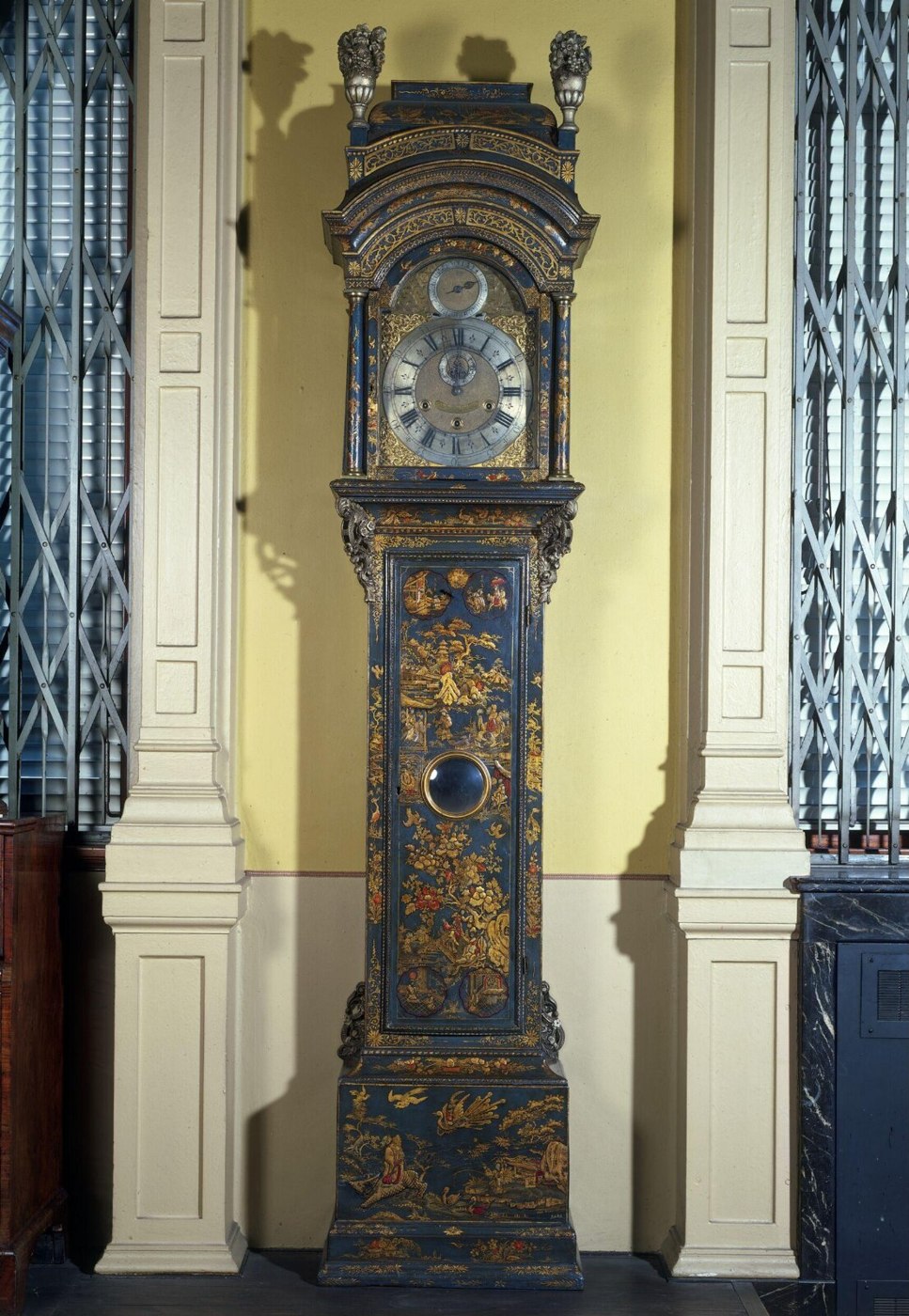
Quarter chiming month-going longcase clock

Partially verified

This quarter-chiming, month-going longcase clock is attributed to James Markwick the Younger of London and dates to approximately 1725. The clock features a pine carcase finished in japanning, consisting of red and gold lacquer applied over a peacock blue ground, decorated with figures, vases, and flowering shrubs. The case includes a caddy-top sliding hood with carved wooden finials and free-standing brass-capped columns flanking a break-arch glazed door. The brass dial, measuring 14 inches square with a break-arch, contains a silvered brass chapter ring, subsidiary seconds, and a calendar aperture. The movement is weight-driven with three trains, a recoil escapement, and a pendulum. It has undergone various modifications, including additions to the hour wheel bridge and lever assemblies, and currently lacks the chime warning, fly, and quarter bell standard.

Quarter chiming month-going longcase clock
Quarter chiming month-going longcase clock — Victoria and Albert Museum. Rights pending — permission not yet requested. Original source

Catalogue identity

Source
collections.vam.ac.uk
Category
Clock · Longcase clock
Maker / attribution
Markwick, James (the younger)
Reference
Not recorded
Catalogue / lot identifier
W.49:1 to 8-1935
Source-reported date
ca. 1725
Source-reported place
London

Source-reported attribution and specifications are not independent authentication. A listing does not establish present ownership, current display, availability or permission to reproduce.

Object description

Case Construction and Decoration

The clock is housed in a pine carcase treated with japanning, a technique involving layers of coloured varnish applied over a gesso base, often built up in relief. The exterior is finished in red and gold lacquer set against a peacock blue ground, featuring depictions of Chinese figures, vases, and flowering shrubs. The structure includes a rectangular trunk with a lenticle and a sliding hood topped by a caddy moulding, flanked by carved and silvered wooden finials in the shape of flowers within urns.

The hood is equipped with free-standing brass-capped columns at the front and capped quarter columns at the rear. Side access doors provide entry to the movement, featuring brass inserts. Decorative carved brackets are present beneath the hood, though historical documentation suggests other decorative elements previously associated with the base are now missing.

Evidence for this section
  • “Japanning on pine carcase.”
  • “case is of pinewood, decorated with red and gold lacquer on a peacock blue lacquer ground.”
  • “The finials and brackets are of carved and silvered wood.”

Dial and Indication

The brass dial measures 19 inches in total height, with a 14-inch square central portion and a break-arch top. The centre is matted, featuring a ringed seconds aperture and the signature 'Markwick London' engraved between the winding squares. A silvered brass chapter ring is pinned to the dial plate, featuring Roman hour numerals, Arabic minute numerals at five-minute intervals, and fleur-de-lis markers.

The arch includes a calendar display with a silvered ring indicating the date 1-31, flanked by foliate engraving. Two small slots located between the main chapter ring and the calendar allow for strike and chime selection for both hours and quarters, a function controlled by internal levers. The hands are fashioned from pierced steel.

Evidence for this section
  • “Brass, with broad break-arch, total height 19 inches, central portion 14 inches square.”
  • “Markwick London engraved on semicircular area between winding squares and central hole for hands.”
  • “Two small triangular areas lie between main chapter ring and calendar within which are slots, proper left for strike/no strike (hours), proper right, the same for the quarters.”

Movement and Modifications

The movement is a weight-driven, month-duration mechanism featuring three trains, a recoil escapement, and a pendulum with a steel rod and brass-cased bob. The train wheels are brass with four semicircular crossings, and the movement utilizes finned pillars with central knops. The hour and quarter chiming functions are regulated by an internal rack and a star wheel with a jumper.

Evidence of modifications is present throughout the movement, including vacant steady pin holes in the backplate and plugged holes near the chime train. The hour wheel bridge has been built up with additional brass to accommodate adjusted calendar drive components. Certain striking and chiming levers exhibit evidence of repairs using lead solder or alternative brass materials, and the chime warning, fly, and quarter bell standard are currently absent.

Evidence for this section
  • “The movement appears to have been modified: the vacant holes, and the unused steady pin holes in the backplate indicate that modification to the escapement had occurred”
  • “The hour wheel bridge appears to have been built up.”
  • “Chime warning and fly missing. Quarter bell standard is missing.”

Open research questions

  • What was the exact purpose of the vacant steady pin and threaded holes on the backplate relative to the original escapement configuration?
  • Can the 'redder' brass components definitively be attributed to a specific period of repair or a particular restorer?

Source evidence

Recorded claims and source quotations for Quarter chiming month-going longcase clock
FieldSource-reported valueSource quotation
MakerMarkwick, James (the younger)“Inscribed 'Markwick, Londini', made in about 1725”
Dateca. 1725“made in about 1725”
Case materialJapanned pine“Japanning on pine carcase.”
Dial height19 inches“Brass, with broad break-arch, total height 19 inches”
Movement typeQuarter chiming month-going“QUARTER CHIMING MONTH-GOING LONG CASE CLOCK”
Accession numberW.49:1 to 8-1935“Accession number: W.49:1 to 8-1935”
ProvenanceWalter J. Iden“Purchased from Walter J. Iden, Keswick Road SW15”

Visible details

  • Case features japanned decoration on a peacock blue ground
  • Hood features carved wooden finials in the form of flowers in an urn
  • Dial includes a silvered brass chapter ring and subsidiary seconds ring
  • Pendulum bob is brass-cased with an octagonal rating nut

Research qualifications

  • The provenance notes indicate that decorative brackets formerly on the base are now absent
  • The movement contains various vacant, plugged, or modified holes suggesting historical repairs or alterations

Photograph identity and source facts were screened before import; rights clearance remains pending.

Consulted source

Longcase clock

Reviewed 2026-11-02 · Record 63a747943f

Terms in this record

Glossary explanations for terms named in this object’s record.