
Skip to content
The Encyclopedia of Horology

Movement · Pocket watch movement

Pocket Watch Movement by Charles Taylor

Partially verified

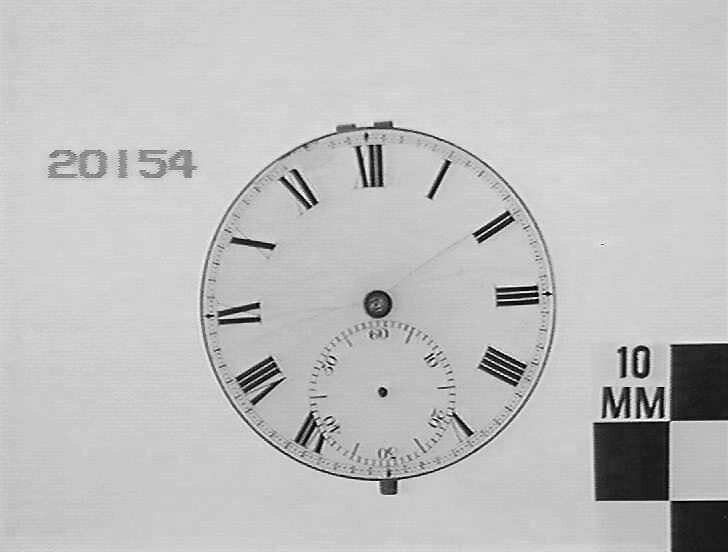
This gentleman's pocket watch movement, bearing the registration number ST 20154, was produced in Bristol, England, around 1830. Attributed to the maker Charles Taylor, the movement is stamped with the serial number 2431 on its back plate. The technical construction features a key-wound spring mechanism and a duplex escapement, supplemented by a fusee and chain drive system with a fast-to-slow speed regulation scale. The white enamel dial is marked with black Roman numerals and includes a subsidiary seconds dial positioned at six o'clock. This object represents a collection of movements preserved by Ingram Brothers jewelers in the 1930s, after they acquired watches to reclaim gold and silver cases. Measuring 4.6 cm in diameter and 1.8 cm in depth, the movement retains its dial, though the original hands are currently missing from the assembly.

Front view of the pocket watch movement showing the enamel dial, Roman numerals, and subsidiary seconds dial.
Front view of the pocket watch movement showing the enamel dial, Roman numerals, and subsidiary seconds dial. — Museums Victoria. Rights pending — permission not yet requested. Original source

Catalogue identity

Source
collections.museumsvictoria.com.au
Category
Movement · Pocket watch movement
Maker / attribution
Charles Taylor
Reference
Not recorded
Catalogue / lot identifier
ST 20154
Source-reported date
circa 1830
Source-reported place
England
Source-reported serial
2431

Source-reported attribution and specifications are not independent authentication. A listing does not establish present ownership, current display, availability or permission to reproduce.

Object description

Dial and Physical Characteristics

The movement is presented with its original white enamel dial, which features black Roman numeral hour markers. A subsidiary seconds dial is located at the six o'clock position, indicating the functional capability for timekeeping. The overall physical configuration of the movement has an outside diameter of 4.6 centimeters and a width of 1.8 centimeters.

The assembly is currently noted to be lacking its hands. The dial remains in place over the mechanical components, providing a clear view of the numerals and the small, recessed seconds tracking scale. No further components or protective casings are present.

Evidence for this section
  • “White enamel dial has black roman numerals and a seconds dial at 6. Hands are missing.”
  • “1.8 cm (Width), 4.6 cm (Outside Diameter)”

Movement and Mechanical Construction

Internally, the movement is constructed with a key-wound spring mechanism. The power transmission is facilitated by a traditional fusee and chain system. This setup incorporates a scale designed for regulating the timing between fast and slow rates.

The escapement utilized in this piece is a duplex escapement. The back plate is engraved with the manufacturer's details and the individual movement identification number, confirming its association with Charles Taylor of Bristol.

Evidence for this section
  • “Key wound spring; duplex escapement. Fusee and chain. Scale fast to slow.”
  • “Back plate is marked 'Chas. Taylor, Bristol, 2431'.”

Provenance and Acquisition

The object was acquired by the museum through a donation made by J. Ingram on 18 February 1937. It was originally part of a group of movements retained by the Ingram Brothers, who operated as jewelers.

During the 1930s, the firm processed numerous fob watches for the purpose of recovering precious metals.

Evidence for this section
  • “Acquisition: Donation from J. Ingram, 18 Feb 1937”
  • “During the 1930s Depression, customers would bring in gold or silver fob watches to sell for the value of the gold or silver. Ingrams (and other jewelers) melted down the cases to sell the metal, but kept the movements of historically interesting watches.”

Open research questions

  • What specific materials were used for the movement plates and wheels?
  • Are there contemporary records confirming the production volume or specialized output of Charles Taylor in Bristol?

Source evidence

Recorded claims and source quotations for Pocket Watch Movement by Charles Taylor
FieldSource-reported valueSource quotation
MakerCharles Taylor“Charles Taylor, Bristol”
Serial Number2431“no 2431”
Datecirca 1830“circa 1830”
CountryEngland“England”
EscapementDuplex escapement“duplex escapement”
Registration NumberST 20154“Registration number: ST 20154”
Mechanism FeaturesFusee and chain“Fusee and chain.”

Visible details

  • White enamel dial with Roman numerals
  • Subsidiary seconds dial at the 6 o'clock position
  • Stamping of 'Chas. Taylor, Bristol, 2431' on back plate
  • Absence of hands

Research qualifications

  • Mechanism condition not described beyond missing hands
  • Internal wear or functional status not documented

Photograph identity and source facts were screened before import; rights clearance remains pending.

Consulted source

Pocket Watch Movement - Charles Taylor, Bristol, circa 1830

Reviewed 2026-10-26 · Record aedd7931ad

Terms in this record

Glossary explanations for terms named in this object’s record.