
Skip to content
The Encyclopedia of Horology

Pocket watch · Key wound pocket watch

Pocket Watch by J. McCabe, 1856

Partially verified

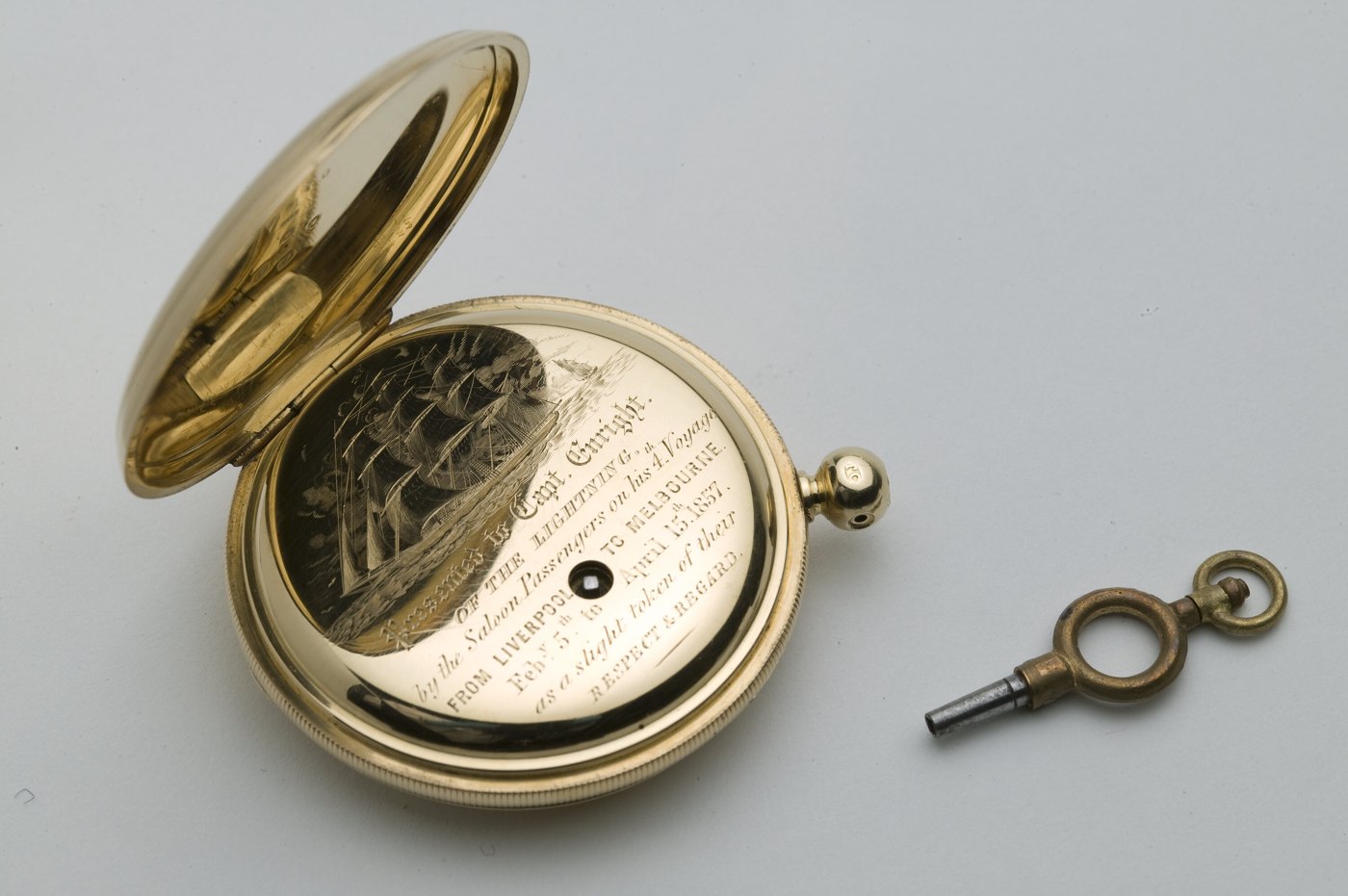
This 18-carat gold pocket watch was manufactured by James McCabe of the Royal Exchange, London, in 1856. The watch features a white enamel dial with black Roman numerals, gold hands, and a subsidiary seconds dial located at the 6 o'clock position. The movement is key-wound and utilizes a duplex escapement with a diamond end stone to the balance. The watch is accompanied by a brass winding key. The exterior case back is engraved with a detailed illustration of a sixteen-sail clipper ship on a calm sea, accompanied by an inscription detailing the vessel name, the recipient Captain Enright, and the circumstances of the 1857 presentation by saloon passengers during the ship's fourth voyage from Liverpool to Melbourne. The piece is marked with London hallmarks corresponding to the year 1856.

The open pocket watch displaying the engraved case back alongside the brass winding key.
The open pocket watch displaying the engraved case back alongside the brass winding key. — Museums Victoria. Rights pending — permission not yet requested. Original source

Catalogue identity

Source
collections.museumsvictoria.com.au
Category
Pocket watch · Key wound pocket watch
Maker / attribution
James McCabe
Reference
Not recorded
Catalogue / lot identifier
HT 1118
Source-reported date
1856
Source-reported place
England
Source-reported serial
01203

Source-reported attribution and specifications are not independent authentication. A listing does not establish present ownership, current display, availability or permission to reproduce.

Object description

Case and Dial Design

The pocket watch is housed in an 18-carat gold case characterized by an embossed, repetitive pattern on the exterior. The face consists of a white enamel dial featuring black Roman numerals and gold hands, including a gold hand for the subsidiary seconds dial located at the 6 o'clock position. The dial is explicitly signed with the maker's details.

The case back provides a surface for an engraved illustration of a sixteen-sail clipper ship set against a calm sea with clouds and another vessel visible in the distance. Below this image, an extensive inscription details the presentation of the watch to Captain Enright of the clipper ship Lightning by saloon passengers during the ship's 1857 voyage. This engraving commemorates the transit from Liverpool to Melbourne occurring between February and April of that year.

Evidence for this section
  • “Single 18 ct gold case embossed with repetitive patterm.”
  • “Face, black " JA.s M.cCABE/ Royal Exchange/ LONDON/ 01203”
  • “Back of watch, engraved illustration of sixteen sail sailing ship on calm sea, with seagulls, clouds and another sailing ship in the distance.”

Movement and Mechanism

The horological mechanism within the case is a key-wound movement, which requires an external brass key for operation. The movement features a duplex escapement, a specific design choice for this caliber. To further refine the performance of the oscillating balance, the watch includes a diamond end stone.

The movement is signed, aligning with the branding found on the dial.

Evidence for this section
  • “Key wound spring; duplex escapement.”
  • “Diamond end stone to balance.”
  • “Signed dial and movement.”

Signatures, Marks, and History

The watch bears clear indicators of its origin and production date through serial numbers and standard assay marks. The serial number 01203 appears on both the dial and the interior of the gold case. Hallmarks identified as those for London in 1856 confirm the year of production. The case also contains the initials "AS" within an oval and the manufacturer's mark "LMC".

The object's provenance is tied to the maritime history of the clipper ship Lightning and its service between Liverpool and Melbourne.

Evidence for this section
  • “Inside front case, stamped, "AS" in oval; "01203" [upside down]; "LMC"; [upside down]; "a" in square, triangle and "18" in square = London hallmark for 1856.”
  • “presented to Captain Enright of the Lightning sailing ship by the saloon passengers on his 4th voyage from Liverpool to Melbourne 1857.”

Open research questions

  • What is the identification of the maker's mark 'AS' found within the case?
  • Which specific silversmith or casemaker utilized the mark 'LMC' in 1856?

Source evidence

Recorded claims and source quotations for Pocket Watch by J. McCabe, 1856
FieldSource-reported valueSource quotation
MakerJames McCabe“Mr James McCabe”
Material18 ct gold“18 ct gold case”
EscapementDuplex“duplex escapement”
Date of Manufacture1856“London hallmark for 1856”
Presentation DateApril 1857“Presented To, name: Captain Enright, date: Apr 1857”
Dimensions47 mm diameter“47 mm (Outside Diameter)”

Visible details

  • Case back features an elaborate engraving of a clipper ship
  • Brass winding key is included with the watch
  • Subsidiary seconds dial positioned at 6 o'clock
  • Dial is signed with the maker's name and location

Research qualifications

  • Exact identity of the four hallmarks inside the back case remains to be checked
  • The attribution of the engraving artist is not stated

Photograph identity and source facts were screened before import; rights clearance remains pending.

Terms in this record

Glossary explanations for terms named in this object’s record.

Other key wound pocket watch records