
Skip to content
The Encyclopedia of Horology

Tool · Iberian astrolabe

Planispheric Astrolabe

Partially verified

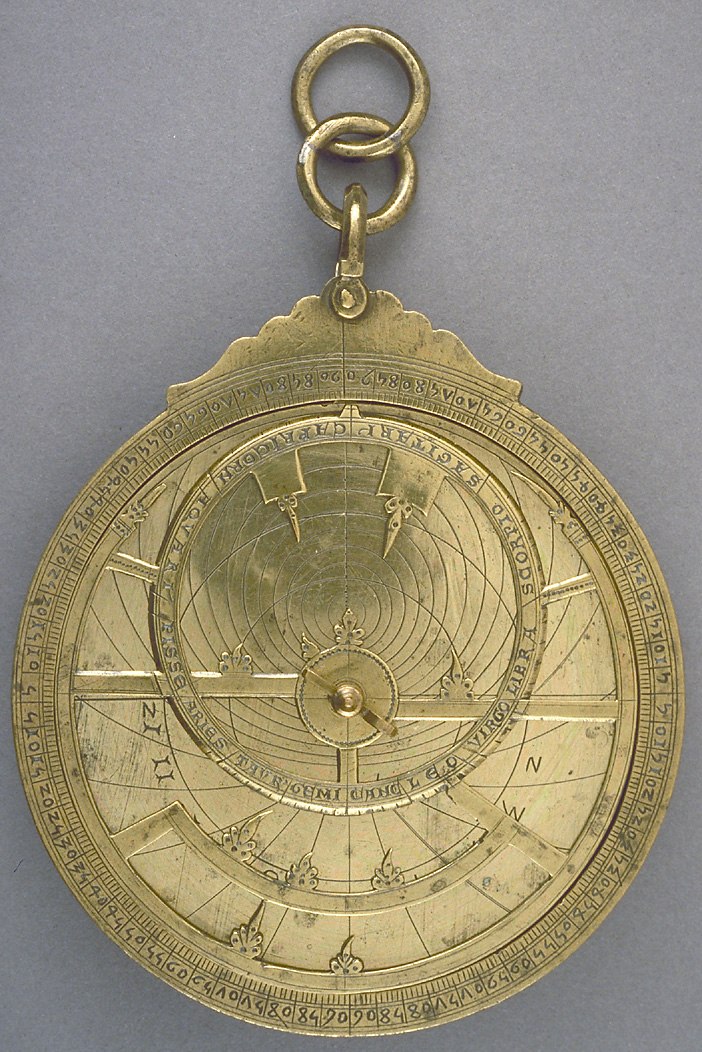
This planispheric astrolabe, crafted from brass and measuring 114 mm in diameter, is unsigned and undated. However, the instrument is engraved with Gothic letters and numerals, leading to an attribution of 14th-century Spanish origin. The instrument comprises a mater with a 360-degree altitude scale, multiple plates for varying latitudes, a rete with zodiacal markings, and an alidade. Construction markings appear on the reverse of the rete. The back features Julian calendar scales and zodiacal divisions. The piece includes later additions, specifically a poorly engraved double shadow square and a superimposed horary quadrant. The pin head is flower-shaped, and the wedge is shaped like a stylized horse. It was acquired from the Findlay collection and is held by the British Museum.

Front view of the unsigned brass astrolabe showing the rete, scales, and triangular throne with interlocked suspension rings.
Front view of the unsigned brass astrolabe showing the rete, scales, and triangular throne with interlocked suspension rings. — © British Museum, London. Rights pending — permission not yet requested. Original source

Catalogue identity

Source
www.mhs.ox.ac.uk
Category
Tool · Iberian astrolabe
Maker / attribution
Not established
Reference
Not recorded
Catalogue / lot identifier
MLA 1961,12-1.1
Source-reported date
14th century ?
Source-reported place
Spain

Source-reported attribution and specifications are not independent authentication. A listing does not establish present ownership, current display, availability or permission to reproduce.

Object description

Structural Design and Construction

The astrolabe is constructed of brass and measures 114 mm in diameter. Its rim, soldered to the backplate, features an altitude scale of 360 degrees, divided into single degrees and numbered by fives. The throne, which follows a design seen on early Islamic instruments, is triangular with three lobes on each side, and the shackle is suspended from two interlocked rings. The rete maintains this Islamic-inspired aesthetic, featuring unmarked flame-shaped star pointers set on quadruple lobes.

The ecliptic is marked with Latin names for the zodiacal signs, which are partially abbreviated, with each sign divided into 6-degree segments. Construction markings are visible on the reverse side of the rete. The pin head is shaped like a flower, and the wedge is stylized in the form of a horse, providing a distinct decorative contrast to the functional components of the instrument.

Evidence for this section
  • “The rim is soldered to the backplate.”
  • “The throne looks very similar to those to be found on early Islamic astrolabes: it is triangular consisting of three lobes on each side.”
  • “The wedge is a very stylized horse.”

Plates and Calendar Scales

The instrument includes three internal plates and one plate integrated within the mater, all marked with tropical and equatorial circles. These plates provide almucantars at 6-degree intervals and lines for unequal hours. They are marked for seven different latitudes, known as the seven climates, ranging from 15 to 48 degrees. The mater itself is marked for latitude 15 degrees.

The back of the instrument features circular scales for the zodiacal signs and the Julian calendar. The zodiacal signs are divided into 30-degree segments, subdivided into single degrees. The calendar scale lists the months with Latin names, divided into the appropriate number of days. These scales indicate that the equinoxes fall on March 15 and September 17.5.

Evidence for this section
  • “The three plates and the plate in the mater are marked with the circles for the tropics and the equator”
  • “They are laid out and marked (upside down) for the following latitudes (the seven climates): mater 15?”
  • “The equinoxes correspond with March 15 and September 171/2.”

Condition and Later Modifications

The instrument is largely considered unfinished, as evidenced by the lack of labels on the star pointers. Further analysis of the back of the instrument indicates that the lower portion of the vacant space contains a double shadow square and a superimposed horary quadrant. These elements are described as being poorly engraved and are interpreted as later additions to the original structure.

This instrument is part of the British Museum collection, having been purchased from the Findlay collection via Sotheby's in 1961. It is documented in F. A. B. Ward's catalogue of European scientific instruments, confirming its historical and academic placement within the Department of Medieval and Later Antiquities.

Evidence for this section
  • “The star pointers are unnamed and the shadow square is a later addition, so it was probably left unfinished.”
  • “The lower half of the vacant space inside these circles is taken up by a very badly engraved double shadow square and a superimposed horary quadrant on the right which appear to be later markings.”
  • “The instrument was purchased from the Findlay collection through Sotheby's in 1961”

Open research questions

  • What is the definitive provenance of the instrument prior to its acquisition from the Findlay collection?
  • Can the specific metallurgical composition of the brass be analyzed to further confirm the regional attribution to Spain?

Source evidence

Recorded claims and source quotations for Planispheric Astrolabe
FieldSource-reported valueSource quotation
MaterialBrass“Brass; 114 mm in diameter”
Diameter114 mm“114 mm in diameter”
OriginSpanish“Spanish”
Date14th century ?“14th century ?”
Inventory NumberMLA 1961,12-1.1“Registration no. MLA 1961,12-1.1”
Later additionsDouble shadow square and horary quadrant“The lower half of the vacant space inside these circles is taken up by a very badly engraved double shadow square and a superimposed horary quadrant on the right which appear to be later markings.”

Visible details

  • The throne has three lobes on each side
  • The rete features unmarked star pointers in flame shapes
  • The instrument displays Gothic script
  • The wedge is designed as a stylized horse

Research qualifications

  • The exact date of manufacture is uncertain and queried as the 14th century in documentation
  • The attribution to Spanish origin is suggested by the combination of Islamic-style design and Gothic engraving

Photograph identity and source facts were screened before import; rights clearance remains pending.

Consulted source

Astrolabe

Reviewed 2026-10-26 · Record 3991fd3d1a

Terms in this record

Glossary explanations for terms named in this object’s record.