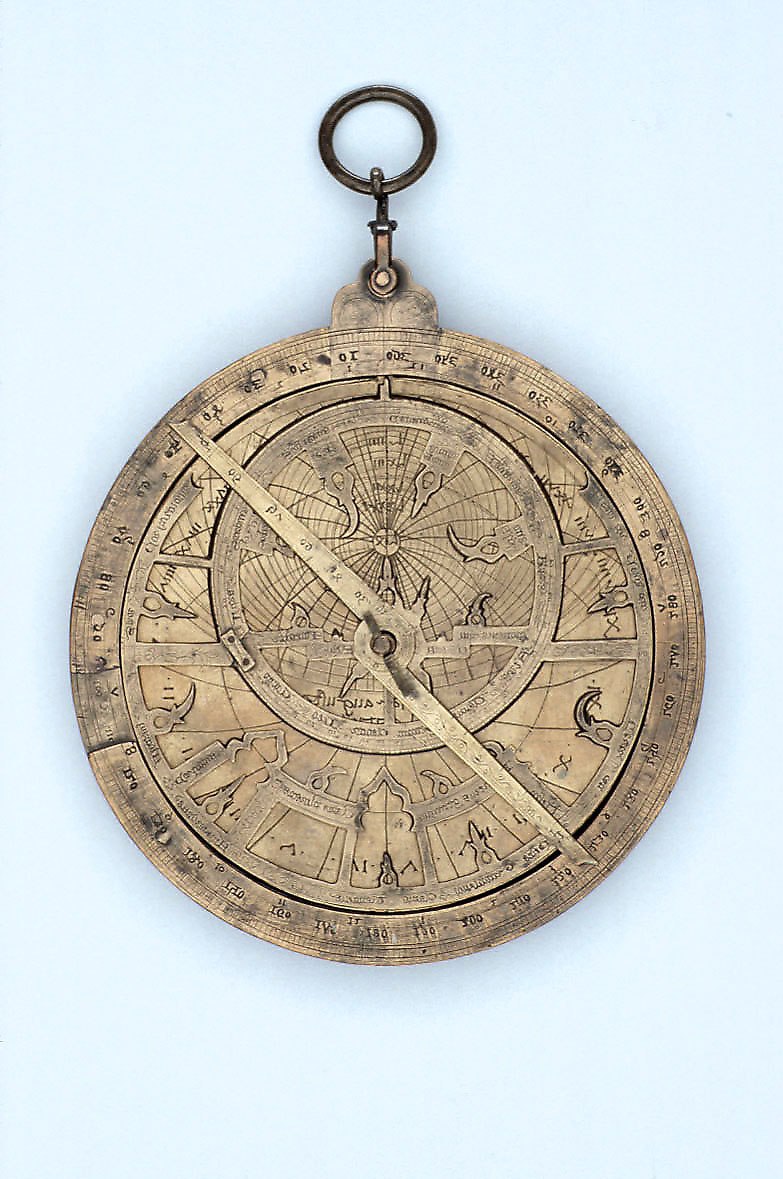
Construction and Mater
The mater of the astrolabe is composed of three riveted brass layers. The central layer is cast in one piece with a three-lobed throne that exhibits simple decoration. The limb is marked with two scales: one for hours, divided into 1-12 twice, and another for degrees, spanning 0 to 360 degrees. The limb shows evidence of alteration, specifically in the segment between 100 and 110 degrees, which has been replaced.
The rear of the mater contains a zodiac scale with signs named in abbreviated forms, and an inner circle representing a calendar scale. The calendar is divided into days, with the 10th, 20th, and final days numbered. Additionally, the back features unequal hour lines numbered 1 to 6 and a double shadow square, designated as 'umbra recta' and 'umbra versa', divided into half-units and numbered by four.
Evidence for this section
- “The mater of this astrolabe is made of three riveted layers of brass, the central of which is cast in one piece with the throne.”
- “The part of the limb between 100? and 110? has been replaced.”
- “on the bottom half is a double shadow square indicating 'umbra recta' and 'umbra versa' divided to 1/2 and numbered by 4.”
Rete and Plates
The astrolabe includes a Gothic-style rete containing 27 named star pointers. Most of these are flame-shaped with perforated bulbar bases, while four are situated on rectangular mounts atop the ecliptic. The ecliptic itself is divided by two degrees and numbered in increments of ten, connecting to the Capricorn band via two ties. The rete shows signs of re-engraving with a lighter, potentially later, script.
Seven plates are provided, each featuring engraved east-west lines, meridian lines, tropic lines, and the equator. With few exceptions, these plates include unequal hour lines. Latitude settings range from 38 degrees to 58 degrees, with specific plates dedicated to locations such as Paris (Parisius) and Zaragoza (Cesar augusta). Plate 1b and 6b display the same later script observed on the rete, suggesting the instrument may have been adapted for a French owner.
Evidence for this section
- “The rete is of Gothic type with 27 named stars, and is etched with a different, perhaps later, script.”
- “The rete and a plate for the latitude of Paris are engraved with this latter script, so it is possible that the instrument had been adapted, the rete re-engraved and one of the plates made (or re-engraved) for a later French owner.”
- “Plate 1b is etched more faintly and in the same script as the rete 'Parisius' with a scroll decoration.”
Accessories and Alterations
The instrument is accompanied by a diametrical rule, an alidade, a pin, and a wedge. The diametrical rule is counterchanged and decorated with arabesque patterns, marked with numerals including 20, 30, and 90. The alidade is also counterchanged twice and features Gothic ends, with the two sights each containing double holes. The pin is adorned with concentric circles, while the wedge is shaped like a horse.
Evidence suggests the astrolabe underwent modifications after its original manufacture. The rete and specific plates bear a distinct, lighter script compared to the bold Lombardic script found elsewhere on the instrument.
Evidence for this section
- “The diametrical rule is counterchanged and decorated with arabesques”
- “The alidade is counterchanged twice with Gothic ends, and the two sights have double holes.”
- “The wedge is horse-shaped and the pin is decorated with concentric circles.”