
Skip to content
The Encyclopedia of Horology

Tool · Iberian astrolabe

Astrolabe with Hebrew Markings

Partially verified

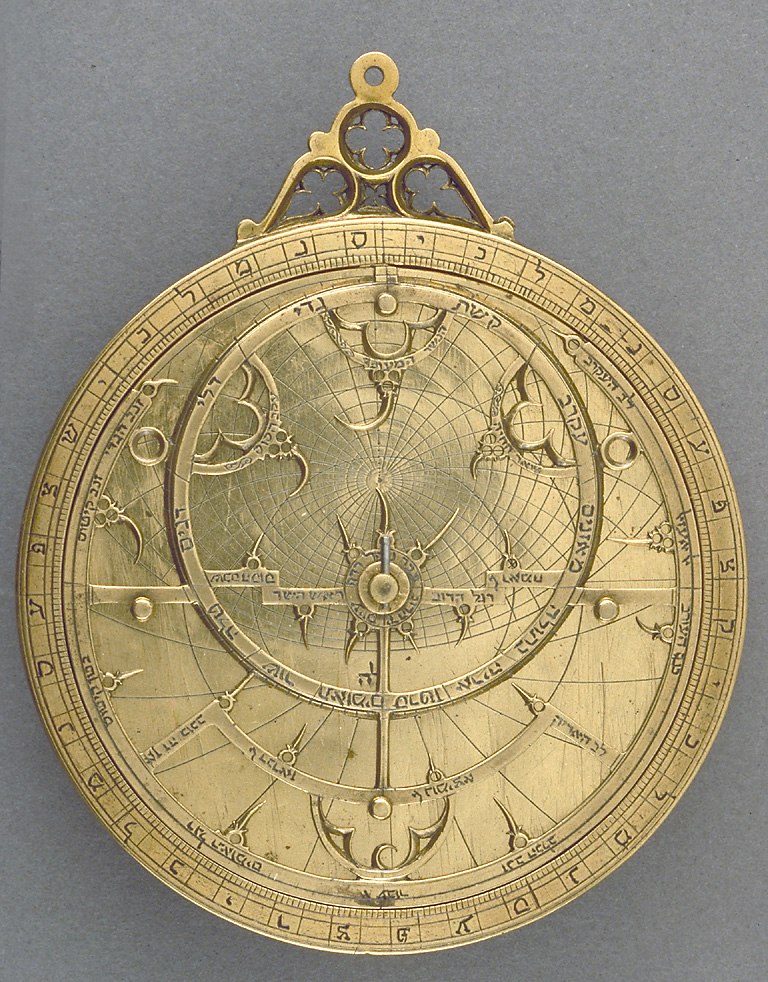
This is a gilt brass astrolabe measuring 92 mm in diameter, featuring significant engravings in Hebrew script. It is an unsigned instrument that includes a throne with a pierced quatrefoil design composed of three metal layers. The rete displays a semi-quatrefoil pattern, with star-pointers shaped like bent daggers, and utilizes a double counterchanged equinoctial bar with two small knobs. The instrument is equipped with five plates for various latitudes ranging from 33 to 43 degrees, marked with coordinates and unequal hour lines. The back of the instrument features an altitude scale, a zodiacal scale, and an eccentric calendar scale alongside a double shadow scale and horary quadrants. The instrument was formerly part of the Spitzer collection and was acquired by the British Museum in 1893.

Front view of the gilt brass astrolabe showing the rete, throne, and circular scales.
Front view of the gilt brass astrolabe showing the rete, throne, and circular scales. — British Museum, London. Rights pending — permission not yet requested. Original source

Catalogue identity

Source
www.mhs.ox.ac.uk
Category
Tool · Iberian astrolabe
Maker / attribution
Not established
Reference
Not recorded
Catalogue / lot identifier
MLA 1893,6-16.3
Source-reported date
mid 14th century
Source-reported place
Spain

Source-reported attribution and specifications are not independent authentication. A listing does not establish present ownership, current display, availability or permission to reproduce.

Object description

Construction and Design

The astrolabe is constructed from gilt brass and measures 92 mm in diameter. Its throne is distinguished by a pierced quatrefoil design, crafted from three distinct layers of metal. The interior rim of the mater includes a recess positioned at 12 o'clock, intended to accommodate the tongues of the various plates, and the rim itself is secured to the backplate via rivets.

The rete features a semi-quatrefoil motif and incorporates star-pointers designed as bent daggers. For operational ease, the double counterchanged equinoctial bar is fitted with small knobs on either side, which serve as handles for rotating the component. The instrument includes five individual plates, each engraved on both sides to support different latitudes ranging from 33 to 43 degrees.

Evidence for this section
  • “The throne has a pierced quatrefoil design made up of three layers of metal.”
  • “The rete has a semi-quatrefoil design with the star-pointers in the shape of bent daggers sitting on one or triple lobes.”
  • “Two little knobs are attached to both sides of the double counterchanged equinoctial bar which act as handles to turn the rete.”

Scales and Markings

The instrument is notable for its Hebrew inscriptions. The rete displays star names in a mix of Hebrew and Arabic, while the ecliptic features the names of zodiacal signs in Hebrew. The interior of the mater is engraved with two sets of circular scales, including a 28-year solar cycle, weekday numbering, and month names in transliterated forms such as 'Yanir' and 'Febrir'.

The reverse side of the instrument contains an altitude scale, a zodiacal scale with degree divisions, and an eccentric calendar scale. Furthermore, the base contains a double shadow scale and two horary quadrants dedicated to unequal hours. All numerical data on these scales is presented using alphanumerical notation.

Evidence for this section
  • “24 star names are given partially in Hebrew, partially in Arabic in Hebrew script.”
  • “The ecliptic is marked with the Hebrew names of the zodiacal signs.”
  • “The bottom half of the vacant space inside these circles is taken up by a double shadow scale marked [zl isr] and [zl hpuk] to the base of 12”

History and Documentation

This astrolabe was previously documented as part of the Spitzer collection before its acquisition by the British Museum in 1893. While the instrument bears no signature or date, historical research suggests a mid-14th-century origin in Spain, based on its stylistic characteristics and the specific month names employed in the calendar.

The astrolabe is identified in the literature by its registration number MLA 1893,6-16.3. It has been examined in comparative studies of Hebrew-marked astrolabes, specifically those referenced in catalogues of the British Museum and research by B. Goldstein regarding similar instruments held in international collections.

Evidence for this section
  • “It is neither signed nor dated, but the style and the month names used suggest it might have been made in 14th century Spain.”
  • “The instrument was formerly in the Spitzer collection and was purchased in 1893.”
  • “It is described and illustrated in F. A. B. Ward, A Catalogue of European Scientific Instruments in the Department of Medieval and Later Antiquities of the British Museum (London, 1981)”

Open research questions

  • What is the specific significance of the Hebrew names used for the zodiacal signs on this instrument?
  • Could the specific latitudes supported by the plates indicate a particular geographic origin within 14th-century Spain?

Source evidence

Recorded claims and source quotations for Astrolabe with Hebrew Markings
FieldSource-reported valueSource quotation
MaterialGilt brass“Gilt brass”
Diameter92 mm“92 mm in diameter”
CollectionBritish Museum“British Museum, London”
Accession numberMLA 1893,6-16.3“Registration no. MLA 1893,6-16.3”
ProvenanceSpitzer collection“The instrument was formerly in the Spitzer collection”

Visible details

  • Pierced quatrefoil design on the throne
  • Star-pointers in the shape of bent daggers on the rete
  • Alphanumerical notation used for scales

Research qualifications

  • Date is marked with a question mark by the source suggesting a mid-14th century origin
  • Attribution to Spain is based on stylistic analysis and month names rather than an explicit maker's signature

Photograph identity and source facts were screened before import; rights clearance remains pending.

Consulted source

Astrolabe

Reviewed 2026-10-26 · Record 49f5d22748

Terms in this record

Glossary explanations for terms named in this object’s record.