
Skip to content
The Encyclopedia of Horology

Tool · Iberian astrolabe

Gilt Copper Astrolabe

Partially verified

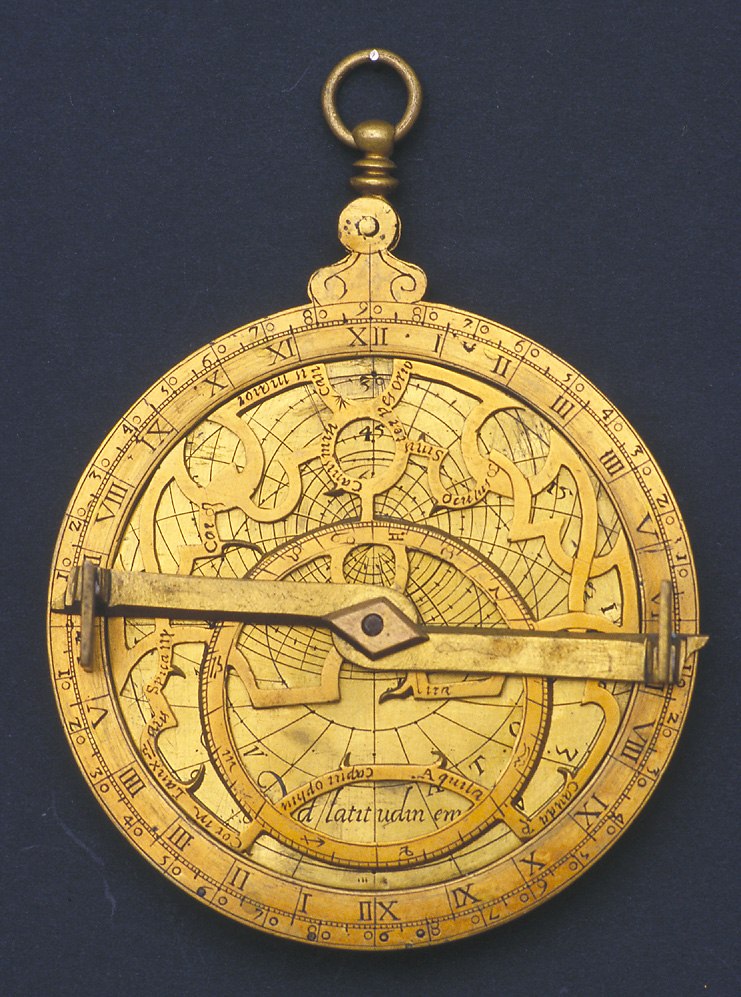
This unsigned astrolabe, dating to the later 16th century, is constructed from gilt copper and measures 85 mm in diameter. The instrument features a throne composed of a double block, with an integrated attachment for a ring. It includes two internal plates calibrated for latitudes of 37° and 40°, corresponding to Spanish locations, which supports the attribution of its origin. The mater remains unmarked. The back of the instrument is distinctive for its use of the orthographic projection developed by the Spanish mathematician Juan de Rojas, which occupies approximately three quarters of the surface area. The astrolabe is completed by a hinged bar graduated in 15° intervals. The limb of the instrument is graduated in four 90° quadrants. Its design incorporates various astronomical markings, including zodiacal symbols, meridians, and parallels, as well as specific Latin inscriptions related to astronomical observation and the Rojas projection system.

Front view of the unsigned Spanish gilt copper astrolabe, showing the rete and graduated limb.
Front view of the unsigned Spanish gilt copper astrolabe, showing the rete and graduated limb. — Istituto e Museo di Storia della Scienza, Firenze. Rights pending — permission not yet requested. Original source

Catalogue identity

Source
www.mhs.ox.ac.uk
Category
Tool · Iberian astrolabe
Maker / attribution
Not established
Reference
Not recorded
Catalogue / lot identifier
1108
Source-reported date
Later 16th century
Source-reported place
Spain

Source-reported attribution and specifications are not independent authentication. A listing does not establish present ownership, current display, availability or permission to reproduce.

Object description

Structural Components and Dimensions

The astrolabe is a compact instrument measuring 85 mm in diameter, manufactured from gilt copper. Its suspension system is anchored by a throne formed from a double block, which provides the anchor point for the ring. The design reflects an integration of both functional astronomical utility and specific geometric projection.

The instrument includes a mater, which is noted as lacking specific markings, alongside two separate plates calibrated specifically for the latitudes of 37° and 40°. This calibration suggests alignment with Spanish geographical locations, reinforcing the attribution of the object's origin.

Evidence for this section
  • “Gilt copper; 85 mm in diameter”
  • “The throne is made up of a double block.”
  • “The mater has no markings and contains plates for latitudes of 37? and 40?.”

The Rojas Projection and Back Plate

A central element of this astrolabe is the use of the orthographic projection established by the Spanish mathematician Juan de Rojas. This projection covers approximately three quarters of the rear surface of the device. The design includes meridians beginning from a cap inscribed 'ARTICVS' and includes specific labeling regarding the time, marked 'HORAE ANTE MERIDIEM'.

The entire assembly is complemented by a hinged bar at the rear, featuring graduations between 15° and 90°.

Evidence for this section
  • “The back of the astrolabe presents the Rojas projection, which occupies three quarters of its surface.”
  • “ending at the cap with the inscription 'UMBRA VERSA RECTA'.”
  • “The instrument is completed by a bar, hinged to its ends, graduated from 90? to 15? and 15? to 90? in 15? intervals.”

Limb Graduations and Chronological Context

The limb of the instrument is calibrated in four quadrants, each graduated from 0° to 90°. The exterior side of the device features additional astronomical data, including the initials of the months and symbols representing the zodiac signs along with the corresponding day of entry.

The instrument remains unsigned and undated, leading researchers to rely on the projection technique and the geographical calibration of the plates to determine its context. These factors point to a production date in the latter half of the 16th century within Spain.

Evidence for this section
  • “The limb is graduated from 90? to 0?, 0? to 90?, repeated twice.”
  • “The outer part of the side bears the initials of the months, the day of the month on which the sign is entered, and the symbol for the sign.”
  • “Later 16th century; Spanish”

Open research questions

  • What is the specific historical significance of the orthographic projection of Juan de Rojas in the context of late 16th-century Spanish astrolabes?
  • Are there any undocumented repair or restoration marks on the internal components that might provide information about the instrument's usage history?

Source evidence

Recorded claims and source quotations for Gilt Copper Astrolabe
FieldSource-reported valueSource quotation
Inventory Number1108“Inventory no. 1108”
Dimensions85 mm diameter“85 mm in diameter”
MaterialsGilt copper“Gilt copper”
Projection SystemOrthographic projection of Juan de Rojas“On the back the meridians and parallels are depicted in accordance with the orthographic projection of the Spaniard Juan de Rojas.”
Latitude plates37 and 40 degrees“contains plates for latitudes of 37? and 40?.”
Limb graduation90 to 0 degrees, repeated twice“The limb is graduated from 90? to 0?, 0? to 90?, repeated twice.”

Visible details

  • Throne features a double block construction.
  • Limb is graduated from 0 to 90 degrees in four segments.
  • Hinged sighting bar is graduated.
  • Rojas projection is visible on the rear surface.

Research qualifications

  • Origin is attributed based on geographical indicators rather than a maker's signature.
  • The dating to the later 16th century is an estimation provided by the institution.

Photograph identity and source facts were screened before import; rights clearance remains pending.

Consulted source

Astrolabe

Reviewed 2026-10-26 · Record 58034f5e37

Terms in this record

Glossary explanations for terms named in this object’s record.