
Skip to content
The Encyclopedia of Horology

Pocket watch · Quarter-repeating musical automaton pocket watch

Piguet et Meylan Le Jardin de Cupidon Pocket Watch

Partially verified

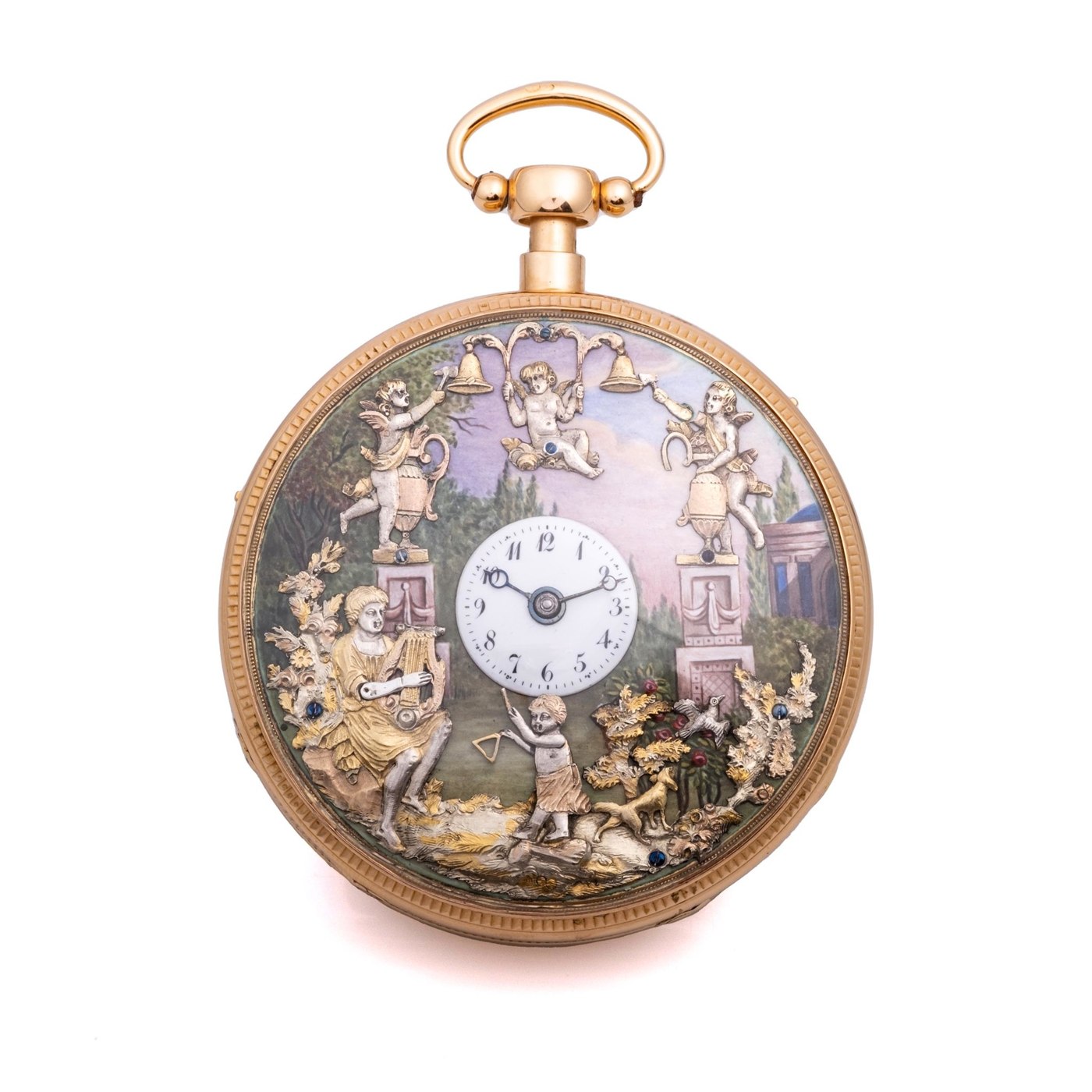
This 18k pink gold manual-wind open-face pocket watch is attributed to Piguet et Meylan, Geneva, circa 1820. Named "Le Jardin de Cupidon," the timepiece features an enamel dial with a classical garden scene incorporating four automaton actions. Two applied multicoloured gold cherubs rest upon urns to strike the hours and quarters on bells, while a seated man playing the lyre and a cherub striking a triangle operate below. The watch is equipped with a caliber 23''' gilt movement, utilizing going barrels for the timekeeping and musical trains, a cylinder escapement, and a brass three-arm balance with flat balance spring. The "sur plateau" musical mechanism features 29 tuned steel teeth. The case carries the "IE" master mark, attributed to a maker supplying Piguet & Meylan. The piece includes a silence/musique lever located under the cuvette.

Front view of the Le Jardin de Cupidon pocket watch showing the four automaton figures and central enamel dial.
Front view of the Le Jardin de Cupidon pocket watch showing the four automaton figures and central enamel dial. — Antiquorum. Rights pending — permission not yet requested. Original source

Catalogue identity

Source
catalog.antiquorum.swiss
Category
Pocket watch · Quarter-repeating musical automaton pocket watch
Maker / attribution
Piguet et Meylan
Reference
Not recorded
Catalogue / lot identifier
281
Source-reported date
Circa 1820
Source-reported place
Switzerland
Source-reported serial
11795

Source-reported attribution and specifications are not independent authentication. A listing does not establish present ownership, current display, availability or permission to reproduce.

Object description

Case and Dial

The watch is housed in an 18k pink gold case with a diameter of 58 mm, featuring an engine-turned band. The interior of the back cover displays the master mark "IE," identified as a case maker known for supplying Piguet & Meylan. The enamel dial depicts a classical garden scene, serving as the backdrop for the automaton mechanism.

Four automaton actions are integrated into the scene. Two multicoloured gold cherubs are positioned atop urns, acting as strikers for the hour and quarter-hour bells. Below them, the scene includes a seated man playing a lyre and an additional cherub striking a triangle. The hands are recorded by the auction house as later additions.

Evidence for this section
  • “The master mark ''IE'' punched on the inside of the back cover is that of the case maker who made many cases for Piguet & Meylan in Geneva.”
  • “Painted on enamel scene of a classical garden with two applied multicoloured gold cherubs resting on urns appearing to strike the hours and quarters on bells”
  • “HANDS Later”

Movement and Musical Mechanism

The watch is powered by a gilt 23''' caliber movement. It employs two going barrels, one dedicated to the timekeeping train and one to the musical train. The regulation of the escapement is handled by a cylinder escapement, a brass three-arm balance, and an index regulator. The balance, escape wheel, and third wheel are jeweled.

The musical functionality is provided by a "sur plateau" arrangement featuring 29 tuned steel teeth, which strike against a pinned disc. Control over the musical train is managed by a lever located beneath the cuvette, allowing the user to switch between silent and musical operation.

Evidence for this section
  • “Caliber 23''', gilt, going barrels for the going and musical trains, cylinder escapement”
  • “the balance, brass escape wheel and third wheel jeweled, flat balance spring, index regulator”
  • “sur plateau musical movement with 29 tuned steel teeth playing on both sides of the pinned disc, silence/musique lever protruding from under the cuvette.”

Signatures and Identification

The watch displays inconsistent numbering and signatures. The movement and the case are consistently stamped with the serial number 11795. However, the cuvette features an alternative, apocryphal signature accompanied by the number 20112, which contradicts the numbers found on the case and movement.

The watch is attributed to the firm Piguet et Meylan, consistent with the model name "Le Jardin de Cupidon." The auction house explicitly identifies the signature on the cuvette as apocryphal, distinguishing it from the production marks found elsewhere on the timepiece.

Evidence for this section
  • “Cuvette with apocryphal signature and number 20112, movement and case punch numbered 11795.”
  • “Model Le Jardin de Cupidon”

Open research questions

  • What is the specific identity of the case maker 'IE' associated with Piguet et Meylan?
  • What is the origin of the apocryphal signature and number 20112 on the cuvette?

Source evidence

Recorded claims and source quotations for Piguet et Meylan Le Jardin de Cupidon Pocket Watch
FieldSource-reported valueSource quotation
MakerAttributable to Piguet et Meylan“Attributable to Piguet et Meylan”
Case material18k pink gold“18k pink gold”
Movement serial11795“movement and case punch numbered 11795”
EscapementCylinder“cylinder escapement”
Musical movement29 tuned steel teeth“sur plateau musical movement with 29 tuned steel teeth”
Case maker markIE“The master mark ''IE'' punched on the inside of the back cover”
Diameter58 mm“Diameter 58 mm”

Visible details

  • Painted enamel dial with applied multicoloured gold automata
  • Four distinct automaton figures interacting with bells, lyre, and triangle
  • Silence/musique lever positioned beneath the cuvette
  • Engine-turned decorative case band

Research qualifications

  • The cuvette bears an apocryphal signature and number 20112
  • Movement and case are numbered 11795
  • The auction description reports the hands are later

Photograph identity and source facts were screened before import; rights clearance remains pending.

Terms in this record

Glossary explanations for terms named in this object’s record.