
Skip to content
The Encyclopedia of Horology

Pocket watch · Hunting-cased keyless pocket watch

Omega Hunting-Cased Pocket Watch with Portrait of Ras Tafari

Partially verified

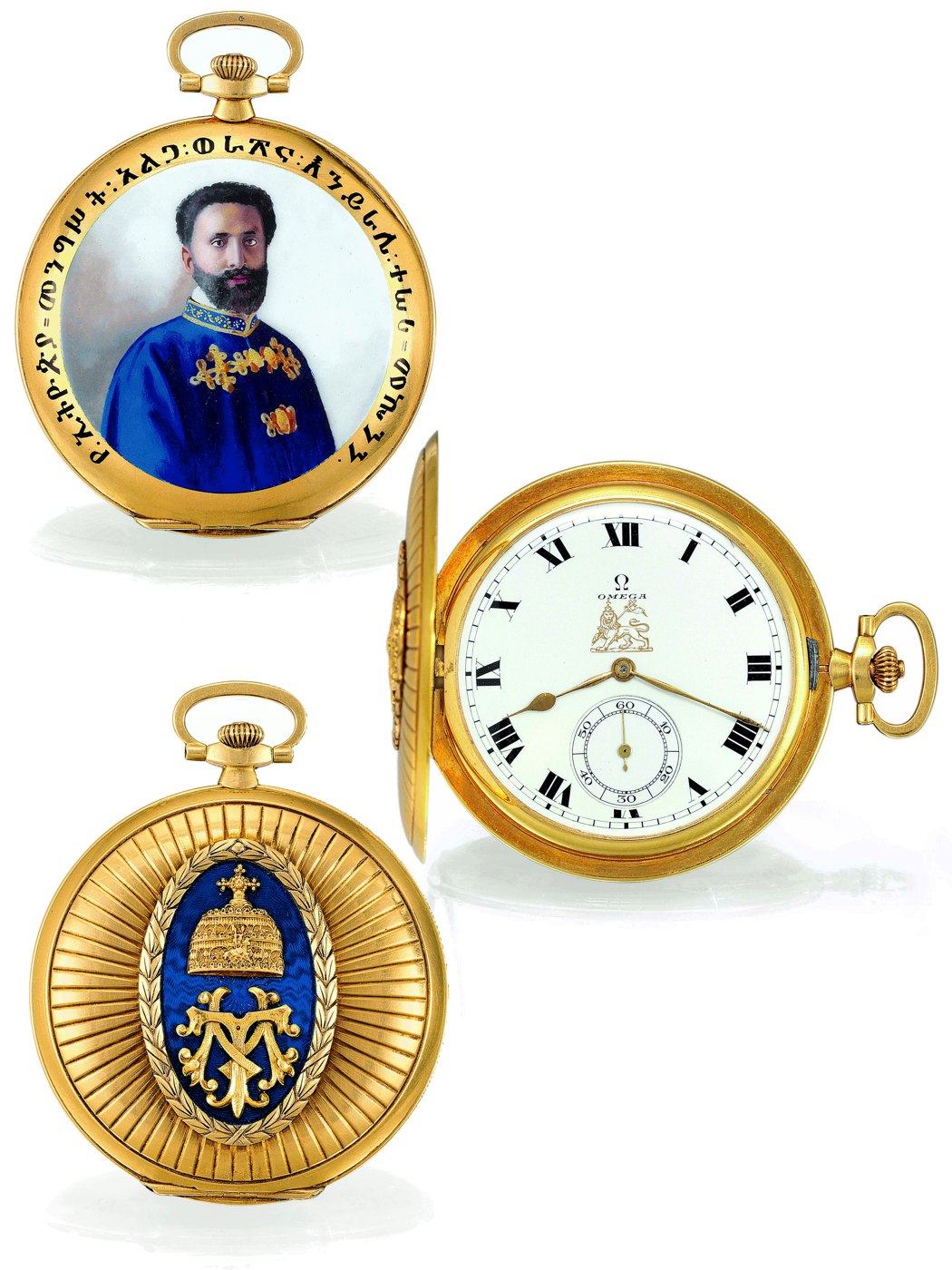
This Omega keyless pocket watch is a four-body, 18K yellow gold, hunting-cased timepiece. It features a Calibre 34 M.S. movement, which is rhodium-plated and contains 16 jewels. The watch is equipped with a straight-line lever escapement, a cut bimetallic compensation balance, a blued steel Breguet balance spring, and an index regulator. The exterior is decorated with polychrome enamel and engraving. The hinged back cover bears a portrait of Ras Tafari (Haile Selassie) surrounded by an Amharic inscription. The front cover displays a blue enamel medallion with the monogram TM surmounted by an Ethiopian crown, set against a radially engraved ground. The white enamel dial features Roman numerals, a subsidiary seconds dial, and a gilt Lion of Judah emblem. The case, dial, and movement are signed. The watch was sold on January 9, 1929, and originates from the Omega Museum collection.

Front, back, and dial views of the Omega pocket watch.
Front, back, and dial views of the Omega pocket watch. — Antiquorum. Rights pending — permission not yet requested. Original source

Catalogue identity

Source
catalog.antiquorum.swiss
Category
Pocket watch · Hunting-cased keyless pocket watch
Maker / attribution
Omega
Reference
Cal. 34 M.S.
Catalogue / lot identifier
45
Source-reported date
Sold January 9, 1929
Source-reported place
Switzerland
Source-reported serial
6931030

Source-reported attribution and specifications are not independent authentication. A listing does not establish present ownership, current display, availability or permission to reproduce.

Object description

Case and Dial Design

The watch is housed in a four-body, 18K yellow gold, hunting-style case of the 'bassine et filets' type. The front cover is decorated with a central medallion featuring the monogram 'TM' (Tafari Makonnen) and the Ethiopian Crown, framed by laurel leaves on a radially engraved background. The hinged back cover contains a polychrome enamel portrait of Haile Selassie dressed in royal blue, circled by an inscription in Amharic that translates to 'His Highness Tafari Makonnen'.

The interior white enamel dial displays bold radial Roman numerals and an outer minute track. A subsidiary seconds dial is located at the bottom. A gilt emblem depicting the 'Lion of Judah' is applied to the dial center beneath the Omega signature. The watch uses gilt 'spade' hands for time indication.

Evidence for this section
  • “Four-body, solid, 'bassine et filets', cover with central blue enamel medallion with monogram TM (Tafari Makonnen) surmounted by the Ethiopian Crown within a laurel leaf frame on a radially engraved ground”
  • “White enamel with bold radial Roman numerals, outer minute track, subsidiary seconds, gilt emblem of the ?Lion of Judah?.”

Movement and Escapement

The internal mechanism is an Omega Calibre 34 M.S. movement, with 'M' denoting 'Thin' (Mince) and 'S' denoting 'Hunter' (Savonnette) configurations. It is finished with rhodium plating and is constructed with 16 jewels. The technical configuration includes a straight-line lever escapement paired with a cut bimetallic compensation balance to regulate the watch.

Timekeeping is managed by a blued steel Breguet-style balance spring and an index regulator. The movement, dial, and case are all signed by Omega, adhering to standard production conventions for high-grade watches from this factory period in Geneva.

Evidence for this section
  • “Cal. 34 M.S., rhodium-plated, 16 jewels, straight-line lever escapement, cut bimetallic compensation balance, blued steel Breguet balance spring, index regulator.”
  • “Case, dial and movement signed.”

Provenance and Historical Context

This watch is documented as having been sold on January 9, 1929. The provenance is attributed to the Omega Museum. The portrait on the case is identified as an identical enamel to one published in the reference work 'Omegamania' by Marco Richon.

Although the watch was sold in early 1929, the source suggests it may have been created to commemorate the 1930 coronation of Ras Tafari as Emperor. The choice of the 'Lion of Judah' emblem on the dial aligns with the traditional imperial symbolism associated with the Ethiopian monarchy and the Book of Genesis.

Evidence for this section
  • “Sold on January 9, 1929.”
  • “Provenance: Omega Museum.”
  • “A watch with identical enamel portrait is illustrated in Omegamania, by Marco Richon, Chap. 9, p. 35.”
  • “The present watch was probably made to commemorate Ras (Prince) Tafari Makonnen` s coronation as Emperor on November 2, 1930.”

Open research questions

  • How does the 1929 sale date correlate with the alleged 1930 commemorative purpose of the watch?
  • Are there additional records in the Omega archives regarding the commission of this specific timepiece?

Source evidence

Recorded claims and source quotations for Omega Hunting-Cased Pocket Watch with Portrait of Ras Tafari
FieldSource-reported valueSource quotation
Movement Number6336712“'Usine de Genève' No. 6336712”
Case Number6931030“case No. 6931030”
Sold DateJanuary 9, 1929“Sold on January 9, 1929.”
Movement TypeCal. 34 M.S.“Cal. 34 M.S., rhodium-plated, 16 jewels, straight-line lever escapement”
Case Material18K yellow gold“18K yellow gold and enamel hunting-cased”
Case Diameter49.5 mm“Diam. 49.5 mm.”
Dial FeaturesRoman numerals and Lion of Judah emblem“White enamel with bold radial Roman numerals, outer minute track, subsidiary seconds, gilt emblem of the ?Lion of Judah?.”

Visible details

  • The dial features a gilt Lion of Judah emblem positioned below the Omega logo.
  • The front cover displays the monogram TM in enamel inside a laurel leaf frame.
  • The movement is a Calibre 34 M.S. finished in rhodium plating.

Research qualifications

  • The source notes the watch was 'probably' made to commemorate the 1930 coronation, which post-dates the recorded 1929 sale date.
  • The provenance from the Omega Museum is noted, but the specific path of ownership prior to inclusion in the museum is not documented.

Photograph identity and source facts were screened before import; rights clearance remains pending.

Terms in this record

Glossary explanations for terms named in this object’s record.