
Skip to content
The Encyclopedia of Horology

Tool · Arabic-inscribed astrolabe, North Africa

North African Astrolabe

Partially verified

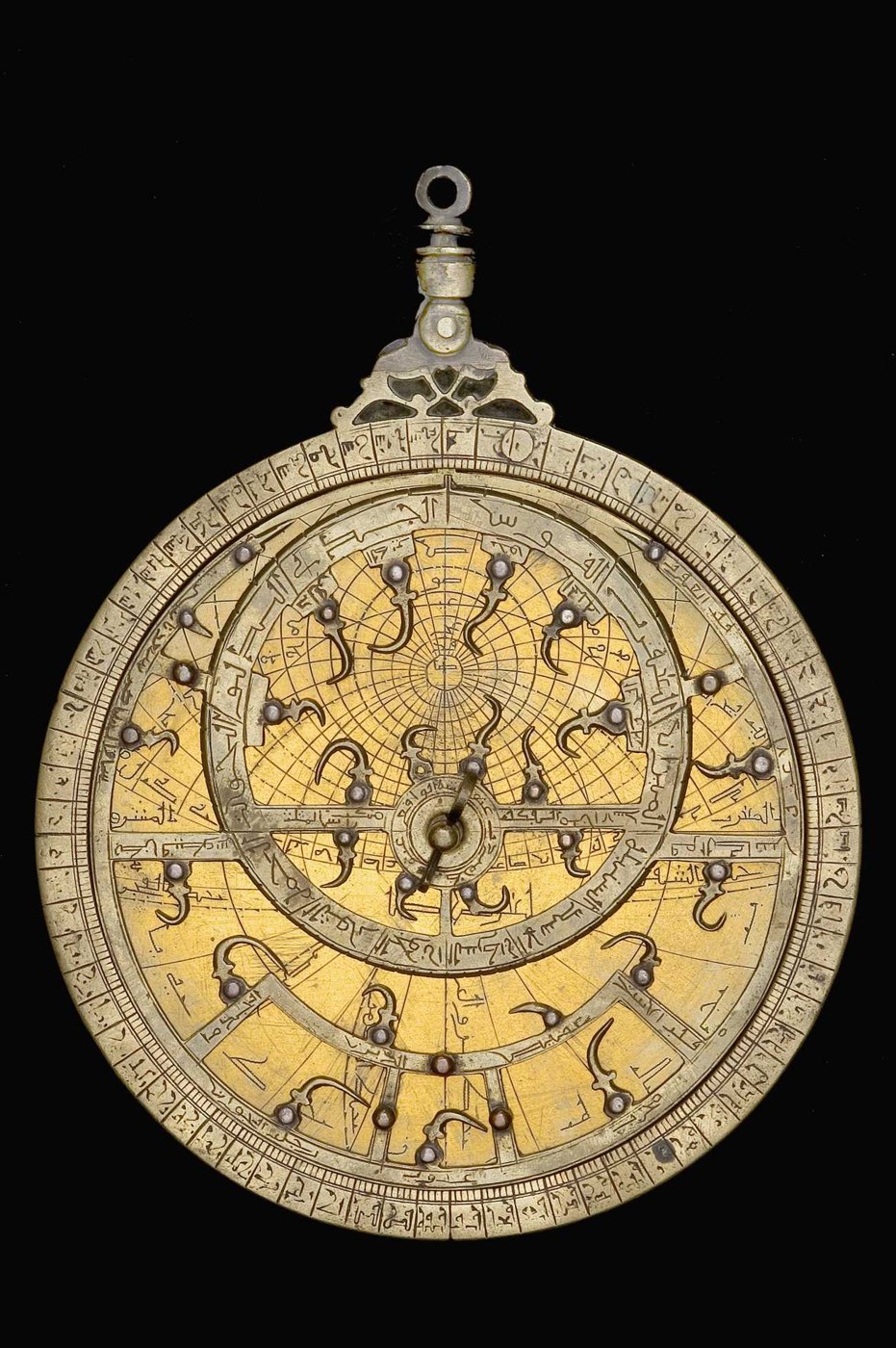
This brass astrolabe, catalogued under inventory number 53556, dates to the 14th century and is attributed to North Africa. The instrument features a pierced throne with an integrated base and a rotating pin-type shackle. The mater and limb are constructed from two soldered pieces of brass. The back of the instrument carries five distinct scales: altitude, zodiacal signs, calendar, unequal hours, and a shadow square. It is equipped with five plates covering latitudes up to 45 degrees. The rete is of the simple indicator-line type, featuring knobs for manipulation and zodiacal labels in Arabic. The double-ended alidade is original to the piece, featuring three engraved lines along its length. The astrolabe was presented to the collection by Lewis Evans in 1924, having been previously acquired through the London trade in 1894.

Full view of the astrolabe, showing the rete and the Arabic inscriptions.
Full view of the astrolabe, showing the rete and the Arabic inscriptions. — History of Science Museum, University of Oxford. Rights pending — permission not yet requested. Original source

Catalogue identity

Source
www.mhs.ox.ac.uk
Category
Tool · Arabic-inscribed astrolabe, North Africa
Maker / attribution
Not established
Reference
Not recorded
Catalogue / lot identifier
53556
Source-reported date
14th century
Source-reported place
North Africa

Source-reported attribution and specifications are not independent authentication. A listing does not establish present ownership, current display, availability or permission to reproduce.

Object description

Construction and Design

The astrolabe is constructed primarily of brass. The main body consists of a mater and limb assembly made of two pieces using a soldered construction method. The throne is a pierced design fixed to an integrated base, characterized by its notably diminutive size. The suspension mechanism comprises a rotating pin shackle with a ball-joint end, which attaches to a circular bracket that pivots directly on the throne.

The instrument features a double-ended alidade, identified as original, which is rigid and features single sights. The rule is detailed with three engraved lines running down its length. Internally, the instrument supports five plates with latitudes ranging up to 45 degrees. The rete is of the simple indicator-line type, which includes five knobs designed for turning the component during use.

Evidence for this section
  • “The mater and limb are of two pieces, soldered construction.”
  • “The throne is of the pierced type made of brass attached with integrated base made of brass and rotating pin type shackle made of brass”
  • “The rule is decorated by three lines engraved down its length.”
  • “There are 5 plates with latitudes ranging from to 45°0'”

Scales and Markings

The reverse of the astrolabe contains five distinct scales etched into the brass surface. These include altitude scales covering 0 to 90 degrees of arc in the upper quadrants, a zodiacal sign scale, a calendar scale, a scale for unequal hours, and a shadow square occupying the lower central portion of the instrument. The altitude scales are arranged in circular, concentric geometry and are numbered every 5 degrees.

The rete is designed with an indicator-line style and bears Arabic labels for the twelve signs of the zodiac, including Al-Hamal (Aries) and Al-Hut (Pisces). While the catalog indicates there are zero stars marked on the rete, it notes the presence of flame-shaped pointers. Additionally, vestige engravings of an ecliptic are visible on the back side of the rete component, representing some signs of the zodiac.

Evidence for this section
  • “The back contains 5 scales of the following types: Altitude; Zodiacal signs; Calendar; Unequal hours; Shadow square.”
  • “The zodiac on the rete is labelled: الحمل , الثور , الجوزا , السرطان , الاسد , السنبله , الميزان , العقرب , القوس , الجدي , الدلو , الحوت .”
  • “There are 0 stars on the rete marked with flamant pointers.”

Provenance and Acquisition

The astrolabe was entered into the collection via a presentation by Lewis Evans in 1924. According to archival records, Evans purchased the instrument from a London dealer named Harding in 1894.

Harding had previously acquired the astrolabe at one of the sales conducted by H. Weishaupt at the auction house Puttick & Simpson. H. Weishaupt and a dealer named Heilbronner, both based in Paris, were noted for regularly offering antiques sourced from the continent through this specific London venue.

Evidence for this section
  • “Presented by Lewis Evans in 1924”
  • “Evans bought it from Harding, a London dealer, in 1894. He in turn bought it at one of H. Weishaupt's sales at Puttick & Simpson's.”
  • “Weishaupt and Heilbronner, dealers based in Paris, regularly offered antiques acquired on the continent through this London auction house.”

Open research questions

  • What is the significance of the ecliptic vestige engravings found on the back of the rete?
  • Could the absence of marked stars on the rete indicate a partial loss of original function or a specific variant of astrolabe design?

Source evidence

Recorded claims and source quotations for North African Astrolabe
FieldSource-reported valueSource quotation
Inventory number53556“Inventory no. 53556”
MaterialBrass“Material Brass”
Date14th century“Date 14th century”
Place of originNorth Africa“Place North Africa”
Throne stylePierced“The throne is of the pierced type”
Shackle styleRotating pin“Shackle of the rotating pin type (i.e. pin with a 'ball-joint' on the end)”
Acquisition1924“Presented by Lewis Evans in 1924”
Alidade configurationDouble-ended“Alidade Double-ended.”

Visible details

  • Pierced throne with an integrated base
  • Zodiacal signs on the rete labeled in Arabic
  • Double-ended alidade with triple-line engraving
  • Shadow square on the back instrument face

Research qualifications

  • The rete is stated to contain zero stars despite having indicator pointers
  • Origin is attributed generally to North Africa rather than a specific workshop

Photograph identity and source facts were screened before import; rights clearance remains pending.

Consulted source

Astrolabe, inventory 53556 (North Africa, 14th century)

Reviewed 2026-10-26 · Record 2dacdd5bf4

Terms in this record

Glossary explanations for terms named in this object’s record.