
Skip to content
The Encyclopedia of Horology

Clock · Bracket clock

Musical bracket clock by Samuel Cleghorn

Partially verified

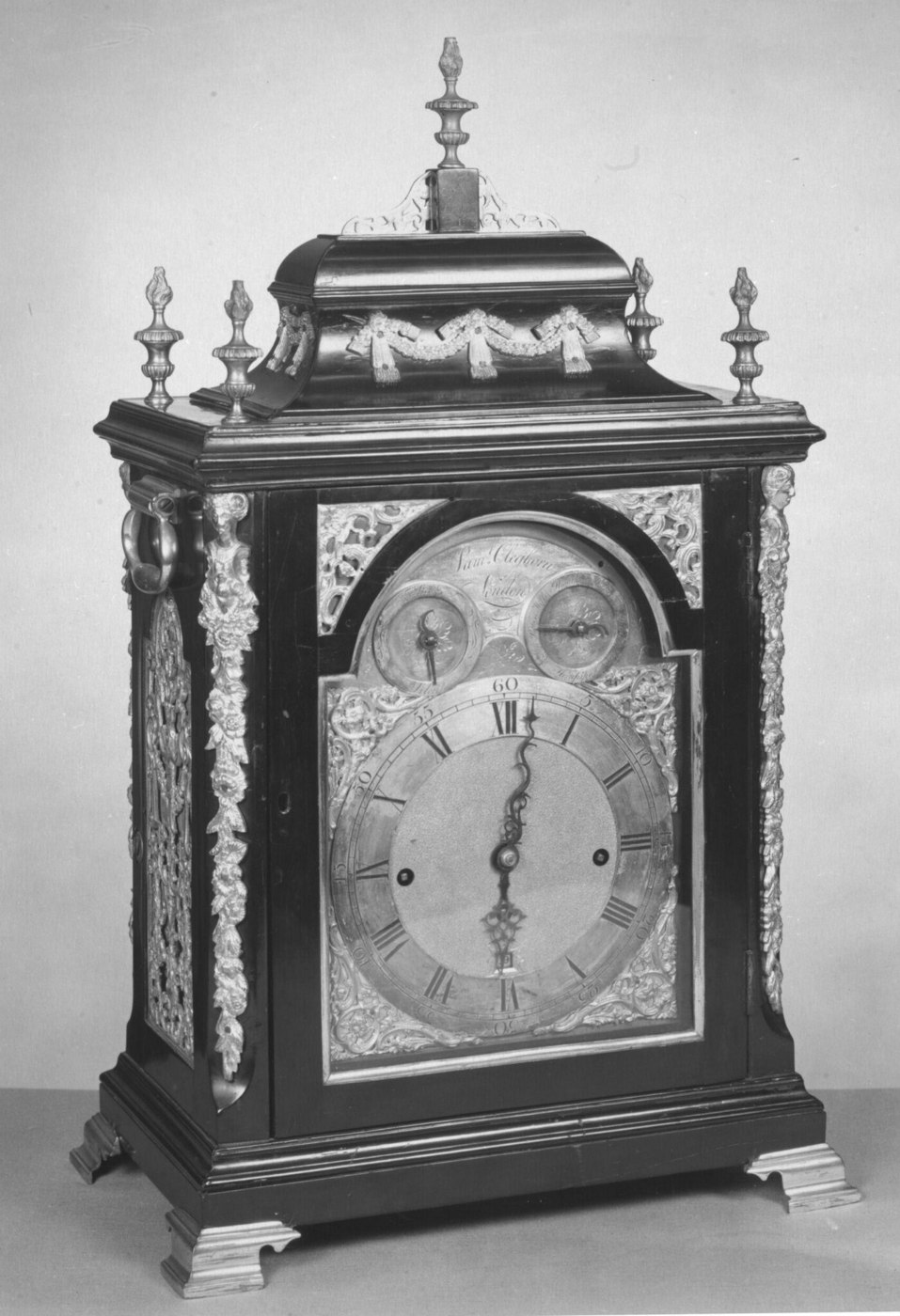
This musical bracket clock, manufactured in 1790, is attributed to the London-based maker Samuel Cleghorn. Constructed from ebonised wood and ornamented with gilt brass mounts, the clock features a rectangular case raised on four irregular brass feet. The arch-topped design is surmounted by a moulded oblong dome topped with a central flaming urn and four additional corner urns. The brass-faced dial includes a silvered chapter ring, brass spandrels, and a date aperture. Positioned within the arch are two auxiliary dials: one for Strike/Silent control and the other displaying a selection of musical tunes, including 'Hornpipe', 'Lass Patty's Mill', 'Highland Laddie', and 'March'. The clock is currently part of the collection held by the Victoria and Albert Museum and has been on loan to the Judges' Lodgings Museum in Lancaster since 1987.

Front view of the musical bracket clock showing the dial, auxiliary tune selection dial, and ebonised wood case with gilt mounts.
Front view of the musical bracket clock showing the dial, auxiliary tune selection dial, and ebonised wood case with gilt mounts. — Victoria and Albert Museum. Rights pending — permission not yet requested. Original source

Catalogue identity

Source
collections.vam.ac.uk
Category
Clock · Bracket clock
Maker / attribution
Samuel Cleghorn
Reference
W.14-1965
Catalogue / lot identifier
Source URL identifies the listing
Source-reported date
1790
Source-reported place
London

Source-reported attribution and specifications are not independent authentication. A listing does not establish present ownership, current display, availability or permission to reproduce.

Object description

Case and Dial Design

The clock is housed in an ebonised wood case which rests on four brass feet of irregular design. The architectural form includes a moulded oblong dome featuring a central brass flaming urn, complemented by four similar urns at the corners of the case. Gilt-brass mounts are applied to the case corners, each featuring a female head figure from which floral and foliage trails extend.

The brass dial is fitted with a silvered chapter ring and brass arabesque-style spandrels. The dial layout includes going and striking winding holes, alongside a central date aperture. Within the arch, two circular dials are present; the left dial provides Strike/Silent control, while the right dial is engraved with a list of musical tunes for the chime mechanism.

Evidence for this section
  • “The case rests on four brass bracket feet of irregular shape.”
  • “At each corner there is a mount in the form of a female head from which hangs a trail of flowers and foliage.”
  • “Brass face, silvered chapter ring and brass arabesques in the spandrels.”
  • “Within the arched top a small Strike/Silent dial on the left and on the right a similar one marked 'Hornpipe, Lass Patty's Mill, Highland Laddie, March'.”

Signatures and Inscriptions

The maker, Samuel Cleghorn, has marked the clock in two locations. An inscription is visible on the dial face itself, stating the maker's name and location. Further evidence of the maker's identity is provided by a printed ink label found on the inside of the clock door.

This label provides the specific workshop address of 65 Shoe Lane and reiterates the date of 1790. Historical records indicate that Cleghorn was active as a clockmaker in London between the years 1790 and 1808.

Evidence for this section
  • “'Sam. l Cleghorn London'”
  • “'Samuel Cleghorn, 65 Shoe Lane, 1790'”
  • “Samuel Cleghorn is known to have worked in London between 1790 and 1808.”

Provenance and Documentation

The clock is currently documented under the accession number W.14-1965 and is held by the Victoria and Albert Museum. It was gifted to the institution by the Science Museum in London.

Since 1987, the clock has been on public display as part of a loan to the Judges' Lodgings Museum, which is situated in Lancaster. The physical state of the object is described through the primary materials of ebonised wood, gilt brass, and glass.

Evidence for this section
  • “Accession number: W.14-1965”
  • “Given by the Science Museum, London”
  • “On loan to the Judges' Lodgings Museum, Lancaster from 1987.”

Open research questions

  • What is the specific type of musical mechanism installed within the movement?
  • Are the internal movement components original to the 1790 construction?

Source evidence

Recorded claims and source quotations for Musical bracket clock by Samuel Cleghorn
FieldSource-reported valueSource quotation
MakerCleghorn, Samuel (maker)“Cleghorn, Samuel (maker)”
Place of originLondon (made)“London (made)”
Accession numberW.14-1965“W.14-1965”
DimensionsHeight: 62.8 cm; Width: 37.1 cm; Depth: 22.8 cm“Height: 62.8 cm; Width: 37.1 cm; Depth: 22.8 cm”
Musical selectionHornpipe, Lass Patty's Mill, Highland Laddie, March“Hornpipe, Lass Patty's Mill, Highland Laddie, March”
Signature locationAbove the dial and inside the door“Signed by Samuel Cleghorn above the dial, and on the inside of the door a label with the inscription”

Visible details

  • Case features gilt-brass mounts depicting female heads with floral trails
  • Dual subsidiary dials located within the dial arch
  • Presence of side panels with fretted brass over crimson silk
  • Brass ring handles attached to the side of the clock case

Research qualifications

  • The specific internal musical mechanism components are not visible in the provided imagery
  • The precise operational condition of the movement is not reported by the source

Photograph identity and source facts were screened before import; rights clearance remains pending.

Consulted source

Bracket clock

Reviewed 2026-10-26 · Record 01bcef7063

Terms in this record

Glossary explanations for terms named in this object’s record.