
Skip to content
The Encyclopedia of Horology

Pocket watch · Grande Sonnerie clock-watch

Mugnier Horloger de l'Empereur et Roi No. 795

Partially verified

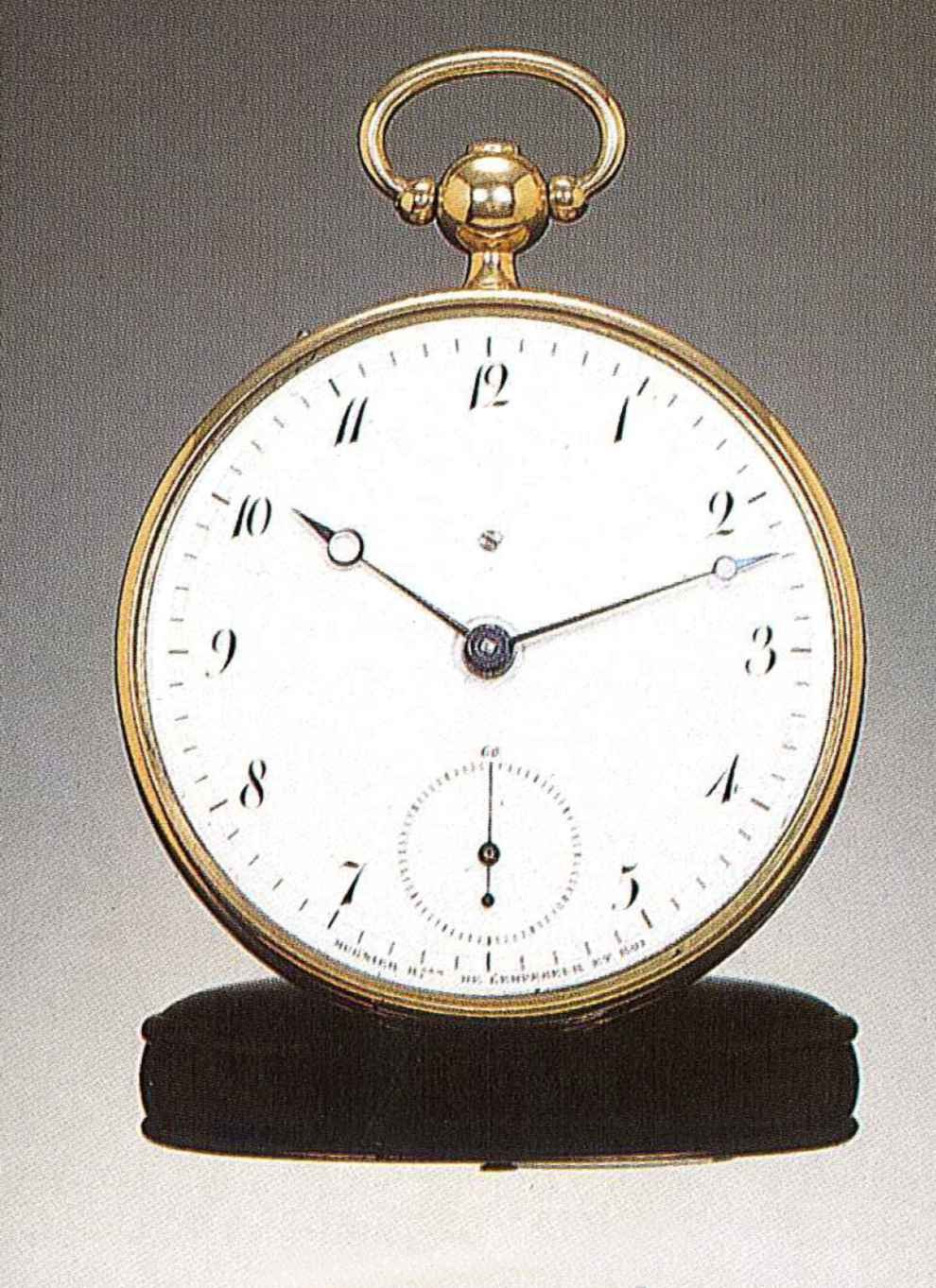
This 18k gold quarter-repeating 'Grande Sonnerie' clock-watch, numbered 795, is attributed to the horologist Mugnier, active in Paris. Dating to approximately 1805, the watch features an Empire-style four-body case constructed by Amy Gros. The white enamel dial displays Breguet numerals and is accompanied by blued steel Breguet-style hands. Technical features include a going train with a free-standing barrel, a plain gold three-arm balance with a Breguet 'parachute' suspension, and a flat balance spring with a compensation curb. The striking mechanism utilizes a fixed barrel with a revolving arbor to strike hours and quarters, with repeating functions activated by a button on the pendant. The piece is signed by the maker on both the dial and the hinged gilt brass cuvette, reflecting an early 19th-century production standard.

Front view of the 18k gold Mugnier clock-watch showing the white enamel dial and Breguet hands.
Front view of the 18k gold Mugnier clock-watch showing the white enamel dial and Breguet hands. — Antiquorum. Rights pending — permission not yet requested. Original source

Catalogue identity

Source
catalog.antiquorum.swiss
Category
Pocket watch · Grande Sonnerie clock-watch
Maker / attribution
Mugnier
Reference
Not recorded
Catalogue / lot identifier
309
Source-reported date
circa 1805
Source-reported place
France
Source-reported serial
795

Source-reported attribution and specifications are not independent authentication. A listing does not establish present ownership, current display, availability or permission to reproduce.

Object description

Case and Dial

The timepiece is housed in a four-body, Empire-style case produced in 18-karat gold. The assembly includes a hinged gilt brass cuvette protecting the movement.

The dial is rendered in white enamel and is clearly legible with black Breguet-style numerals. The time is indicated by a pair of blued steel Breguet hands. A subsidiary seconds dial is integrated into the primary face, positioned above the six o'clock marker. Signatures are present on the dial surface.

Evidence for this section
  • “Four body, massive, Empire, polished, by Amy Gros (Master mark).”
  • “Hinged gilt brass cuvette.”
  • “White enamel with Breguet numerals.”
  • “Signed on the dial and cuvette.”

Movement and Escapement

Internally, the watch contains a 22-line gilt brass movement. It is equipped with a Robin detent-lever escapement, a mechanism noted in the documentation for being less sensitive to inertia than standard pivoted or spring detent varieties. The going train incorporates a free-standing barrel, while the balance assembly consists of a plain three-arm gold balance supported by a Breguet-style 'parachute' shock protection system.

The striking train is powered by a fixed barrel with a revolving arbor.

Evidence for this section
  • “22-, gilt brass, the going train with free standing barrel, detent-lever Robin's escapement”
  • “plain gold three-arm balance, Breguet "parachute" suspension”
  • “Striking train with fixed barrel and revolving arbor, striking hours and quarters and repeating on gongs with button on the pendant.”

Maker and Historical Context

The watch is attributed to Mugnier, identified in the auction record as the younger, who served as a watchmaker to the Emperor and later to the brother of Louis XVIII. His workshop was located on the Rue Neuve des Petits Champs in Paris. The documentation notes that Mugnier served an apprenticeship under Abraham Louis Breguet.

The construction of this watch involves an original blank design also utilized by Breguet. The inclusion of the Robin detent-lever escapement is described as a mark of the maker's high-quality production, placed in a category the source compares to the 'Perpetuelles' produced by his master.

Evidence for this section
  • “Mugnier, the younger, watchmaker to the Emperor”
  • “Mugnier served his apprenticeship under Abraham Louis Breguet”
  • “it was made from a blank of an entirely original design which was used by Breguet.”
  • “Mugnier used for this watch the Robin's detent-lever escapement, which he only used for his top quality production”

Open research questions

  • What specific archival evidence confirms the attribution of this serial number to Mugnier's Paris workshop?
  • How does the specific execution of the Robin escapement in this movement differ from documented examples by Breguet?

Source evidence

Recorded claims and source quotations for Mugnier Horloger de l'Empereur et Roi No. 795
FieldSource-reported valueSource quotation
MakerMugnier“Mugnier, Horloger de 1'Empereur et Roi”
Serial Number795“No. 795”
Case MakerAmy Gros“by Amy Gros (Master mark)”
EscapementRobin's detent-lever“detent-lever Robin's escapement”
Diameter54 mm“Diam. 54 nun.”
Datingcirca 1805“circa 1805.”
Material18k gold“18I< gold”

Visible details

  • White enamel dial with black Breguet numerals
  • Blued steel Breguet-style hands
  • Sub-seconds dial positioned at six o'clock
  • Polished gold case finish

Research qualifications

  • Attribution to Mugnier the younger depends on the auction description
  • Stylistic comparisons to Breguet are subjective interpretations by the source
  • Functional state of the striking mechanism and movement not independently verified

Photograph identity and source facts were screened before import; rights clearance remains pending.

Terms in this record

Glossary explanations for terms named in this object’s record.