
Skip to content
The Encyclopedia of Horology

Clock · Longcase clock

Month-going longcase clock by James Beverly

Partially verified

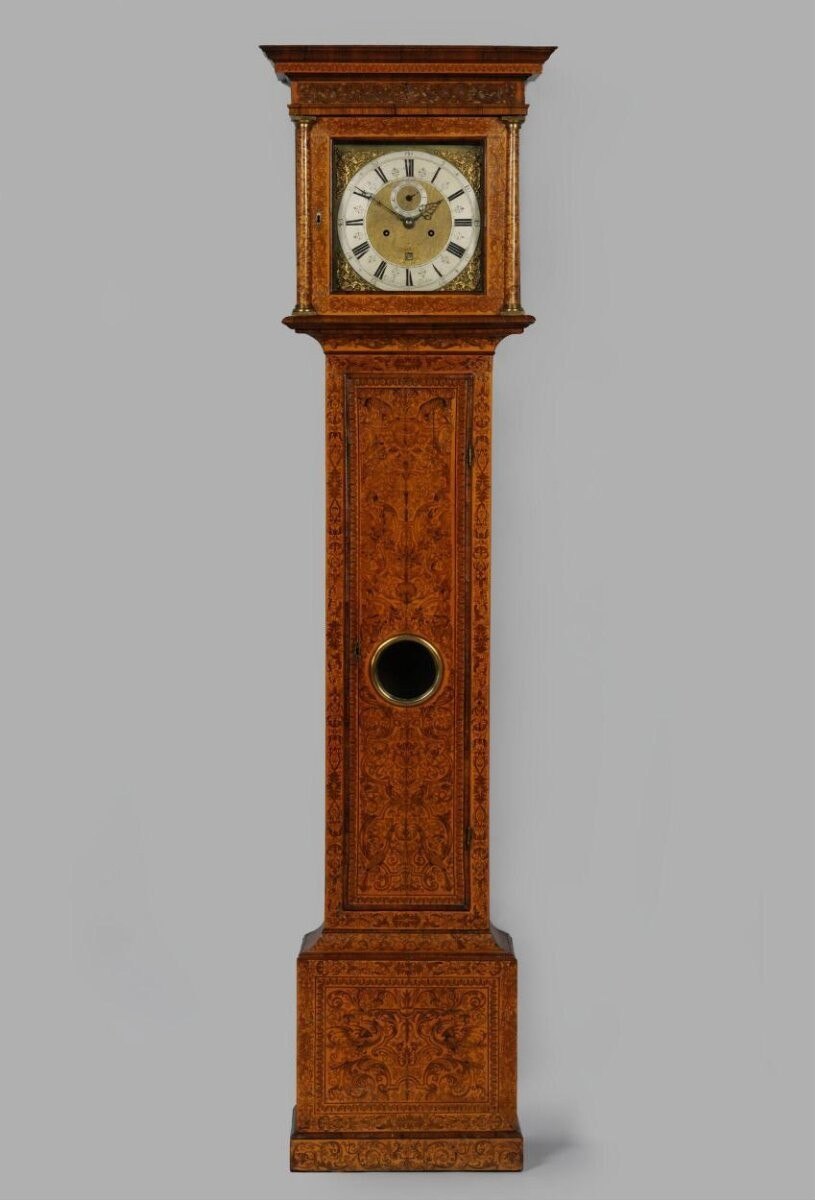
This month-going longcase clock features a case constructed of walnut and other woods on an oak carcase, decorated with arabesque marquetry. The case components include a hood with an architectural form, corner columns, and an ogee moulding, alongside a straight-sided body and a stepped base. The silvered twelve-inch square brass dial is signed 'James Beverly London' between the Roman numerals VII and V, and includes Roman hour numerals, a subsidiary seconds ring, and a square calendar aperture. The brass and steel movement is weight-driven with a two-train configuration, featuring an anchor escapement and an external countwheel for hour striking. Attributed to the maker James Beverly, who became free of the Clockmakers' Company in 1691, the clock exhibits signs of historical adjustments, including evidence of modifications to the escapement and the hammer spring mechanism. It was bequeathed to the museum by V. B. Crowther-Beynon in 1952.

Month-going longcase clock in walnut and marquetry, by James Beverly, c. 1700.
Month-going longcase clock in walnut and marquetry, by James Beverly, c. 1700. — Victoria and Albert Museum, London. Rights pending — permission not yet requested. Original source

Catalogue identity

Source
collections.vam.ac.uk
Category
Clock · Longcase clock
Maker / attribution
James Beverly
Reference
Not recorded
Catalogue / lot identifier
W.19:1-1952
Source-reported date
ca. 1700
Source-reported place
London

Source-reported attribution and specifications are not independent authentication. A listing does not establish present ownership, current display, availability or permission to reproduce.

Object description

Case Construction

The longcase clock features an architectural hood with a moulded cornice and an ogee moulding connecting it to the body. The hood is flanked by three-quarter columns at the front and quarter columns at the back, all featuring brass bases and capitals.

The straight-sided case and stepped base are adorned with marquetry consisting of arabesques, birdlike creatures, and Berainesque motifs. The sides of the case utilize plain walnut veneer within panels outlined by stringing. A concave moulding connects the waist of the case to its base, and the door features a round glass window framed by a brass band.

Evidence for this section
  • “The hood, which is connected to the body of the case with an ogee moulding, decorated with arabesque marquetry”
  • “The marquetry ground was identified visually (2015) as possibly sycamore.”

Dial and Hands

The twelve-inch square brass dial plate includes a matted center and twin cherub-and-crown spandrels at the corners. The silvered chapter ring displays Roman numerals for the hours and a subsidiary seconds ring. A square calendar aperture is bordered by engraved drapery.

The steel hands include pierced hour and minute indicators, with the hour hand featuring carved and bevelled surfaces. The minute scale is integrated into the chapter ring, with Arabic five-minute numerals positioned on either side of the extended five-minute strokes.

Evidence for this section
  • “Twelve inch square. Brass dial plate with matted centre and square calendar aperture”
  • “Signed between VII and V on chapter ring James Beverly London.”

Movement and Condition

The movement is a weight-driven, two-train, month-going mechanism. It includes a five-pillar configuration with riveted backplate pillars and a recoil anchor escapement. The striking train is controlled by an externally mounted countwheel located on the backplate.

The auction report identifies that the escapement has been altered, evidenced by plugged holes and different collet profiles. Additionally, the hammer spring has been replaced or moved. Surfaces on the front plate show residual scribe lines from the original manufacturing process.

Evidence for this section
  • “Month going, brass and steel, weight driven, two train movement.”
  • “the profile of the collets on pallet and escape arbors, the style of pallets and the presence of related plugged holes in the plate all lead to the conclusion that the escapement has been altered”

Open research questions

  • What specific horological purpose did the scribe lines on the front plate serve during the assembly process?
  • Can the 'wrapping' technique used for the hood columns be identified in other clocks by James Beverly?

Source evidence

Recorded claims and source quotations for Month-going longcase clock by James Beverly
FieldSource-reported valueSource quotation
MakerJames Beverly“Inscribed ‘James Beverly London’”
Dateca. 1700“ca. 1700”
Case materialsWalnut, oak, and other woods“walnut and other woods on an oak carcase”
Dial featuresSilvered chapter ring with Roman numerals“the silvered dial with Roman numerals engraved in black”
Movement typeMonth-going, weight driven“Month going, brass and steel, weight driven, two train movement”
EscapementRecoil anchor“Going train with recoil anchor escapement”
Accession numberW.19:1-1952“W.19:1-1952”

Visible details

  • Arabesque marquetry features birdlike creatures and Berainesque motifs
  • Brass dial plate exhibits matted centre with twin cherubs and crown spandrels
  • Front plate shows scribe lines used during movement layout

Research qualifications

  • Escapement has been partially replaced and back cock lowered
  • Hammer spring component appears to have been moved or replaced

Photograph identity and source facts were screened before import; rights clearance remains pending.

Consulted source

Month-going longcase clock

Reviewed 2026-11-02 · Record a8860668bb

Terms in this record

Glossary explanations for terms named in this object’s record.