
Skip to content
The Encyclopedia of Horology

Clock · Monstrance clock

Monstrance clock

Partially verified

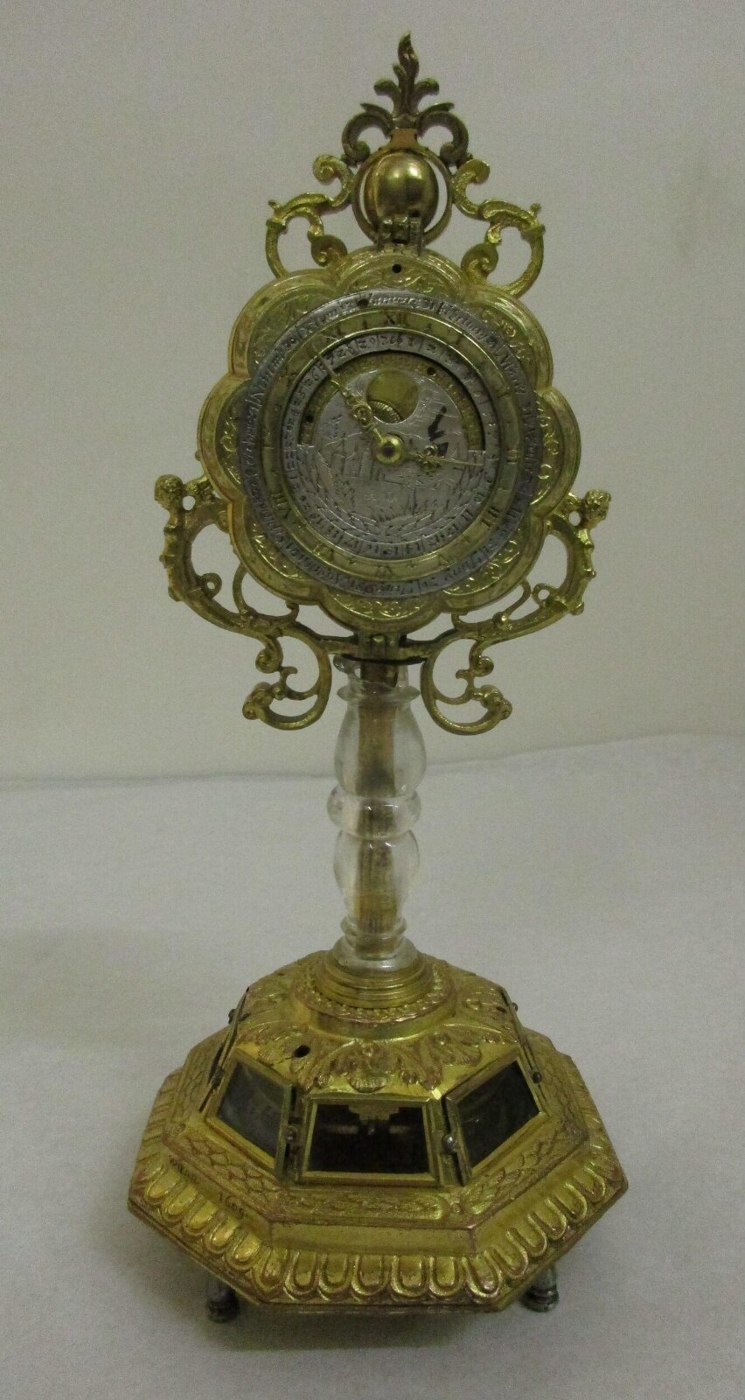
This monstrance clock is composed of a gilt-brass and rock crystal case standing on four turned iron feet. The base contains a striking movement in a watch-type case with a bell. The clock is supported by a baluster-shaped rock crystal stem. The going train is housed in an octagonal, escalloped vertical drum-shaped case. The front of this case includes a gilt-brass dial with applied silver rings displaying the months, Roman numeral hours, and days of the month. An aperture shows the phases of the moon. The dial is punched 'ANNO 1609 WIENN', indicating a sale in Vienna. While the clock is attributed to J. The object was purchased by the V&A from the collection of Ralph Bernal in 1855,

A front view of the monstrance clock, showing the gilt-brass dial, rock crystal stem, and octagonal base.
A front view of the monstrance clock, showing the gilt-brass dial, rock crystal stem, and octagonal base. — Victoria and Albert Museum, London. Rights pending — permission not yet requested. Original source

Catalogue identity

Source
collections.vam.ac.uk
Category
Clock · Monstrance clock
Maker / attribution
J. Wolf
Reference
Not recorded
Catalogue / lot identifier
2376-1855
Source-reported date
1600-1625
Source-reported place
Austria

Source-reported attribution and specifications are not independent authentication. A listing does not establish present ownership, current display, availability or permission to reproduce.

Object description

Construction and Materials

The clock is constructed with a combination of brass, silver, and rock crystal. The octagonal base features four turned iron feet and contains the striking movement. Eight sloping panels of rock crystal provide a view into the base housing. The clock is elevated on a baluster-shaped stem made of rock crystal.

The upper drum-shaped case is octagonal and escalloped. Its rear is formed by a hinged door of rock crystal, while the front holds the dial. The drum is flanked by pierced scrolls that terminate in female busts and are surmounted by a pierced scroll surrounding a small globe.

Evidence for this section
  • “The base standing on four turned iron feet and molded and chased contains the striking movement”
  • “Eight sloping rock crystal panels allow a partial view of this movement”
  • “The turned-brass stem is encased in rock crystal of baluster shape”
  • “The sides of the drum are of rock crystal; they are flanked by pierced scrolls terminating in female busts”

Dial and Functions

The gilt-brass dial is adorned with applied silver rings. The outermost ring is engraved with the names of the months and the number of days for each, though no hand indicates these. A brass ring displays Roman numerals I to XII for the hours.

A central silver disc is numbered 1 to 30 for the date and contains an engraved landscape. A semi-circular slot provides a view of the moon's age, and a circular aperture displays the lunar phase. Two hands indicate the hour and the date, with the date hand rotating once every thirty days.

Evidence for this section
  • “Dial with an outermost narrow silver ring”
  • “Engraved with the names of the months and the number of their days”
  • “within this a narrow brass hour ring with hours I to XII in Roman numerals”

Movement and Inscriptions

The going train is constructed of brass, with iron motion-work wheels. It utilizes a fusee and a verge escapement, along with a brass balance-wheel, balance-spring, and a Tompion-type regulator. The single-foot cock is pierced and bears the letter A.

The striking movement utilizes a conventional count-wheel system with a sliding ring marked 1 to 12. The dial bears the inscription 'ANNO 1609 WIENN'. There is a discrepancy between this date and the going movement, which reflects technology associated with the late 17th century.

Evidence for this section
  • “Going train of brass throughout, except for motion-work wheels, which are of iron”
  • “The whole going movement is consistent with a date of about 1680”
  • “thin brass sheet attached to the inside of the silver dial centre is punched “ANNO 1609 WIENN'”

Open research questions

  • What is the extent of the later modifications to the movement relative to the 1609 date on the dial?
  • Is there further biographical information confirming the work of J. Wolf in Vienna?

Source evidence

Recorded claims and source quotations for Monstrance clock
FieldSource-reported valueSource quotation
Accession number2376-1855“2376-1855”
Dial inscriptionANNO 1609 WIENN“ANNO 1609 WIENN”
MakerJ. Wolf“The clock is signed J.Wolf Wien (Vienna)”
EscapementVerge“verge escapement”
ProvenanceRalph Bernal Collection“Bought from the sale of the collection of Ralph Bernal MP in 1855”

Visible details

  • Dial features engraved landscape at centre
  • Eight sloping rock crystal panels at the base
  • Pierced scrolls terminate in female busts
  • Dial includes silver ring engraved with months

Research qualifications

  • Going movement appears consistent with circa 1680 despite 1609 dial inscription
  • Specific manufacturer J. Wolf is noted but documentation of the identity is limited
  • Origin attributed to South Germany or Austria

Photograph identity and source facts were screened before import; rights clearance remains pending.

Consulted source

Monstrance clock

Reviewed 2026-11-02 · Record 2ba038a504

Terms in this record

Glossary explanations for terms named in this object’s record.