
Skip to content
The Encyclopedia of Horology

Clock · Monstrance clock

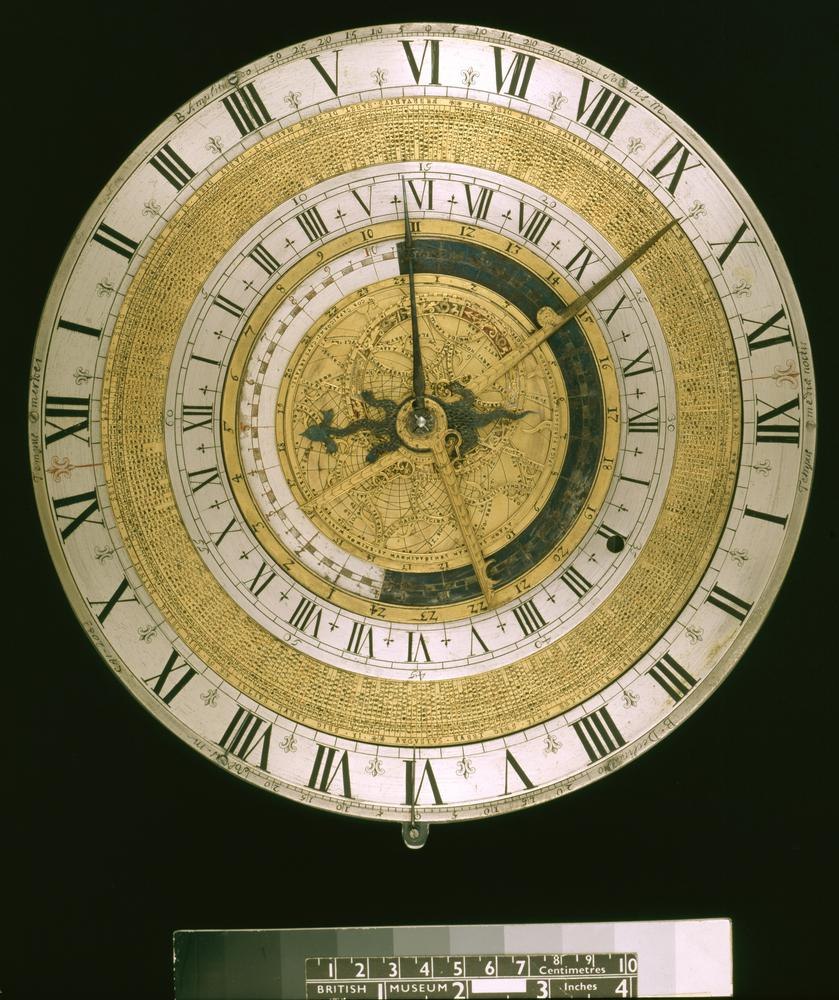
Thomas Starck monstrance clock movement and astronomical dial

Partially verified

According to the British Museum, this movement, dial, and alarm originated as components of a large monstrance clock made by Thomas Starck in 1620, probably in Augsburg, before being rehoused in a late-17th-century French wooden case. The spring-driven movement operates with a verge escapement and balance, featuring striking trains for quarters and either 1–12 or 1–24 hours, alongside a separate alarm mechanism. The elaborate front dial includes a mechanical astrolabe with a rete showing 27 fixed stars, length-of-day shutters, a 365-day calendar ring marking saints' days, and added outer rings. The movement backplate incorporates six enameled subsidiary dials.

Front view of the astronomical and calendar dial of the monstrance clock movement
Front view of the astronomical and calendar dial of the monstrance clock movement — British Museum. Rights pending — permission not yet requested. Original source

Catalogue identity

Source
www.britishmuseum.org
Category
Clock · Monstrance clock
Maker / attribution
Thomas Starck
Reference
Not recorded
Catalogue / lot identifier
Source URL identifies the listing
Source-reported date
1620 (clock); 1680 (case)
Country
Germany

Source-reported attribution and specifications are not independent authentication. A listing does not establish present ownership, current display, availability or permission to reproduce.

Object description

Provenance and Configuration

The movement is signed "Thomas Starck. Anno 1620" on the backplate. While the movement originated from a large monstrance clock, the original case is almost entirely lost, with the exception of a housing fragment for the alarm movement.

The current housing is a French religeuse-style wooden case with tortoise-shell and metal inlay, dating to the end of the 17th century. During this re-casing, the main dial was enlarged and additional rings were added.

Evidence for this section
  • “Engraved on the back plate: "Thomas Starck. Anno 1620."”
  • “The original case is almost entirely lost.”
  • “The present case of the clock is a French religeuse-case with tortoise-shell and metal inlay, dating from the end of the 17th century.”

Dial and Astronomical Features

The main dial features a gilded brass mechanical astrolabe, engraved for 48 degrees latitude, with a blued-steel nodal hand and a pierced rete showing 27 stars. Surrounding these are circular shutters for length-of-day and Nuremberg hour indications.

A 365-day calendar ring displays saints' feast days in red and black wax. The backplate includes six subsidiary dials, which indicate functions such as the regulator, days of the week, and striking train controls.

Evidence for this section
  • “LATIT POLI 48 GRAD”
  • “At the centre of the main dial is a mechanical astrolabe, made of gilded brass.”
  • “The backplate of the movement has six subsidiary dials”

Movement and Escapement

The movement consists of circular gilded brass plates connected by four pillars. It features a verge escapement with a balance, though the original balance was replaced.

The striking trains are designed for 1-12 or 1-24 hour counts, with a separate alarm train. While the fusee was originally cut for gut, it has been modified to use a steel cable.

Evidence for this section
  • “The main movement consists of two circular plates connected by four cylindrical pillars”
  • “verge escapement with balance; spring-driven; striking-trains for 1-12 or 1-24 hours as required”
  • “The fusee is now attached to the barrel by a steel cable”

Open research questions

  • What is the source of the attribution to Augsburg?
  • Does the 'PS 1842' scratched on the astrolabe refer to a specific restorer or owner?
  • What specific technical evidence suggests the 19th-century origin of the chapter ring?

Source evidence

Recorded claims and source quotations for Thomas Starck monstrance clock movement and astronomical dial
FieldSource-reported valueSource quotation
Maker SignatureThomas Starck. Anno 1620.“Engraved on the back plate: "Thomas Starck. Anno 1620."”
Production PlaceAugsburg (?)“Made in: Augsburg (?)”
EscapementVerge escapement with balance“verge escapement with balance”
Museum Number1958,1006.2063“Museum number 1958,1006.2063”
Astrolabe Latitude48 degrees“LATIT POLI 48 GRAD”
Museum Inventory Number1958,1006.2063“Museum number 1958,1006.2063”
Height20.50 inches“Height: 20.50 inches”

Visible details

  • The multi-layered astronomical dial features a blued steel dragon-shaped nodal hand, pierced astrolabe rete, and concentric chapter and calendar rings.
  • The outer perimeter includes a silvered brass chapter ring marked twice I through XII alongside minute indices.
  • A scale rule from the British Museum is placed below the dial.

Research qualifications

  • The original monstrance metal case is almost entirely lost; the movement was later installed in a 17th-century Boulle-type case not depicted in the image.
  • The chapter ring and outer Italian hour ring are noted as later additions or replacements rather than purely original 1620 components.

Photograph identity and source facts were screened before import; rights clearance remains pending.

Terms in this record

Glossary explanations for terms named in this object’s record.