
Skip to content
The Encyclopedia of Horology

Clock · Monstrance clock

Monstrance Clock by Jeremias Metzger

Partially verified

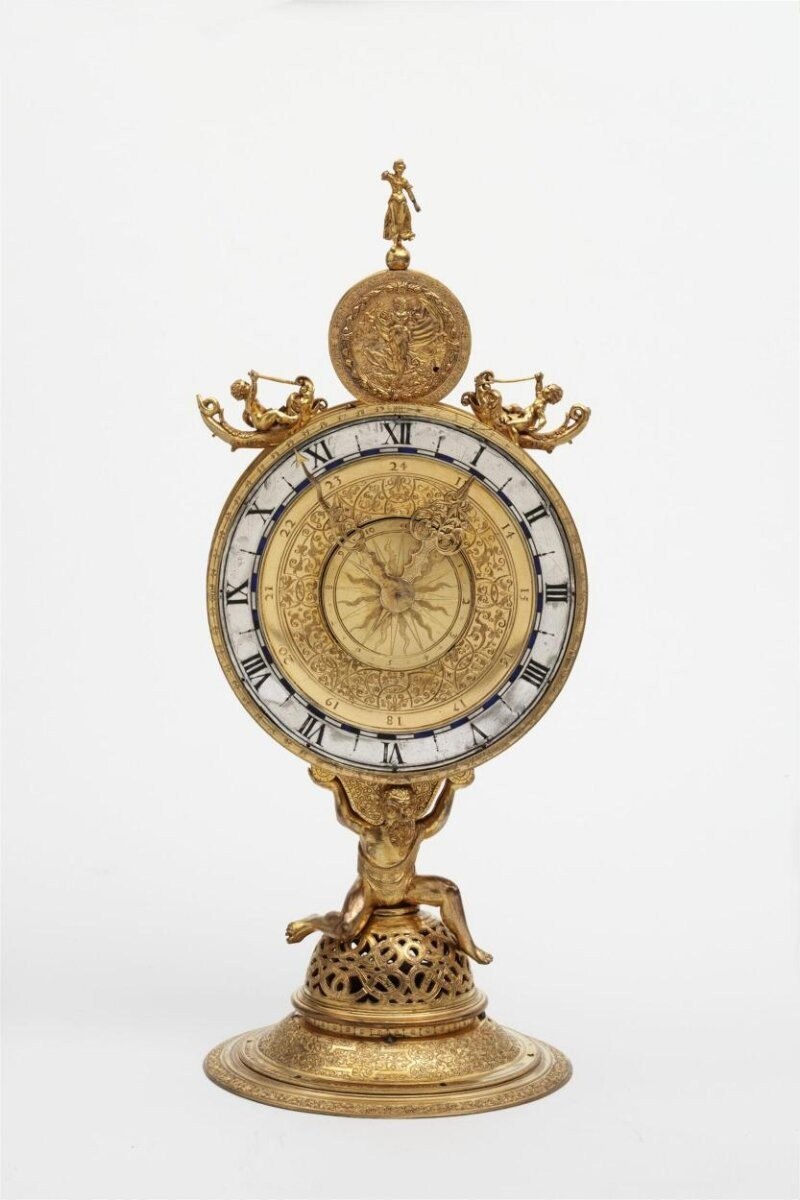
This upright chiming table clock is of monstrance or mirror form, featuring a circular dial set on a footed base. It was made in 1564 by the Augsburg clockmaker Jeremias Metzger. The construction utilizes gilt brass, silver, and enamel. The clock is supported by a figure of Atlas sitting on a dome-shaped, pierced casing that encloses a bell mechanism. The dial ring is made of enamelled silver. The case incorporates intricate chased decoration, including a triumphal procession on the sides, a draped female form on the front, and a figure of Justice on the back, framed by borders with foliate and animal patterns. Two cast putti riding dolphins are situated on the upper shoulders of the case. The movement is contained within a circular housing, and the current back of the clock is noted as being modern.

Front view of the gilt-brass monstrance clock showing the dial and the supporting figure of Atlas.
Front view of the gilt-brass monstrance clock showing the dial and the supporting figure of Atlas. — Victoria and Albert Museum. Rights pending — permission not yet requested. Original source

Catalogue identity

Source
collections.vam.ac.uk
Category
Clock · Monstrance clock
Maker / attribution
Jeremias Metzger
Reference
Not recorded
Catalogue / lot identifier
4273-1857
Source-reported date
1564
Source-reported place
Germany

Source-reported attribution and specifications are not independent authentication. A listing does not establish present ownership, current display, availability or permission to reproduce.

Object description

Case Design and Construction

The clock is constructed in a vertical format known as a monstrance or mirror clock. It features a circular base that rises into a curved section, topped by a dome that houses a bell. A figure of Atlas provides the support for the main clock housing. The recessed sides of the case are decorated with a chased triumphal procession.

The front and back of the clock are highly ornamented. The front dial ring is silver with enamel. The front of the case features a chased image of a draped female figure standing on a fish, while the reverse side depicts a chased figure of Justice holding a sword and scales. The border surrounding the back figure incorporates an array of creature motifs, including an owl, a unicorn, and an eagle.

Evidence for this section
  • “An upright chiming table clock of monstrance (or mirror) form.”
  • “The recessed flat sides of the clock case are finely chased with a triumphal procession.”
  • “The back features a chased figure of a draped Justice holding a sword and scales”

Signatures and Attribution

The clock is signed by Jeremias Metzger, who was based in Augsburg and active during the mid-16th century. His signature is inscribed clearly, including his location and the year of production. This signature is found on the instrument, verifying his role as the maker of the mechanism.

The gilt-brass casing was a specialized component that would have been fabricated by a professional goldsmith or bronze-maker, consistent with the practices of the period.

Evidence for this section
  • “'IEREMIAS.METZGER.VHRMACHER.15.64. IN AVGSPVRG'”
  • “The gilt-brass case would have been supplied by a goldsmith or bronze-maker.”

Historical Context

Clocks of this form were often intended for inclusion in Scientifica, which were collections gathered by elite individuals to exhibit an appreciation for the sciences, mathematics, and the arts. These objects functioned as status symbols and treasury items rather than purely for timekeeping purposes.

The back of the current clock is documented as being a later, modern replacement.

Evidence for this section
  • “Clocks such as this were housed alongside automatons and scientific instruments such as astrolabes and sundials in Scientifica”
  • “The Museum bought this clock in 1857 for £30.”
  • “The back is modern.”

Open research questions

  • What is the full extent of the modern restoration to the back of the case?
  • Can the identity of the goldsmith who collaborated with Metzger on the case be established through style comparisons?

Source evidence

Recorded claims and source quotations for Monstrance Clock by Jeremias Metzger
FieldSource-reported valueSource quotation
MakerJeremias Metzger“signed by Jeremias Metzger”
OriginAugsburg, Germany“Augsburg, southern Germany”
Date1564“dated 1564”
MaterialsGilt brass, silver, enamel“gilt brass with enamelled silver dial ring”
Accession Number4273-1857“Accession number: 4273-1857”

Visible details

  • A central figure of Atlas supports the circular clock housing.
  • The front dial features an inner chapter ring for 24 hours.
  • Pierced and engraved base details include foliate and creature patterns.
  • Putti figures mounted on dolphins decorate the case shoulders.

Research qualifications

  • The back panel of the clock case is identified as a modern replacement.
  • The attribution of the case design to Metzger is questioned, with suggestions that external goldsmiths supplied the gilt-brass work.

Photograph identity and source facts were screened before import; rights clearance remains pending.

Terms in this record

Glossary explanations for terms named in this object’s record.