
Skip to content
The Encyclopedia of Horology

Marine chronometer · Deck chronometer with split-seconds chronograph

Longines L'Heure de l'Observatoire Deck Chronometer

Partially verified

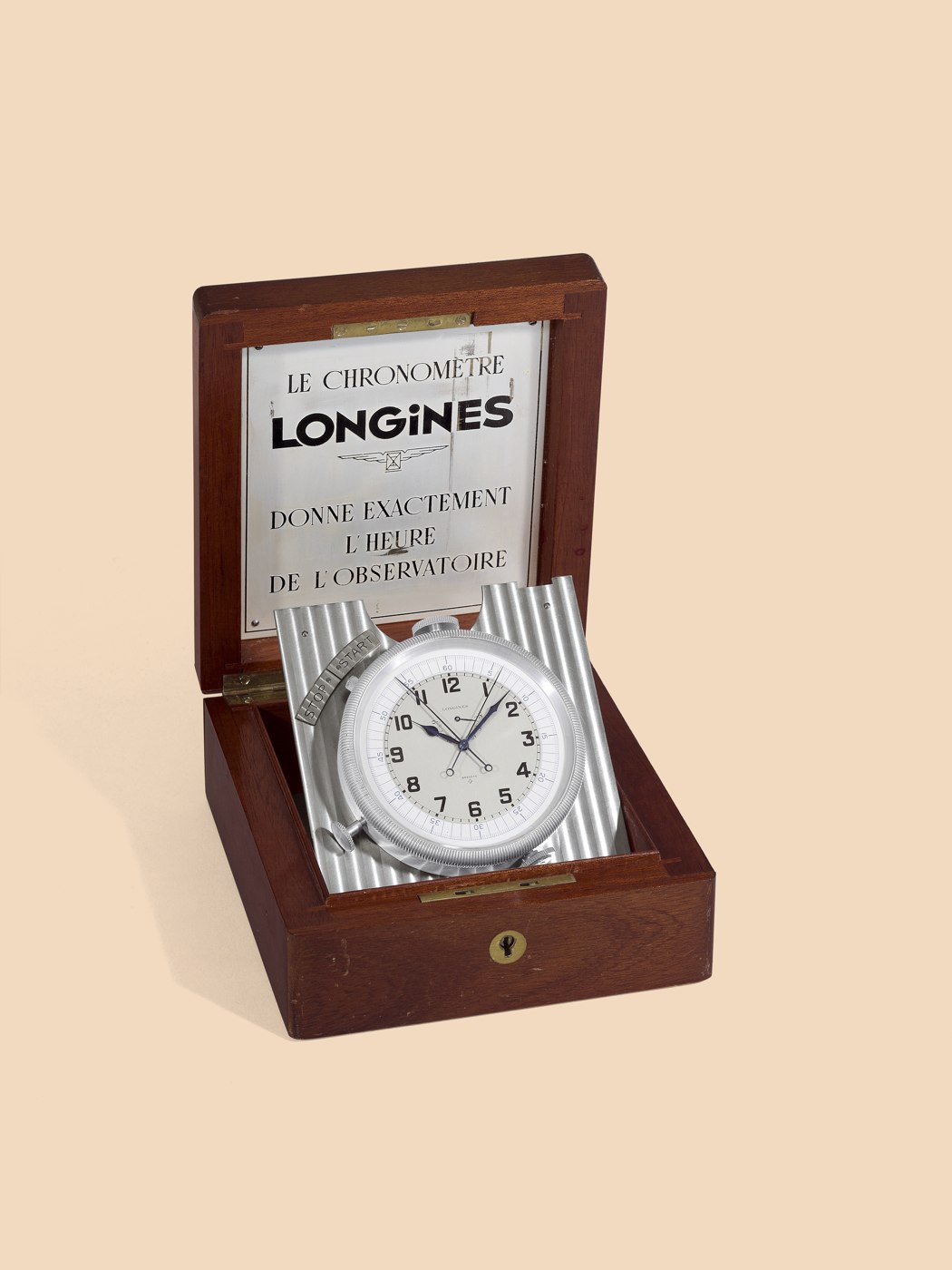
This Longines L'Heure de l'Observatoire is a deck chronometer dating to circa 1935. It features a split-seconds chronograph and a 36-hour power reserve indicator. The timepiece is notable for its specialized mechanism, which includes a revolving disc on the outer dial that allows for time synchronization to within a fraction of a second against an external signal. The watch is housed in an aluminium case with a reeded bezel and is mounted within a mahogany presentation box featuring an interior plaque describing its function. It is powered by the rhodium-plated Calibre 2129 movement, which incorporates 26 jewels, a monometallic balance, and a gold pallet fork. The watch remains in good condition, as reported by the auction description, and is accompanied by its original mahogany box.

Longines L'Heure de l'Observatoire deck chronometer in its fitted mahogany box, circa 1935.
Longines L'Heure de l'Observatoire deck chronometer in its fitted mahogany box, circa 1935. — Antiquorum. Rights pending — permission not yet requested. Original source

Catalogue identity

Source
catalog.antiquorum.swiss
Category
Marine chronometer · Deck chronometer with split-seconds chronograph
Maker / attribution
Longines
Reference
Not recorded
Catalogue / lot identifier
381
Source-reported date
circa 1935
Source-reported place
Switzerland
Source-reported serial
7513094

Source-reported attribution and specifications are not independent authentication. A listing does not establish present ownership, current display, availability or permission to reproduce.

Object description

Case and Dial Design

The chronometer is housed in a two-body mahogany box with a hinged lid. The interior of the box features an inscribed plaque that reads 'Le Chronometre Longines Donne Exactement L'Heure de L'Observatoire'. The watch itself is contained within an aluminium case that features a reeded bezel and side-mounted buttons for controlling the chronograph functions.

The brushed silver dial displays black Arabic numerals and a power reserve sector. A key feature is the outermost revolving chronograph ring, which is painted with blue second and fifth-of-a-second divisions alongside Arabic five-second numerals. The dial is equipped with blued steel spade hands to ensure legibility against the silver background.

Evidence for this section
  • “C. Aluminium with reeded bezel, buttons on the band for stop/ start, the split seconds, and revolving the chronograph scale, mounted in a two-body mahogany box with hinged lid”

Movement and Chronometer Mechanism

The watch is powered by the rhodium-plated Calibre 2129, a movement featuring fausses côtes decoration. It utilizes a straight-line lever escapement with a gold pallet fork, a monometallic balance, and a blued steel Breguet balance spring fitted with a micrometric regulator. The construction of the aluminium case, balance, and pallet fork is noted for providing antimagnetic properties to the device.

The split-seconds chronograph includes visible work. The watch provides a 36-hour power reserve and includes a special device to facilitate precise time synchronization. The user stops the split-seconds hand at an hour signal and adjusts the revolving chronograph ring so that the '60' division aligns with the hand, subsequently releasing it to synchronize the time to a fraction of a second.

Evidence for this section
  • “M. Cal. 2129, 19???, rhodium-plated, "fausses côtes" decoration, 26 jewels, straightline lever escapement with gold pallet fork, monometallic balance”
  • “The aluminium case, monometallic balance and gold pallet fork make the watch antimagnetic.”

Documentation and Attribution

This specific timepiece is attributed to Longines and is identified by the serial number 7513094, manufactured circa 1935. The object, dial, box, and movement are signed by the manufacturer.

The chronometer is documented in literature regarding historical timing instruments. Specifically, it is described and illustrated in the 1948 publication 'L'Horlogerie - Une Tradition Helvétique' by Samuel Guye, within the chapter concerning onboard chronometers for automobiles and aircraft.

Evidence for this section
  • “Made circa 1935.”
  • “This type of chronometer is described and illustrated in ?L'Horlogerie - Une Tradition Helvétique?, Samuel Guye, 1948, chapter: Les montres de bord pour automobiles et avions, p. 202.”

Open research questions

  • What is the specific production volume of the L'Heure de l'Observatoire model?
  • Are there variations in the mahogany box interior plaque text across different production batches?

Source evidence

Recorded claims and source quotations for Longines L'Heure de l'Observatoire Deck Chronometer
FieldSource-reported valueSource quotation
MakerLongines“Longines, Swiss, No. 7513094.”
Case MaterialAluminium“Aluminium with reeded bezel”
Calibre2129“M. Cal. 2129”
Jewel Count26“26 jewels”
Dial Diameter70 mm“Dial diam. 70 mm”
FunctionsSplit seconds chronograph and power reserve“split seconds chronograph, 36-hour power reserve indication”
Box Dimensions16 x 14 x 6 cm“Box dim. 16 x 14 x 6 cm”

Visible details

  • Reeded bezel on the aluminium watch case
  • Interior mahogany box plaque text
  • Power reserve sector on the dial
  • Visible split-seconds function

Research qualifications

  • Movement is stated to require an overhaul
  • Revolving ring mechanism operation assumes active user interaction

Photograph identity and source facts were screened before import; rights clearance remains pending.