
Skip to content
The Encyclopedia of Horology

Clock · Longcase clock

Longcase clock

Partially verified

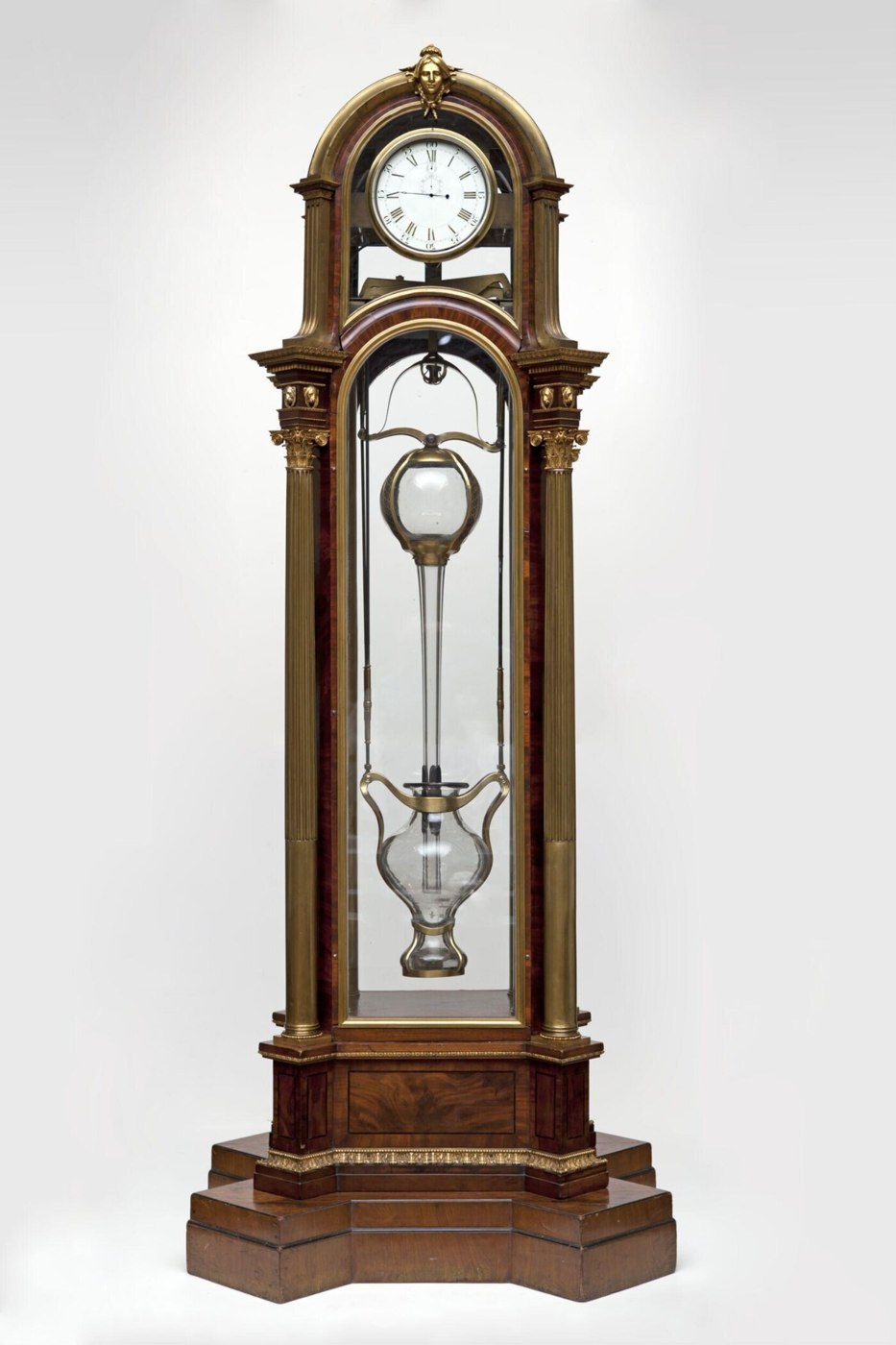
This longcase clock, dating to approximately 1760, was created by James Cox with later modifications attributed to Thomas Weeks. The clock is housed in a mahogany case with ormolu mounts, featuring glass panels on all four sides to expose the movement and barometer mechanism. The hood is topped with arched glazing and adorned with brass Corinthian columns and gilded lion’s head mounts. The clock operates via a dead-beat escapement and a bar-balance. It is powered by a unique atmospheric pressure-driven mechanism, utilizing approximately 68 kilograms of mercury contained within a barometer bowl and tube system. This arrangement drives the clock continuously. The object is inscribed "Weeks Royal Museum 1806" on the brass straps holding the barometer bowl. The clock was formerly part of Cox's Mechanical Museum in London and represents an attempt to create a perpetual motion timekeeper, later modified during its residency in Thomas Weeks's Royal Mechanical Museum between 1796 and 1837.

Full view of the longcase clock showing the mahogany casing, glass panels, and internal mercury barometer mechanism.
Full view of the longcase clock showing the mahogany casing, glass panels, and internal mercury barometer mechanism. — Victoria and Albert Museum, London. Rights pending — permission not yet requested. Original source

Catalogue identity

Source
collections.vam.ac.uk
Category
Clock · Longcase clock
Maker / attribution
James Cox
Reference
Not recorded
Catalogue / lot identifier
W.20:1 to 3-1961
Source-reported date
ca. 1760
Source-reported place
London

Source-reported attribution and specifications are not independent authentication. A listing does not establish present ownership, current display, availability or permission to reproduce.

Object description

Case Construction and Design

The clock is contained within a mahogany case designed with full-length glass panels on all four sides, allowing for visibility of the internal mechanism. The structure is divided into two sections, with the dial and movement located in the upper hood and the remainder of the case housing the barometer apparatus. The base is constructed as a rectangular plinth.

Ornamentation includes gilded brass Corinthian columns at the four projecting corners, topped by lion's head mounts. The hood and the glass panels beneath the dial are arched. A gilded brass frieze surrounds the base. The top of the hood is decorated with female masks in gilded brass, though historical records indicate the top ornament has been altered from its original 18th-century appearance.

Evidence for this section
  • “The clock is contained in a large mahogany case that is glazed on all four sides.”
  • “The four projecting corners of the case are adorned with brass Corinthian columns.”
  • “Around the bottom of the case is a gilded brass frieze.”
  • “The heads of the hood arches at front and rear are mounted with female masks in gilded brass.”

Mechanism and Operation

The movement features a dead-beat escapement and a bar-balance, beating 30 times per minute. It is powered by a weight system connected to an endless chain loop. The winding energy is supplied by a barometer integrated into the lower section of the case.

This barometer relies on changes in atmospheric pressure to move mercury between a tube and a bowl, causing the tube to rise and fall. This movement is transmitted via a rod to a series of wheels that drive the clock, intended to maintain continuous operation. The system requires approximately 150 pounds of mercury.

Evidence for this section
  • “The movement has a dead-beat escapement and a bar-balance beating 30 to the minute.”
  • “The barometer tube and bowl are suspended from opposite ends of rocking levers.”
  • “As atmospheric pressure changes, mercury moves between these vessels.”
  • “This required at least one hundred and fifty pounds (about 68 kg) of mercury.”

Provenance and Display History

It was a key exhibit in Cox's Mechanical Museum at Charing Cross from 1768 until 1774. Following the dispersal of the museum by lottery, it was later displayed at Thomas Weeks's Royal Mechanical Museum in Titchbourne Street from 1796 to 1837.

Following a period of unknown location, the clock was recorded in 1898 at the Clerkenwell Institute as the property of W.F.B. Massey-Mainwaring. It was later acquired by a private owner, exhibited in Edinburgh, and subsequently sold at auction to Messrs Blairman. The Victoria and Albert Museum purchased the clock from Blairman and Sons in 1961 with the assistance of the National Art Collections Fund. The clock was produced in the 1760s by James Cox with assistance from Joseph Merlin.

Evidence for this section
  • “From 1768 to 1774 the clock was exhibited in Cox's own museum of automata in Charing Cross, London.”
  • “In 1921 the clock was bought by a Mr. R.G. Carruthers in Edinburgh and placed by him on loan in the Laing Gallery, Newcastle on Tyne.”

Open research questions

  • What specific alterations were performed by Thomas Weeks beyond the addition of the 1806 brass straps?
  • Are there further archival records to bridge the gap in the clock's provenance between 1837 and 1898?

Source evidence

Recorded claims and source quotations for Longcase clock
FieldSource-reported valueSource quotation
MakerJames Cox; modifications by Thomas Weeks“Made by James Cox, London, in about 1760 with later modifications by Thomas Weeks.”
Dateca. 1760“Date: ca. 1760”
Dimensions258 cm H x 104 cm W x 84.5 cm D“Height: 258 cm; Width: 104 cm; Depth: 84.5 cm”
MechanismAtmospheric pressure-driven perpetual motion“The clock's mechanism used the difference in atmospheric pressure between two jars of mercury to achieve a perpetual motion.”
InscriptionWeeks Royal Museum 1806“Inscribed 'Weeks Royal Museum 1806'”
EscapementDead-beat“The movement has a dead-beat escapement and a bar-balance beating 30 to the minute.”

Visible details

  • Mahogany case with four-sided glass panels
  • Gilded brass Corinthian columns at case corners
  • Barometer mercury bowl with engraved straps
  • White enamel dial with Roman numerals

Research qualifications

  • Nature and extent of modifications by Thomas Weeks are not fully itemized
  • Exact historical gap between 1837 and 1898 is documented
  • Original top ornament configuration differs from 1796 engraving

Photograph identity and source facts were screened before import; rights clearance remains pending.

Consulted source

Longcase clock

Reviewed 2026-10-26 · Record f72c2d740f

Terms in this record

Glossary explanations for terms named in this object’s record.