
Skip to content
The Encyclopedia of Horology

Clock · Longcase clock

Longcase clock by Matthew and Thomas Dutton, no. 239

Partially verified

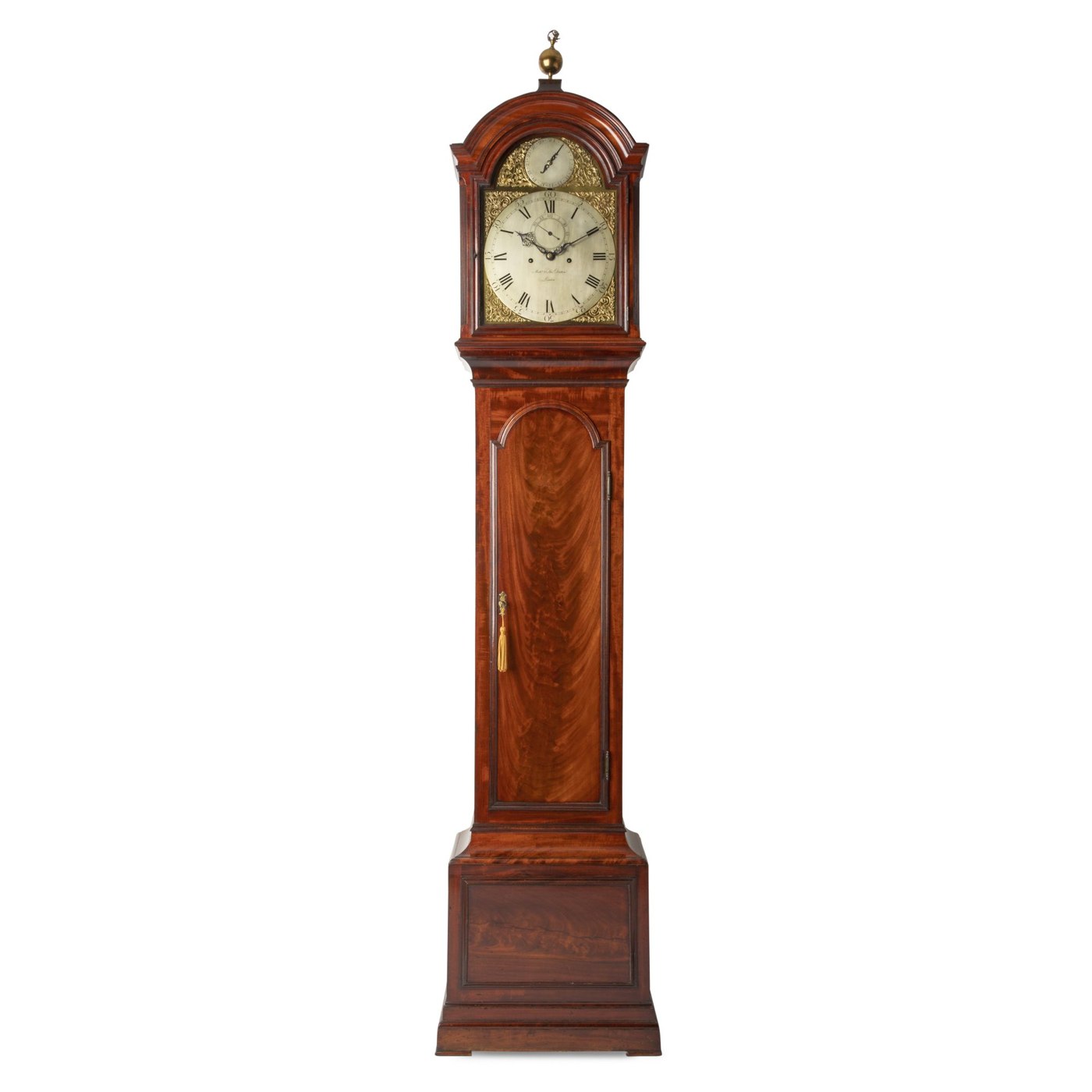
This 8-day longcase clock is attributed to the London-based makers Matthew and Thomas Dutton, numbered 239. The mahogany case features a break arch hood with a moulded door, flanked by fluted, reeded, and canted corners, and is topped by a four-sided concave pedestal with a brass ball and flame finial. The trunk door and the base panel utilize flame veneers, with the base sitting on a double plinth. The 12-inch brass break arch dial includes pierced foliate spandrels, a silvered chapter ring with a large seconds dial, and a subsidiary calendar dial in the arch. The clock is signed "Mattw. & Thos. Dutton, London" and retains its original blued steel hands. Its 8-day movement features thick plates, five baluster pillars, an anchor escapement, and an iron-rod pendulum with T-bar suspension and a heavy lenticular brass-faced bob, striking the hours on a bell.

Longcase clock by Matthew and Thomas Dutton with flame mahogany case and brass dial.
Longcase clock by Matthew and Thomas Dutton with flame mahogany case and brass dial. — Dorset Antique Clocks. Rights pending — permission not yet requested. Original source

Catalogue identity

Source
www.dorsetantiqueclocks.co.uk
Category
Clock · Longcase clock
Maker / attribution
Matthew and Thomas Dutton
Reference
Not recorded
Catalogue / lot identifier
Source URL identifies the listing
Source-reported date
circa 1790
Source-reported place
England
Source-reported serial
239

Source-reported attribution and specifications are not independent authentication. A listing does not establish present ownership, current display, availability or permission to reproduce.

Object description

Case and Dial

The mahogany clock case is constructed with a break arch hood, which includes a moulded door flanked by fluted, reeded, and canted corner details. The hood is completed by a four-sided concave pedestal supporting a brass ball and flame finial. The trunk contains a break arch door decorated with flame veneers, which are repeated on the raised panel of the base, the whole resting on a double plinth.

The 12-inch brass dial is designed with a break arch and features pierced foliate spandrels at the corners. The silvered chapter ring includes a large seconds dial, and the maker's signature is engraved on the dial face. A subsidiary calendar dial is positioned within the arch, and the clock retains its original blued steel hands.

Evidence for this section
  • “moulded hood door flanked by fluted, reeded and canted corners”
  • “four sided concave pedestal with a brass ball and flame finial”
  • “break arch trunk door with flame veneers matches the raised panel to the base”
  • “12-inch break arch brass dial with subsidiary calendar dial to the arch”

Movement and Pendulum

The clock is powered by a substantial 8-day movement. It is constructed with thick plates and five baluster pillars. The timekeeping is regulated by an anchor escapement.

The pendulum is composed of an iron rod with T-bar suspension, attached to a large backcock. It features a heavy lenticular brass-faced bob. The clock strikes the hours on a bell.

Evidence for this section
  • “substantial 8-day movement with thick plates, five baluster pillars, anchor escapement”
  • “large backcock for the iron-rod pendulum with T-bar suspension and heavy lenticular brass-faced bob”
  • “Striking the hours on bell”

History and Attribution

The movement and dial bear the signature of Matthew and Thomas Dutton, who were the sons of William Dutton. William Dutton was a former business partner of Thomas Mudge. The workshop of Matthew and Thomas Dutton was located at No. 148 Fleet Street, London.

The provenance of this piece is listed as a private collection in the United Kingdom.

Evidence for this section
  • “Matthew & Thomas Dutton were the sons of William Dutton”
  • “working from No.148 Fleet Street”
  • “utilised the skills attained in the Tompion and Graham era”
  • “Provenance: Private collection – U.K.”

Open research questions

  • Does the movement contain any hidden maker's marks or stamps besides the dial signature?
  • Are there any signs of later modification to the dial or spandrels consistent with Georgian-era refurbishments?

Source evidence

Recorded claims and source quotations for Longcase clock by Matthew and Thomas Dutton, no. 239
FieldSource-reported valueSource quotation
MakerMatthew and Thomas Dutton“Mattw. & Thos. Dutton, London”
Serial Number239“numbered 239”
Datecirca 1790“CIRCA. 1790”
Case MaterialMahogany with flame veneers“mahogany break arch case”
Movement8-day duration“substantial 8-day movement”
Dial Diameter12-inch“12-inch break arch brass dial”
PendulumIron-rod with brass-faced bob“iron-rod pendulum with T-bar suspension and heavy lenticular brass-faced bob”
ProvenancePrivate collection, UK“Provenance: Private collection – U.K.”

Visible details

  • Brass ball and flame finial atop the hood
  • Flame veneer pattern on the trunk door
  • Pierced foliate spandrels on the dial corners
  • Silvered subsidiary calendar dial in the arch

Research qualifications

  • Movement condition is subject to restoration process
  • Precise dating is approximated as circa 1790

Photograph identity and source facts were screened before import; rights clearance remains pending.

Consulted source

A FINE MAHOGANY 8-DAY LONGCASE CLOCK BY MATTHEW AND THOMAS DUTTON NO.239

Reviewed 2026-11-02 · Record 60e13ca99e

Terms in this record

Glossary explanations for terms named in this object’s record.