
Skip to content
The Encyclopedia of Horology

Clock · Longcase clock

Longcase clock by John Fromanteel

Partially verified

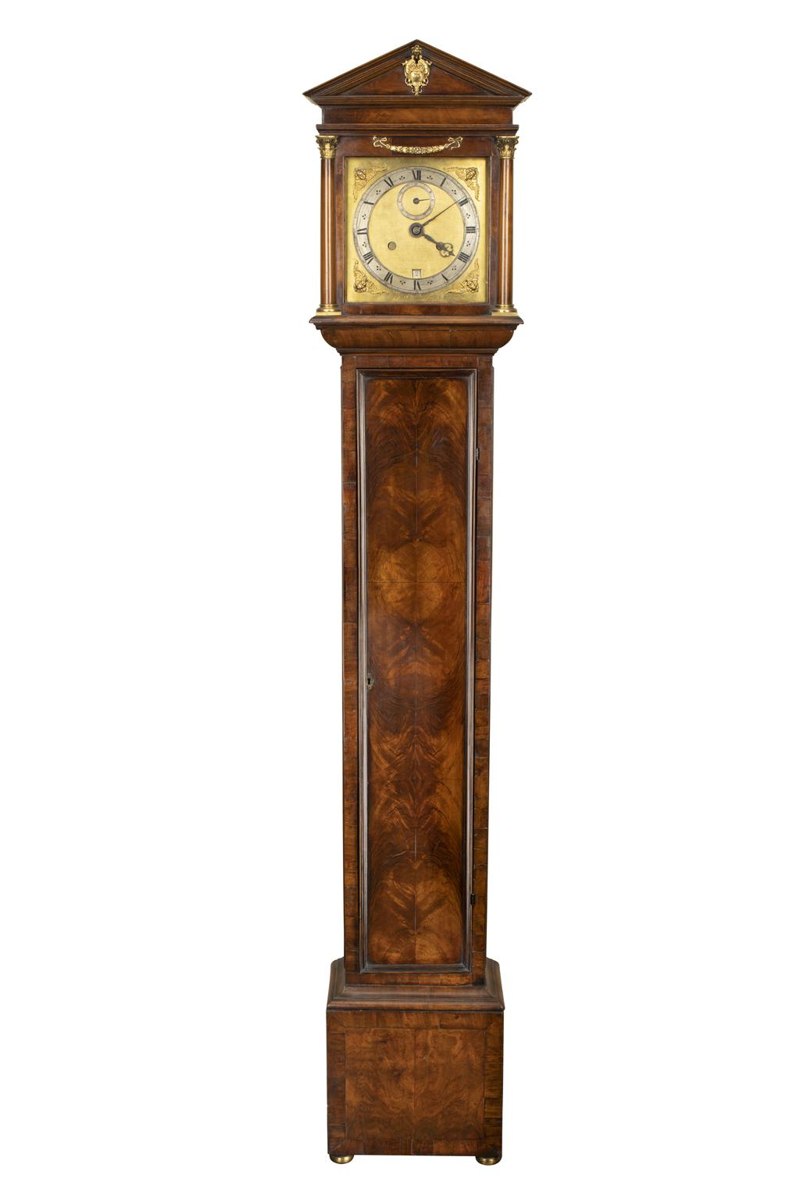
This English longcase clock by John Fromanteel was made in London circa 1665–1670 (dated circa 1668 by the museum) and is housed in a 20th-century reproduction wooden case. The square brass dial features a matted center, silvered chapter ring, subsidiary seconds dial, calendar aperture, maintaining power shutters, and cherub head spandrels in each corner. It is signed 'Johannes Fromanteel Londini' below the chapter ring. The movement features an eight-day duration, bolt-and-shutter maintaining power, latched plates, and an internal count wheel. Originally constructed with an experimental cross-beat escapement, it was later converted to an anchor escapement.

Longcase clock by John Fromanteel in a 20th-century reproduction case, Science Museum Group
Longcase clock by John Fromanteel in a 20th-century reproduction case, Science Museum Group — Science Museum Group/The Clockmakers' Museum. Rights pending — permission not yet requested. Original source

Catalogue identity

Source
collection.sciencemuseumgroup.org.uk
Category
Clock · Longcase clock
Maker / attribution
John Fromanteel
Reference
Clockmakers' Museum No. 1287
Catalogue / lot identifier
L2015-4198
Source-reported date
1665-1670
Country
United Kingdom

Source-reported attribution and specifications are not independent authentication. A listing does not establish present ownership, current display, availability or permission to reproduce.

Object description

Dial and Inscriptions

The clock has a square brass dial with a matted center, a calendar aperture, an applied silvered chapter ring, a subsidiary seconds dial, and cherub spandrels at each corner. Winding holes feature maintaining power shutters, and the hands are pierced steel hour and minute hands.

The plate is signed under the chapter ring at the base of the dial 'Johannes Fromanteel Londini'.

Evidence for this section
  • “The square brass dial has a matted centre with a calendar aperture and winding holes with maintaining power shutters, an applied silvered chapter-ring, a subsidiary seconds dial, and cherub spandrels in each corner.”
  • “Signed under the chapter ring at the base of the dial 'Johannes Fromanteel Londini'.”
  • “Pierced steel hour and minute hand.”

Movement and Escapement History

The movement is recorded with an 8-day duration, bolt-and-shutter maintaining power, latched plates, and a striking train with a count wheel on the inside of the movement. Internal movement components are not visible in the provided exterior photograph.

According to the source documentation, the clock was originally fitted with an experimental cross-beat escapement, which was used by a group of London clockmakers seeking to apply long pendulums to clockwork. It was later upgraded to an anchor escapement.

Evidence for this section
  • “The movement has an anchor escapement, bolt-and-shutter maintaining power, latched plates, and a striking train with a count wheel on the inside of the movement.”
  • “The clock was originally fitted with a ‘cross-beat’ escapement.”
  • “8-day duration.”
  • “The experimental cross-beat escapement was used by a group of London clockmakers in an attempt to apply long pendulums to clockwork. Most cross-beat clocks were later upgraded.”

Case and Physical Housing

Exterior observation reveals a full-height standing wooden longcase clock with figured bookmatched veneer on the trunk door. The architectural hood features a triangular pediment with applied gilt cresting, and classical columns with Corinthian-style capital mounts flank the glazed dial door.

The source documents that the movement and dial are housed in a 20th-century reproduction case rather than an original 17th-century case.

Evidence for this section
  • “Full-height standing wooden longcase clock featuring figured bookmatched veneer on the trunk door.”
  • “Architectural hood topped with a triangular pediment and an applied gilt cresting.”
  • “Hood glazed dial door flanked by classical columns with Corinthian-style capital mounts.”
  • “in a 20th century reproduction case”

Open research questions

  • What physical marks or unpopulated holes remain on the movement plates documenting the original cross-beat escapement geometry prior to the anchor conversion?
  • Is there recorded documentation regarding the maker, date, or commissioner of the 20th-century reproduction case?
  • What specific wood species was identified for the trunk door veneers and case structure?

Source evidence

Recorded claims and source quotations for Longcase clock by John Fromanteel
FieldSource-reported valueSource quotation
MakerJohn Fromanteel“maker: John Fromanteel”
Date range1665-1670“Made: 1665-1670 in London”
Museum Object NumberL2015-4198“Object Number: L2015-4198”
Case construction20th-century reproduction case“in a 20th century reproduction case”
Movement duration8-day duration“8-day duration.”
Escapement historyOriginally fitted with a cross-beat escapement“The clock was originally fitted with a ‘cross-beat’ escapement.”
Dial signatureJohannes Fromanteel Londini“Signed under the chapter ring at the base of the dial 'Johannes Fromanteel Londini'.”
Museum Reference NumberClockmakers' Museum No. 1287“Clockmakers' Museum No. 1287”
Collection SourceLent by the Worshipful Company of Clockmakers“credit: Lent by the Worshipful Company of Clockmakers”
Recorded MaterialsBrass (copper, zinc alloy), steel (metal), lead (metal), wood (unidentified), and glass“Materials: brass (copper, zinc alloy) , steel (metal) , lead (metal) , wood (unidentified) and glass”

Visible details

  • Full-height standing wooden longcase clock featuring figured bookmatched veneer on the trunk door.
  • Architectural hood topped with a triangular pediment and an applied gilt cresting.
  • Hood glazed dial door flanked by classical columns with Corinthian-style capital mounts.
  • Square brass dial with applied silvered chapter ring and gilt cherub spandrels in the four corners.

Research qualifications

  • The wooden case is a 20th-century reproduction rather than the original 17th-century housing.
  • Movement mechanisms, latched plates, and escapement conversion components are internal and not visible in the provided exterior photograph.

Photograph identity and source facts were screened before import; rights clearance remains pending.