
Skip to content
The Encyclopedia of Horology

Clock · Longcase clock

Longcase clock by Frans Jullion

Partially verified

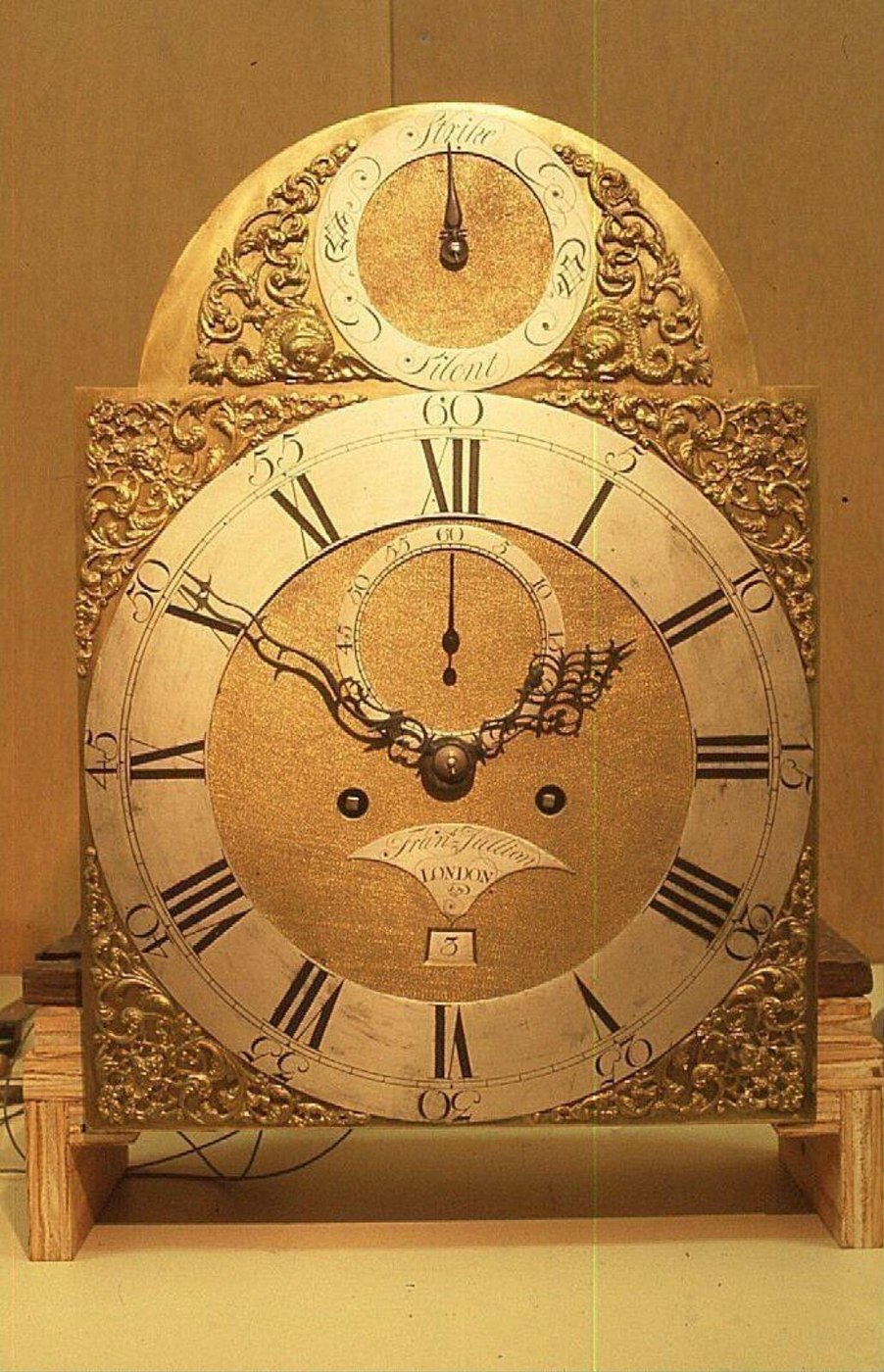
This longcase clock, attributed to the maker Frans Jullion of London and dated between 1775 and 1785, is constructed from an oak carcass veneered with burr walnut. The clock features an arched dial, measuring 16 inches in total height, with a matted central portion. It incorporates a silvered brass chapter ring with Roman numerals and Arabic minute markers at five-minute intervals. The dial includes a subsidiary seconds ring and a rectangular calendar aperture below the maker's signature on a silvered plaque. The movement is weight-driven and brass-framed, providing eight-day hour striking with a recoil escapement and pendulum regulation. While the clock currently features a pagoda-topped hood with brass ball and spire finials, observations suggest historical modifications, including missing parts of the original Strike/Silent mechanism and various vacant holes indicating past alterations to the movement and hammer assembly.

Front view of the clock dial, showing the matted centre, calendar aperture, Strike/Silent arch, and chapter ring.
Front view of the clock dial, showing the matted centre, calendar aperture, Strike/Silent arch, and chapter ring. — Victoria and Albert Museum, London. Rights pending — permission not yet requested. Original source

Catalogue identity

Source
collections.vam.ac.uk
Category
Clock · Longcase clock
Maker / attribution
Frans Jullion
Reference
W.21:1to:5-1946
Catalogue / lot identifier
W.21:1to:5-1946
Source-reported date
1775-1785
Source-reported place
London

Source-reported attribution and specifications are not independent authentication. A listing does not establish present ownership, current display, availability or permission to reproduce.

Object description

Dial and Case Construction

The clock is housed in an oak carcass fully veneered with burr walnut. The design features a break-arched trunk door with a moulded border and a pagoda-style top to the hood, which is adorned with brass ball and spire finials. The hood contains rectangular glazed side panels and is flanked by free-standing, fluted, brass-capped columns.

The brass dial plate is break-arched and features a matted centre. A silvered chapter ring is pinned to the dial, displaying Roman hour numerals and Arabic numerals for five-minute intervals. The arch of the dial contains a Strike/Silent scale, though the necessary hand and operating mechanism are absent from the clock.

Evidence for this section
  • “Longcase clock of oak veneered with burr walnut, with brass mounts”
  • “Pagoda top to hood with blind wood fret at its centre”
  • “In the break-arch, a silvered brass ring bearing engraved designs and Strike / Silent is flanked by arch dolphin spandrels”

Movement and Escapement

The weight-driven, eight-day movement is constructed from brass and steel with five pillars featuring central knops, riveted to the backplate. It utilizes a recoil escapement for pendulum regulation and manages hour striking via a rack and snail system. The train wheels are designed with four semicircular crossings, and the centre wheel features crossings secured by lead soldering.

Evidence of historical servicing or modification is visible throughout the movement. Multiple vacant holes are present on the front and back plates, and the backcock shows elongated locating holes. These indicators suggest that the pallet arbor has been repositioned or that other mechanical adjustments were performed during the clock's service life.

Evidence for this section
  • “Five pillars each with a central knop”
  • “with recoil escapement, pendulum regulated”
  • “The vacant holes are indicative of modifications to the movement”

Provenance and Documentation

The object is recorded in the museum collection under the accession number W.21:1to:5-1946. It was acquired as a bequest from the Reverend E.G. Winstanley. Research notes provided by Francis Brodie date the clock to the latter half of the eighteenth century, suggesting the case design reflects a late example of a walnut clock following mahogany aesthetic trends.

The name of the maker, Frans Jullion, is engraved upon a silvered plaque situated at the lower centre of the dial. Although biographical data on Jullion is limited, existing records place his activity in London around 1780. The physical condition reflects standard eighteenth-century manufacture with later repairs to the wheelwork and mechanical configurations.

Evidence for this section
  • “Bequeathed by the Reverend E G Winstanley (RP 138/1946)”
  • “Francis Jullion c.1780”
  • “n is interesting in being housed in a walnut case; its style is more commonly associated with mahogany.”

Open research questions

  • What was the exact appearance of the missing Strike/Silent mechanism components?
  • To what extent did nineteenth-century repairs alter the original timekeeping accuracy of the movement?

Source evidence

Recorded claims and source quotations for Longcase clock by Frans Jullion
FieldSource-reported valueSource quotation
MakerFrans Jullion“engraved with the name of the maker, 'Frans Jullion, London'”
Date1775-1785“1775-1785”
MaterialOak and walnut“Longcase clock of oak veneered with burr walnut”
Dial height16 inches“total height 16 inches”
EscapementRecoil“with recoil escapement”
Movement type8-day duration“hour striking of 8-day duration”
Accession numberW.21:1to:5-1946“Accession number: W.21:1to:5-1946”

Visible details

  • Silvered chapter ring with Roman hour numerals
  • Arched dial with Strike/Silent indicator
  • Pierced steel hour and minute hands
  • Matted central dial portion with calendar aperture

Research qualifications

  • Possible nineteenth-century shape of the pallet frame
  • Missing Strike/Silent mechanism operating hand and associated hardware
  • Presence of multiple vacant holes suggests prior movement modifications

Photograph identity and source facts were screened before import; rights clearance remains pending.

Consulted source

Longcase clock, Frans Jullion, London, 1775-1785

Reviewed 2026-11-02 · Record 5a596057b1

Terms in this record

Glossary explanations for terms named in this object’s record.