
Skip to content
The Encyclopedia of Horology

Clock · Bracket clock

Late Victorian oak-cased triple fusee bracket clock on pedestal

Partially verified

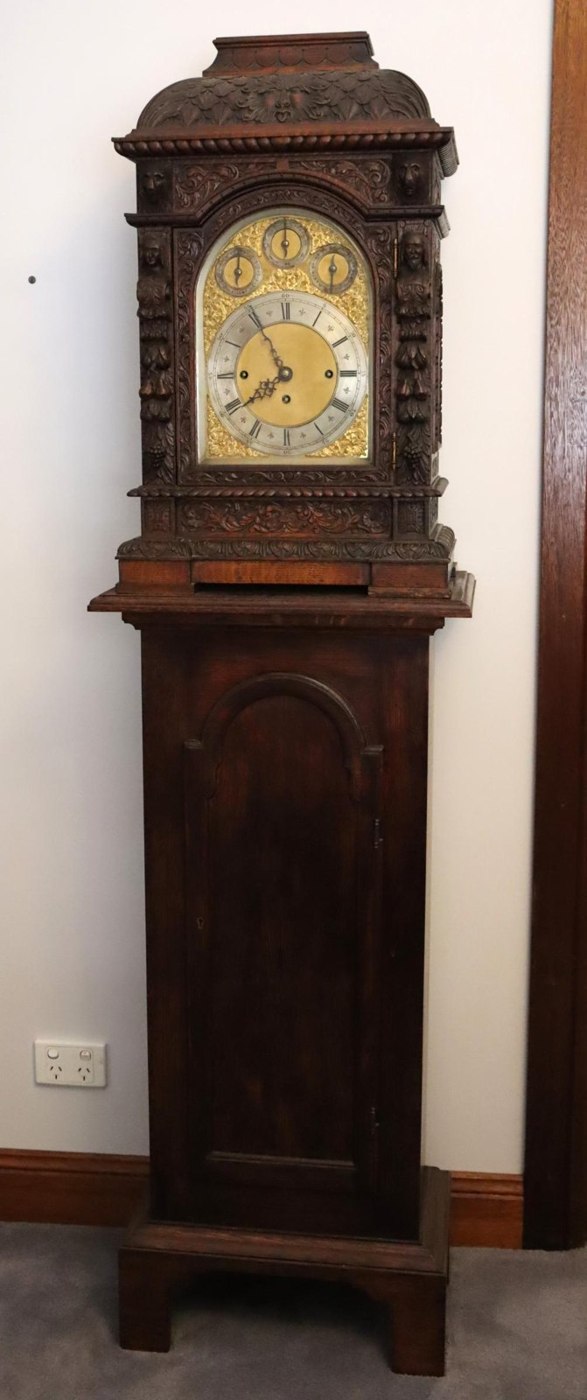
This late Victorian bracket clock is fashioned from oak and features an elaborate case structure on a breakfront base with bracket feet. The clock sits atop a later-manufactured single-door pedestal. The exterior displays extensive relief carvings, including masks, foliage, and herm columns, with sides featuring carved, pierced fretwork panels. The brass arched dial incorporates a silvered chapter ring with Roman numerals and a matte center, flanked by cast gilt scroll spandrels. Three subsidiary dials are positioned for chime/silent, slow/fast, and chime selection. Power is provided by an eight-day triple fusee movement, designed to chime the quarters on a combination of four gongs and eight bells, while striking the hours on a large gong. The clock comes with a pendulum and keys. The clock measures 67cm high by 29.5cm wide and 42cm deep, with the associated pedestal measuring 106cm high.

A late Victorian oak bracket clock and associated pedestal, displaying a carved hood, arched brass dial, and three subsidiary dials.
A late Victorian oak bracket clock and associated pedestal, displaying a carved hood, arched brass dial, and three subsidiary dials. — Vickers & Hoad, via Invaluable. Rights pending — permission not yet requested. Original source

Catalogue identity

Source
orbiscollectibles.com
Category
Clock · Bracket clock
Maker / attribution
Not established
Reference
Not recorded
Catalogue / lot identifier
Source URL identifies the listing
Source-reported date
Late Victorian
Source-reported place
Not established

Source-reported attribution and specifications are not independent authentication. A listing does not establish present ownership, current display, availability or permission to reproduce.

Object description

Case and Aesthetic Features

The clock housing is constructed from oak, characterized by an elaborate design that sits on a breakfront base with bracket feet. The piece is heavily decorated with relief carvings including a mask and foliate scrolls on the top section, lions' masks, and herm columns.

The sides of the case are adorned with carved and pierced mask and scroll fret panels. This clock is supported by a single-door pedestal, which is described as a later addition to the original clock assembly.

Evidence for this section
  • “The clock sits on a breakfront base with bracket feet and is accompanied by a later made single-door pedestal.”
  • “The case is heavily decorated with relief carvings, including a mask and foliate scrolls on the top, lions' masks, and herm columns.”

Dial and Instrumentation

The clock features a brass arched dial with a silvered chapter ring, which displays Roman hour numerals and a matte center. The dial is framed by cast and pierced gilt scroll spandrels.

Functionality is managed through three subsidiary dials located in the arch, which are designated for chime/silent, slow/fast, and chime selection features.

Evidence for this section
  • “The clock features a brass arched dial equipped with a silvered chapter ring displaying Roman hour numerals and a matt center.”
  • “includes three subsidiary dials for chime/silent, slow/fast, and chime selection functions.”

Movement and Functionality

The timekeeping and chime functions are driven by an eight-day triple fusee movement. This mechanism is capable of chiming the quarters on a set of four gongs and eight bells.

Additionally, the movement is configured to strike the hours on a large gong. The clock is accompanied by its necessary pendulum and keys for operation.

Evidence for this section
  • “The clock is powered by an eight-day triple fusee movement designed to chime the quarters on four gongs and eight bells, while striking the hours on a large gong.”
  • “It is supplied with a pendulum and keys.”

Open research questions

  • What is the identification or mark of the clockmaker responsible for the triple fusee movement?
  • At what point was the later pedestal added to the clock assembly?

Source evidence

Recorded claims and source quotations for Late Victorian oak-cased triple fusee bracket clock on pedestal
FieldSource-reported valueSource quotation
Materialoak“constructed from oak”
Movementeight day triple fusee“eight-day triple fusee movement”
Clock Dimensions67cm H x 29.5cm W x 42cm D“67cm high by 29.5cm wide and 42cm deep”
Pedestal Dimensions106cm H“pedestal measuring 106cm high”
Chime mechanismquarters on four gongs and eight bells“chime the quarters on four gongs and eight bells”
Strike mechanismhours on a large gong“striking the hours on a large gong”
Dial featuresthree subsidiary dials“includes three subsidiary dials for chime/silent, slow/fast, and chime selection functions.”

Visible details

  • Cast gilt scroll spandrels on dial
  • Mask and foliate relief carvings
  • Later-made single-door pedestal included
  • Three subsidiary dials in the arch

Research qualifications

  • The maker remains unrecorded
  • The exact age or manufacturer of the pedestal is not specified beyond being 'later made'

Photograph identity and source facts were screened before import; rights clearance remains pending.

Consulted source

Late Victorian oak cased bracket clock with triple fusee movement

Reviewed 2026-11-02 · Record 1ad1cbf319

Terms in this record

Glossary explanations for terms named in this object’s record.