
Skip to content
The Encyclopedia of Horology

Clock · Mantel clock

Late 19th-century French black marble and malachite mantel clock

Partially verified

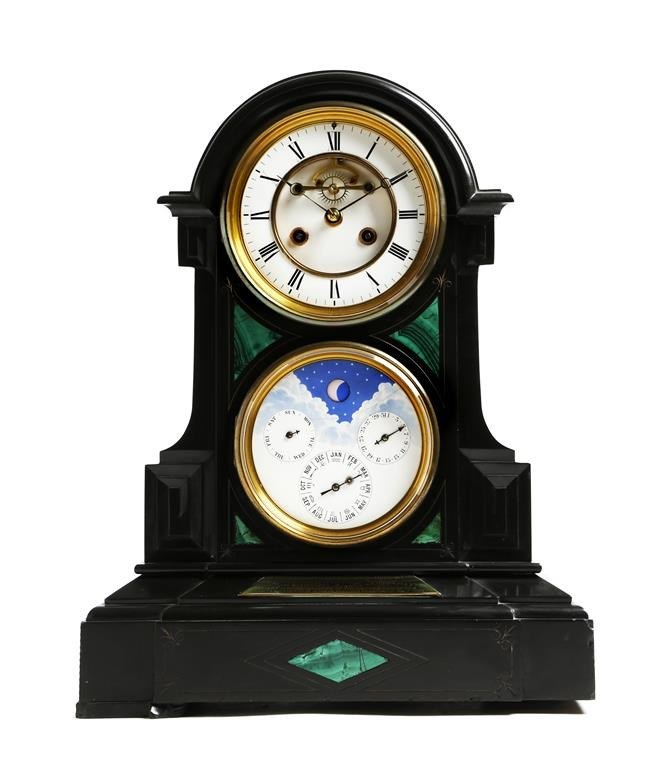
This late 19th-century French mantel clock is constructed in an architectural scroll case made of black marble with inlaid malachite. The source reports an eight-day movement striking on a bell, with the backplate stamped 'G V 30096' (tentatively attributed to Gay Vicarino) and carrying a pastille inscribed 'L. Marti & Cie, MEDAILLE BRONZE'. The upper white enamel dial displays Roman numerals and a visible Brocot escapement set into a recessed center. Beneath it, a secondary calendar dial provides subsidiary day, month, and date indications alongside an aperture for a moonphase against a painted starry sky. An applied brass plaque records a July 1889 retirement presentation to Richard Harding.

Front view of late 19th-century French black marble and malachite mantel clock with visible Brocot escapement and calendar dial
Front view of late 19th-century French black marble and malachite mantel clock with visible Brocot escapement and calendar dial — Woolley and Wallis. Rights pending — permission not yet requested. Original source

Catalogue identity

Source
www.woolleyandwallis.co.uk
Category
Clock · Mantel clock
Maker / attribution
L. Marti & Cie
Reference
Not recorded
Catalogue / lot identifier
252
Source-reported date
late 19th century
Country
France
Source-reported serial
30096

Source-reported attribution and specifications are not independent authentication. A listing does not establish present ownership, current display, availability or permission to reproduce.

Object description

Case Construction and Ornamentation

The clock is housed in an arched architectural case composed of black polished marble. The design incorporates scroll-profile shoulders and a stepped plinth base. Decorative elements include inlaid green malachite, which serves to frame the lower dial aperture and acts as a central lozenge set into the lower base of the clock.

A brass presentation plaque is mounted on the stepped base shelf. This plaque records a retirement presentation to Richard Harding in July 1889.

Evidence for this section
  • “Arched architectural case of black polished marble with stepped plinth and scroll-profile shoulders.”
  • “Green malachite veneer framing the lower dial aperture and set as a central lozenge in the lower base.”
  • “applied brass presentation plaque, for Richard Harding on his retirement from the Officers of the Bedminster Union, July 1889”

Dial Configuration

The frontage features twin glazed circular brass bezels. The upper dial comprises a white enamel chapter ring with Roman numerals, featuring a sunken center that reveals the Brocot escapement.

Positioned beneath this is a secondary calendar dial, which includes three subsidiary indicators for day, date, and month, alongside an arched moonphase display featuring a painted sky.

Evidence for this section
  • “Twin glazed circular brass bezels housing an upper time dial and a lower calendar dial.”
  • “Upper enamel chapter ring with Roman numerals and an exposed Brocot escapement in the sunken center.”
  • “Lower calendar dial with three subsidiary dials for day, date, and month, beneath an arched moonphase display with painted clouds and stars.”

Internal Mechanism and Attribution

The movement is reported by the source as an eight-day mechanism that strikes on a bell. The backplate carries a pastille inscribed 'L. Marti & Cie, MEDAILLE BRONZE'.

The backplate is also stamped 'G V 30096'. The source includes a tentative attribution for the 'G V' stamp to Gay Vicarino. These components are not visible in the provided imagery.

Evidence for this section
  • “eight day movement striking on a bell”
  • “a pastille inscribed 'L. Marti & Cie, MEDAILLE BRONZE'”
  • “the backplate stamped 'G V 30096' possibly for Gay Vicarino”

Open research questions

  • Does the 'G V' stamp definitively correspond to the firm of Gay Vicarino?
  • What is the condition of the movement and the calendar complications?

Source evidence

Recorded claims and source quotations for Late 19th-century French black marble and malachite mantel clock
FieldSource-reported valueSource quotation
Movement duration and strikeEight-day movement striking on a bell“eight day movement striking on a bell”
Maker pastilleL. Marti & Cie, MEDAILLE BRONZE“a pastille inscribed 'L. Marti & Cie, MEDAILLE BRONZE'”
Backplate stampG V 30096“the backplate stamped 'G V 30096' possibly for Gay Vicarino”
EscapementVisible Brocot escapement“visible Brocot escapement to the recessed centre”
Presentation inscriptionRetirement of Richard Harding, July 1889“applied brass presentation plaque, for Richard Harding on his retirement from the Officers of the Bedminster Union, July 1889”
Dimensions43.5cm high, 34cm wide, 18cm deep“43.5cm high, 34cm wide, 18cm deep”

Visible details

  • Arched architectural case of black polished marble with stepped plinth and scroll-profile shoulders.
  • Twin glazed circular brass bezels housing an upper time dial and a lower calendar dial.
  • Green malachite veneer framing the lower dial aperture and set as a central lozenge in the lower base.
  • Upper enamel chapter ring with Roman numerals and an exposed Brocot escapement in the sunken center.
  • Lower calendar dial with three subsidiary dials for day, date, and month, beneath an arched moonphase display with painted clouds and stars.
  • Brass presentation plaque mounted flat on the stepped base shelf above the plinth.

Research qualifications

  • The attribution of the 'G V' stamp to Gay Vicarino is qualified by the source as tentative.
  • The internal eight-day bell-striking movement, stamped markings, and backplate are not visible in the provided front photograph.

Photograph identity and source facts were screened before import; rights clearance remains pending.

Terms in this record

Glossary explanations for terms named in this object’s record.