
Skip to content
The Encyclopedia of Horology

Marine chronometer · Marine timekeeper

Larcum Kendall K1 Marine Timekeeper

Partially verified

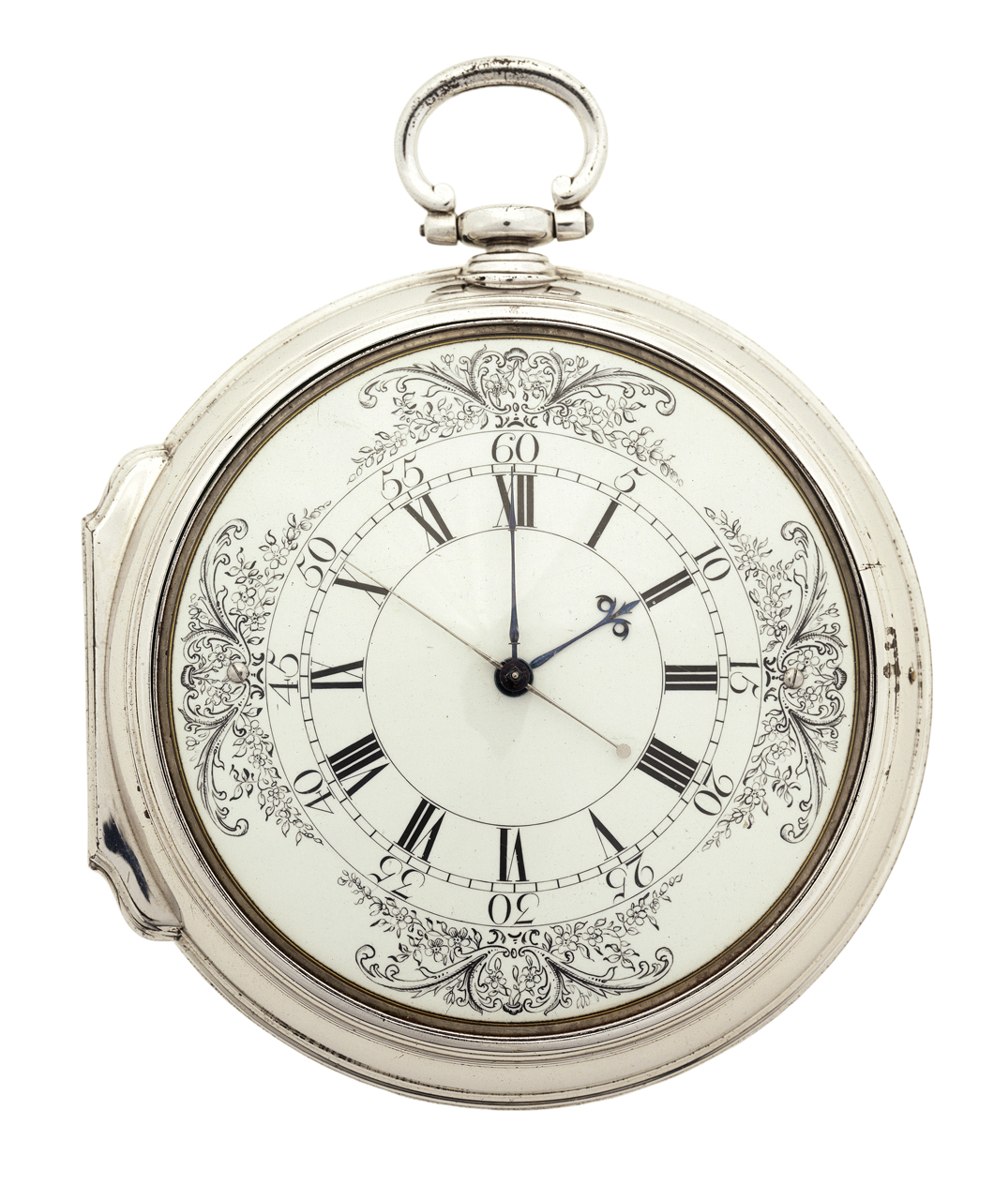
The K1 marine timekeeper is an 18th-century precision instrument completed in 1769 by Larcum Kendall in London, commissioned by the Board of Longitude as an exact copy of John Harrison's H4. According to the National Maritime Museum, the instrument features a 102 mm white enamel dial adorned with floral and foliage scrolling patterns at the quarters, Roman hour numerals, and outer Arabic five- and ten-minute figures. The brass movement incorporates Harrison's maintaining power, a remontoir, an adapted verge escapement with diamond pallets, and a bimetallic compensation curb. The timekeeper is housed in a large silver pair case bearing London hallmarks for 1769–70.

Front view of the K1 marine timekeeper in its silver pair case
Front view of the K1 marine timekeeper in its silver pair case — National Maritime Museum, Greenwich, London. Rights pending — permission not yet requested. Original source

Catalogue identity

Source
www.rmg.co.uk
Category
Marine chronometer · Marine timekeeper
Maker / attribution
Larcum Kendall
Reference
Not recorded
Catalogue / lot identifier
ZAA0038
Source-reported date
1769
Country
United Kingdom

Source-reported attribution and specifications are not independent authentication. A listing does not establish present ownership, current display, availability or permission to reproduce.

Object description

Dial and Visual Appointments

The timekeeper features a 102 mm white enamel dial created in imitation of John Harrison's H4. It displays Roman hour numerals and an outer chapter ring with Arabic ten-minute figures, with floral and foliage scrolling patterns painted at the quarters.

The hands are made of polished and blued steel in a beetle and poker style. They are paired with a slender central pointer seconds hand that features a counterpoised tail.

Evidence for this section
  • “A one day marine timekeeper with a 102mm diameter white enamel dial, in imitation of that of H4”
  • “scrolling decoration at the quarters and roman hour numerals and Arabic ten-minute figures”
  • “polished and blued steel beetle and poker hands with a fine polished steel pointer seconds hand with a counter poised tail”

Mechanical Construction

The movement is a brass, one-day full plate fusee design with four turned pillars. It features Harrison’s maintaining power and a remontoir interposed at the fourth wheel, with the plate engraved ‘Larcum Kendall LONDON 1769’.

The instrument utilizes Harrison’s adapted verge escapement with diamond pallets and a hardened steel balance. It includes a three-turn blued steel spiral balance spring acting against a bimetallic compensation curb and an isochronal curb pin. The jewelling extends to the balance, escape, contrate, and third wheels.

Evidence for this section
  • “brass, one-day full plate fusee movement with four turned pillars”
  • “The plate is engraved ‘Larcum Kendall LONDON 1769’.”
  • “The timekeeper contains Harrison’s adapted verge escapement with diamond pallets”
  • “The jewelling extends to the balance (diamond upper endstone in a polished steel setting), escape wheel, contrate wheel and third wheel, all with endstones”

Casing and Provenance

The timekeeper is contained within a silver pair case with a stirrup bow, measuring 165 mm in height, 124 mm in width, and 28 mm in depth. Both the inner and outer cases bear London hallmarks for 1769–70 and the maker's mark ‘P.M.’ for Peter Mournier.

The silver case was rhodium plated in the 1940s. The instrument is recorded as being in fine condition with some slight scratches to the finish on the case.

Evidence for this section
  • “The timekeeper is held in a large, silver pair case with stirrup bow, 165mms high, 124mms wide and 28mms deep.”
  • “Both inner and outer cases are hallmarked for London, 1769-70 and with the case-maker’s mark ‘P.M’. for Peter Mournier”
  • “The case has a few slight scratches to the finish, and was rhodium plated in the 1940s.”

Open research questions

  • What specific maintenance or restoration work has been performed on the movement beyond the general cleaning noted in the source?
  • Are there additional archival records detailing the specific process or reasoning for the rhodium plating of the silver case in the 1940s?

Source evidence

Recorded claims and source quotations for Larcum Kendall K1 Marine Timekeeper
FieldSource-reported valueSource quotation
Maker's InscriptionLarcum Kendall LONDON 1769“The plate is engraved ‘Larcum Kendall LONDON 1769’.”
Dial Diameter102 mm“A one day marine timekeeper with a 102mm diameter white enamel dial”
EscapementHarrison's adapted verge escapement with diamond pallets“The timekeeper contains Harrison’s adapted verge escapement with diamond pallets”
Case HallmarksLondon, 1769-70 by Peter Mournier“Both inner and outer cases are hallmarked for London, 1769-70 and with the case-maker’s mark ‘P.M’. for Peter Mournier of Frith St, Soho.”
Dimensions165 x 124 x 28 mm“Measurements: Overall: 165 x 124 x 28 mm”
MakerLarcum Kendall“The plate is engraved ‘Larcum Kendall LONDON 1769’.”
Commission Date1766“The timekeeper was commissioned by the Board of Longitude as a copy of H4 in 1766”
Completion Date1769“completed in 1769”

Visible details

  • White enamel dial featuring Roman numerals for hours and an outer chapter ring with Arabic five-minute numerals
  • Intricate floral and foliage scrolling decoration painted at the four quarters outside the hour track
  • Blued steel beetle and poker hands paired with a slender central pointer seconds hand with counterpoise
  • Silver pair case fitted with a stirrup-shaped bow and a prominent side hinge

Research qualifications

  • Movement and movement plate engraving are not visible in the provided exterior photograph
  • The source reports the silver case was rhodium plated in the 1940s

Photograph identity and source facts were screened before import; rights clearance remains pending.

Consulted source

K1 | Royal Museums Greenwich

Reviewed 2026-10-25 · Record 36b0ca9c49

Terms in this record

Glossary explanations for terms named in this object’s record.