
Skip to content
The Encyclopedia of Horology

Clock · Table clock

John Stanton ebony basket top quarter-repeating table clock

Partially verified

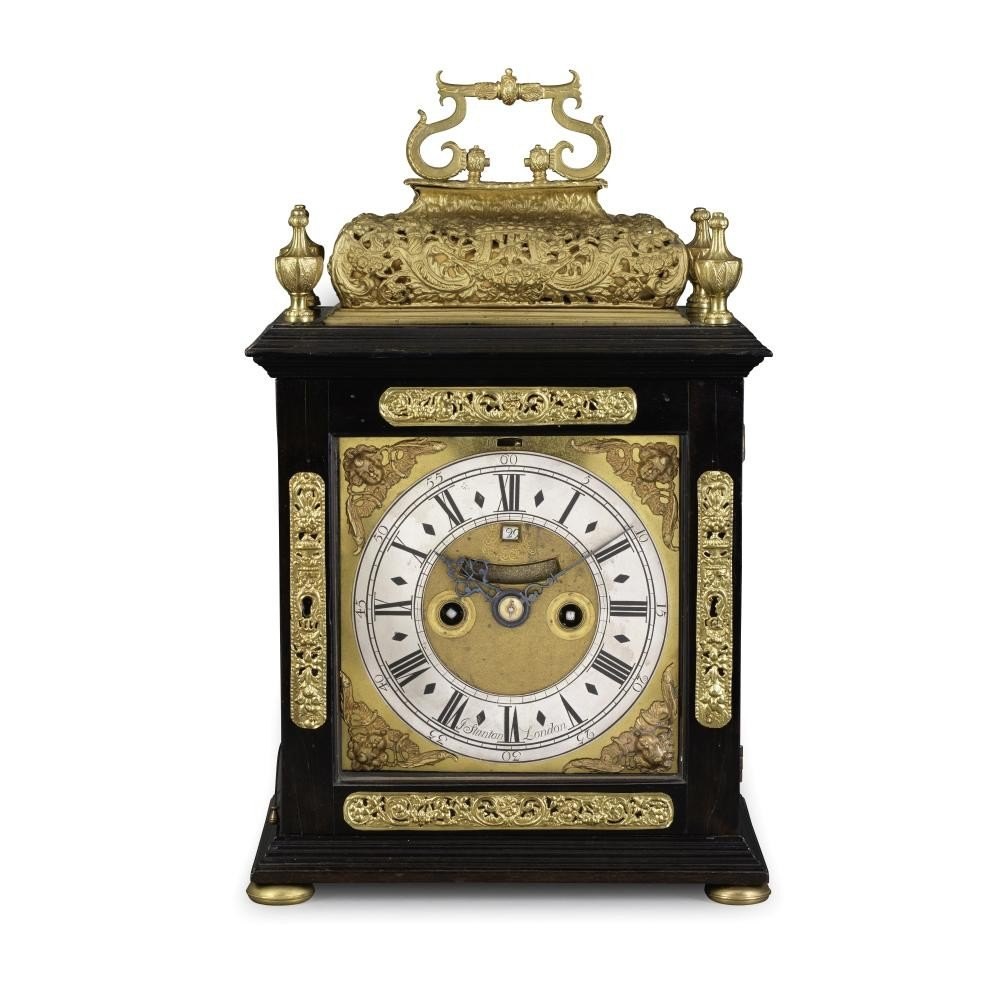
This late 17th-century table clock by John Stanton of London is housed in an ebony case featuring a basket top design. The case is capped with a twin S-shaped handle above a repoussé basket decorated with floral and scroll motifs, further accented by four finials. The clock stands on a moulded plinth supported by brass bun feet. The front door is adorned with pierced repoussé mounts, and the sides incorporate rectangular glazed panels. The clock features a 7-inch square brass dial with a silvered chapter ring showing Roman numerals and five-minute markers. The matted center includes an engraved date aperture, a mock pendulum, and ringed winding squares. The movement is a six-pillared, rack-striking double gut fusee mechanism with a verge escapement and short bob pendulum. The backplate displays floral engravings and is signed by the maker.

Front view of the late 17th-century John Stanton ebony basket top table clock, showing the dial, hands, and decorative brass mounts.
Front view of the late 17th-century John Stanton ebony basket top table clock, showing the dial, hands, and decorative brass mounts. — Bonhams / Invaluable. Rights pending — permission not yet requested. Original source

Catalogue identity

Source
orbiscollectibles.com
Category
Clock · Table clock
Maker / attribution
John Stanton
Reference
Not recorded
Catalogue / lot identifier
201086670
Source-reported date
late 17th century
Source-reported place
London

Source-reported attribution and specifications are not independent authentication. A listing does not establish present ownership, current display, availability or permission to reproduce.

Object description

Case and Dial Construction

The clock is contained within an ebony case of the basket top variety. The upper section consists of a repoussé basket decorated with floral and scroll patterns, surmounted by a pair of S-shaped handles. Four finials are positioned at the corners of the upper housing. The lower body of the clock rests on a molded plinth raised on brass bun feet. The front door exhibits decorative pierced mounts, while the sides are fitted with glazed panels to allow visibility into the interior.

The square brass dial measures 7 inches and is fitted with four winged cherub spandrels. The silvered chapter ring includes Roman hour numerals, five-minute intervals, and distinct lozenge-shaped half-hour markers. The matted dial center contains a decorated date aperture, ringed winding squares for the movement, and a mock pendulum feature. A strike/silent lever is provided at the top of the dial above the twelve o'clock position.

Evidence for this section
  • “The case surmounted by a twin S-shaped handle over a repoussé basket decorated with flowers among scrolls and foliage, flanked by four elaborate finials.”
  • “The front door applied with four pierced repousse mounts, the sides with rectangular glazed panels, all resting on a moulded plinth and brass bun feet.”
  • “The 7-inch square brass dial with silvered chapter ring, Roman numerals and Arabic five-minute markers within bold lines and with distinctive lozenge half-hour markers”

Movement and Technical Specifications

The timekeeping mechanism is a double gut fusee movement featuring six pillars. It employs a verge escapement and a short bob pendulum. The clock is designed to strike the hours on a bell using a rack-striking train. The movement is accompanied by a winding key and a case key to manage its functions. According to the reported condition, the clock is functional regarding its ticking, striking, and repeating capabilities.

The backplate is finished with fine engravings, including floral motifs, tulips, and scrolling patterns enclosed within a wheatear border. The maker's signature, 'John Stanton, London,' is engraved within a central cartouche on the backplate, identifying the origin of the piece.

Evidence for this section
  • “The six-pillared rack-striking double gut fusee movement with verge escapement and short bob pendulum, striking the hours on a bell.”
  • “The finely engraved backplate decorated with tulips, scrolls, and floral motifs framed by a wheatear border, signed in the central cartouche John Stanton, London.”

Provenance and Documentation

This clock is cataloged as a late 17th-century table clock, attributed to the maker John Stanton of London. It is documented as part of an auction house entry, though independent verification of the type and dating remains noted as a required research step for full authentication.

The provided details, including dimensions and stylistic descriptions, were taken from the auction listing. No specific previous owners or exhibition history are recorded in the current documentation.

Evidence for this section
  • “A good late 17th century quarter repeating ebony basket top table clock John Stanton, London”
  • “Auction-house description published on Invaluable”
  • “Research required: confirm the wider type, maker and dating against a specialist reference”

Open research questions

  • Confirm if the engraved signature is original to the backplate movement
  • Compare the movement serial sequence, if found, with known John Stanton records
  • Verify the authenticity of the basket top and mounts as consistent with late 17th-century London manufacture

Source evidence

Recorded claims and source quotations for John Stanton ebony basket top quarter-repeating table clock
FieldSource-reported valueSource quotation
MakerJohn Stanton“John Stanton, London”
Case materialEbony“ebony basket top table clock”
Dial size7-inch“The 7-inch square brass dial”
Movement typeSix-pillared, rack-striking double gut fusee“The six-pillared rack-striking double gut fusee movement”
EscapementVerge“with verge escapement and short bob pendulum”
Height42 cm“42cms (16.5ins) high.”
SignaturesSigned on the backplate“signed in the central cartouche John Stanton, London.”

Visible details

  • Silvered chapter ring with Roman numerals and lozenge half-hour markers
  • Strike/silent lever positioned above the XII numeral
  • Four winged cherub spandrels at the corners of the dial
  • Twin S-shaped carrying handle atop the basket

Research qualifications

  • Independent type authentication remains research required
  • The source describes the clock as 'probable' in its record status
  • Historical accuracy of the maker's signature and components requires expert verification

Photograph identity and source facts were screened before import; rights clearance remains pending.

Consulted source

Clock, table clock, London, 17th century

Reviewed 2026-11-02 · Record 3bb19d8635

Terms in this record

Glossary explanations for terms named in this object’s record.