
Skip to content
The Encyclopedia of Horology

Clock · Bracket clock

James McCabe Regency bracket clock

Partially verified

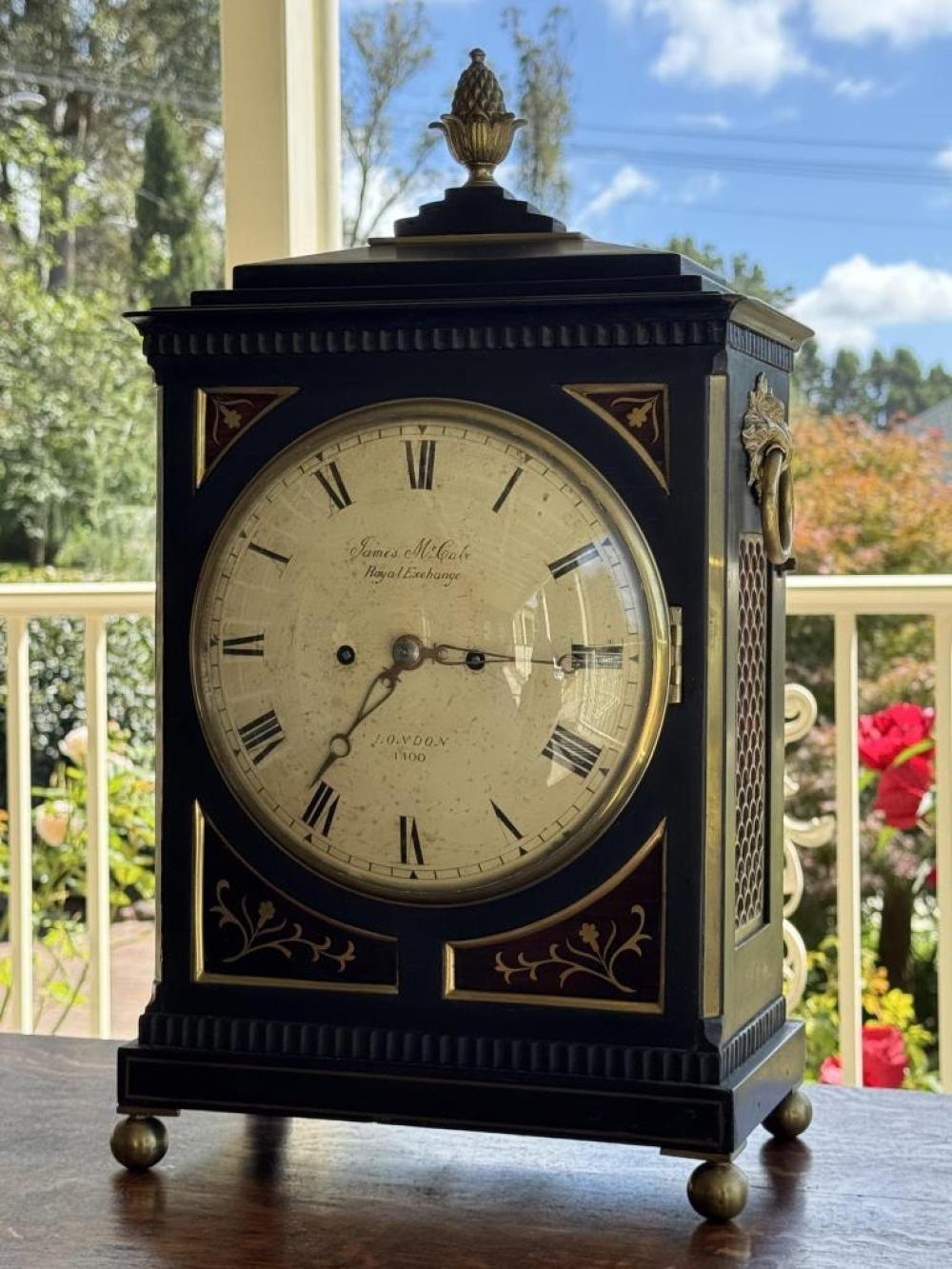
This English Regency period bracket clock is attributed to the maker James McCabe of Royal Exchange, London. The clock is housed in an ebonized wood case featuring decorative brass inlay and is set on brass ball feet. The top of the case is surmounted by a pineapple finial, and the sides incorporate ornamental brass drop ring handles. The clock features an 8-inch cream-painted convex dial with Roman numerals, bearing the signature of James McCabe and the serial number 1400. Internally, the timepiece is powered by an eight-day, five-pillar, twin-chain fusee movement. The mechanism includes a rack and snail striking system designed to chime on a bell, with shouldered plates and an anchor escapement regulated by a lenticular bob pendulum. The backplate also bears the maker's name and the serial number 1400. The dimensions of the object are approximately 50cm in height, 28cm in width, and 17cm in depth.

Antique English Regency period James McCabe bracket clock with ebonized case and brass inlay.
Antique English Regency period James McCabe bracket clock with ebonized case and brass inlay. — Vickers & Hoad, via Invaluable. Rights pending — permission not yet requested. Original source

Catalogue identity

Source
orbiscollectibles.com
Category
Clock · Bracket clock
Maker / attribution
James McCabe
Reference
Not recorded
Catalogue / lot identifier
Source URL identifies the listing
Source-reported date
Regency period
Source-reported place
England
Source-reported serial
1400

Source-reported attribution and specifications are not independent authentication. A listing does not establish present ownership, current display, availability or permission to reproduce.

Object description

Case and Dial

The bracket clock is constructed with an ebonized wooden case that features brass inlay decoration throughout the exterior. The aesthetic is defined by several architectural elements, including a pineapple finial positioned at the top of the case and brass ball feet providing support at the base. Further ornamentation includes brass drop ring handles located on the sides.

The dial features black Roman numerals and is signed with the name 'James McCabe' and 'Royal Exchange', followed by the location 'London' and the serial number 1400.

Evidence for this section
  • “ebonized case accented with brass inlay”
  • “crowned with a distinctive pineapple finial and stands upon brass ball feet”
  • “sides are fitted with ornamental brass drop ring handles”
  • “8-inch circular cream-painted dial displays black Roman numerals and bears the maker's signature and serial number 1400”

Movement and Mechanism

The timekeeping is provided by a high-quality eight-day, five-pillar, twin-chain fusee movement. The clock uses an anchor escapement which is regulated by a lenticular bob pendulum, Striking is managed by a rack and snail system that produces an audible chime on a bell.

The mechanical internal components include shouldered plates. The backplate has been engraved with identifying information that corresponds to the front dial, specifically the maker's name and the serial number 1400, and it also contains a dedicated holdfast bracket for the pendulum.

Evidence for this section
  • “high-quality five-pillar, eight-day twin-chain fusee movement”
  • “rack and snail striking system to chime on a bell and features shouldered plates with an anchor escapement”
  • “regulated by a lenticular bob pendulum”
  • “backplate is also engraved with the maker's name, the serial number 1400”

Attribution and Identification

The clock is attributed to the maker The association is supported by the presence of the signature on both the dial and the backplate of the clock. The use of serial number 1400 serves as the primary identifier for this specific unit.

The documentation notes that while there is credible evidence regarding the clock's history and origin, the overall classification remains established as 'probable' rather than definitively confirmed. No specific catalogue numbers are associated with the object, and the details provided are limited to the single example described in the listing.

Evidence for this section
  • “crafted by the renowned maker James McCabe of Royal Exchange, London”
  • “bears the maker's signature and serial number 1400”
  • “Credible evidence exists but classification is not fully established.”

Open research questions

  • What is the estimated production date for a James McCabe movement with serial number 1400?
  • Does the clock retain its original finish and components, or have historical restorations been performed?

Source evidence

Recorded claims and source quotations for James McCabe Regency bracket clock
FieldSource-reported valueSource quotation
MakerJames McCabe“crafted by the renowned maker James McCabe of Royal Exchange, London”
Serial number1400“serial number 1400”
MovementEight-day, twin-chain fusee“high-quality five-pillar, eight-day twin-chain fusee movement”
Dial size8-inch“8-inch circular cream-painted dial”
Dimensions50cm H x 28cm W x 17cm D“approximately 50cm in height, 28cm in width, and 17cm in depth”
Striking mechanismRack and snail“rack and snail striking system to chime on a bell”
EscapementAnchor escapement“features shouldered plates with an anchor escapement”

Visible details

  • The dial is a cream-painted convex type with black Roman numerals.
  • The case is decorated with brass inlay and has a pineapple finial.
  • The sides feature brass drop ring handles.
  • The clock is supported by brass ball feet.

Research qualifications

  • The status of the object is described as 'Probable', indicating the classification is not fully established.
  • The source does not provide details regarding the current functional condition or historical provenance of the piece.

Photograph identity and source facts were screened before import; rights clearance remains pending.

Consulted source

English Regency ebonized and brass inlaid bracket clock by James McCabe

Reviewed 2026-11-02 · Record 0282bac2b8

Terms in this record

Glossary explanations for terms named in this object’s record.