
Skip to content
The Encyclopedia of Horology

Pocket watch · Deck chronometer

James C. Pellaton Tourbillon Deck Chronometer

Partially verified

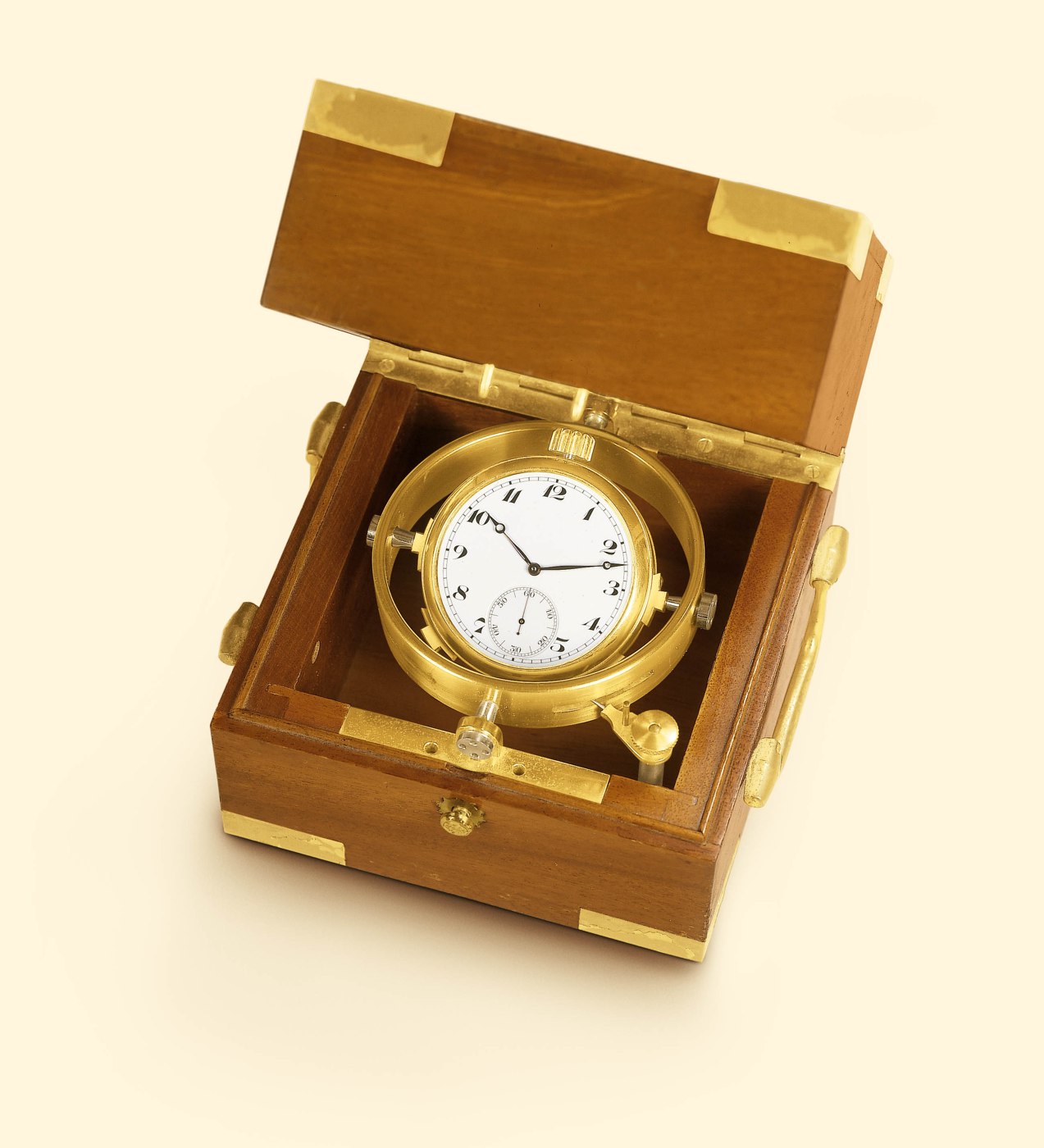
This 1941 keyless deck chronometer was produced by James C. Pellaton in Le Locle, Switzerland, specifically for Georges Perrenoud. The timepiece features an 18K gold three-body case described as "bassine et filets" with a glazed back. It is housed within a two-body mahogany deck box equipped with brass handles, brass-reinforced corners, and a locking mechanism, containing a brass gimbaled ring with a locking slot. The white enamel dial displays Breguet numerals, an outer minute track, and a subsidiary sunk seconds dial, accented by blued steel Breguet hands. The chronometer is powered by a 20 ligne rhodium-plated movement utilizing a Technicum locle caliber, featuring a one-minute tourbillon regulator with a three-arm Pellaton carriage, a lateral calibrated lever escapement, and a Guillaume bimetallic compensation balance with a special alloy balance spring. The movement is finished with fausses-côtes decoration and signed specifically for the original owner.

James C. Pellaton Tourbillon deck chronometer No. 1944, housed in its original mahogany gimbaled box.
James C. Pellaton Tourbillon deck chronometer No. 1944, housed in its original mahogany gimbaled box. — Antiquorum. Rights pending — permission not yet requested. Original source

Catalogue identity

Source
catalog.antiquorum.swiss
Category
Pocket watch · Deck chronometer
Maker / attribution
James C. Pellaton
Reference
Not recorded
Catalogue / lot identifier
250
Source-reported date
1941
Source-reported place
Switzerland
Source-reported serial
1944

Source-reported attribution and specifications are not independent authentication. A listing does not establish present ownership, current display, availability or permission to reproduce.

Object description

Case and Deck Housing

The timepiece is encased in an 18K gold, three-body 'bassine et filets' case. The back of the case is glazed, allowing for a visual of the movement. The watch is designed to be housed in a specialized two-body mahogany box, which serves as a protective deck container for the chronometer.

The mahogany box is outfitted with brass components, including reinforced corners and brass handles for transport. The interior of the box features a brass gimbaled ring, which includes a locking slot to secure the watch in place during use, ensuring the stability of the movement in a maritime or observatory setting.

Evidence for this section
  • “18K gold, keyless deck chronometer with one-minute tourbillon regulator in gimbaled mahogany box.”
  • “C. Three-body, "bassine et filets", glazed back, polished, set in two-body mahogany box with brass handles, brass reinforced corners,lock in front, brass gimbaled ring with locking slot.”

Movement and Regulator

The movement measures 20 lignes and is rhodium-plated, utilizing the Technicum locle caliber. It is characterized by its curved center bridge and fausses-côtes decoration featuring narrow straps. The central feature is a one-minute tourbillon regulator containing a three-arm Pellaton carriage.

The escapement system is a lateral calibrated lever type. The compensation balance is a cut anibal-steel Guillaume bimetallic balance, paired with a special steel alloy balance spring featuring a Phillips outer terminal curve. The rate is controlled by an index regulator with a gold scaleplate, and the pins feature micrometric screw adjustment.

Evidence for this section
  • “M. 44.8 mm (20'''), rhodium-plated, Technicum locle caliber with curved center bridge, "fausses-côtes" decoration with narrow straps”
  • “three-arm Pellaton carriage with lateral calibrated lever escapement, cut anibal-steel Guillaumebimetallic compensation balance”

Signatures and Provenance

The piece bears specific inscriptions denoting its manufacture for Georges Perrenoud, a businessman and owner of the company Dixi. The dial and the movement are both signed with a dedication to the original owner and the maker's name and location.

The provenance of the object is connected to the career of James Casar Pellaton, a prominent maker of tourbillons during the 20th century who later served as the director of the horological school in Le Locle. The watch is documented in R. Meis's book 'Le Tourbillon'.

Evidence for this section
  • “Signed on dial, movement:"Fabriqué spécialement pour Georges Perrenoud. James C. Pellaton, Dr. H.C., Le Locle, 1941.”
  • “The watch is described and illustrated in detail by R. Meis in "Le Tourbillon", pp. 170-71.”

Open research questions

  • Are there known records of other deck chronometers produced by James C. Pellaton for Dixi or Georges Perrenoud?
  • What are the specific variations of the Technicum locle caliber found in other tourbillon pieces by Pellaton?

Source evidence

Recorded claims and source quotations for James C. Pellaton Tourbillon Deck Chronometer
FieldSource-reported valueSource quotation
MakerJames C. Pellaton“James C(asar) Pellaton, Dr. H.C., Le Locle”
Production Year1941“made specially for Georges Perrenoud in 1941”
Case Material18K gold“Very fine and very rare 18K gold”
Movement CaliberTechnicum locle“Technicum locle caliber”
Serial Number1944“No. 1944”
Dimensions11.6 x 9.8 cm“Dim. 11,6 x 9,8 cm.”
EscapementLateral calibrated lever“lateral calibrated lever escapement”

Visible details

  • Gimbaled mahogany case with brass fittings
  • White enamel dial with Breguet numerals
  • Three-arm tourbillon carriage visible
  • Subsidiary seconds dial at the 6 o'clock position

Research qualifications

  • The specific performance of the movement is not detailed beyond its design specifications.
  • The auction report provides a grading for case, movement, and dial condition but does not provide an inspection report.

Photograph identity and source facts were screened before import; rights clearance remains pending.

Terms in this record

Glossary explanations for terms named in this object’s record.