
Skip to content
The Encyclopedia of Horology

Clock · Lantern clock

J Millies of London Lantern Clock

Partially verified

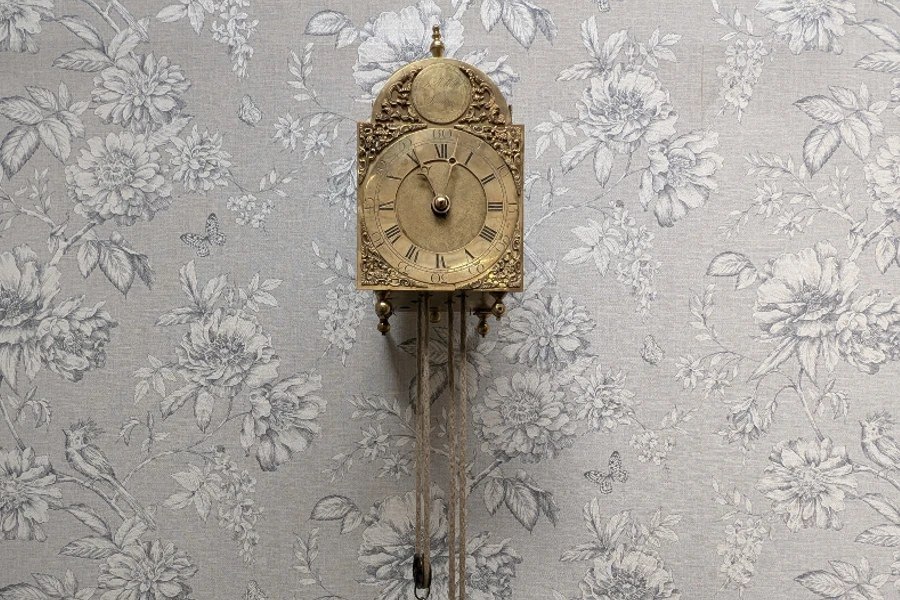
This lantern clock is attributed to J Millies of London and dates to circa 1680. It features a brass case constructed with tapered Doric columns mounted on spherical feet. The clock includes a brass chapter ring with a diameter of 6.5 inches displaying Roman numerals. A distinct feature is the inclusion of two hands, which the source notes is unusual for lantern clocks of this era. The movement is rope-driven, provides a 30-hour power reserve, and utilizes a verge escapement. The striking mechanism sounds on a bell positioned at the top of the clock, which is protected by cross-straps and decorative urn-topped finials with foliate motifs. Side doors on the brass frame provide access to the internal mechanism. The clock is designed as a hook-and-spike wall clock.

Front view of the 17th-century lantern clock showing the brass chapter ring, two-hand configuration, and floral wallpaper background.
Front view of the 17th-century lantern clock showing the brass chapter ring, two-hand configuration, and floral wallpaper background. — W J Morris Clocks. Rights pending — permission not yet requested. Original source

Catalogue identity

Source
zamanito.com
Category
Clock · Lantern clock
Maker / attribution
J Millies of London
Reference
Not recorded
Catalogue / lot identifier
Source URL identifies the listing
Source-reported date
circa 1680
Source-reported place
England

Source-reported attribution and specifications are not independent authentication. A listing does not establish present ownership, current display, availability or permission to reproduce.

Object description

Case and Dial Construction

The clock is housed in a traditional brass lantern clock frame, described as a hook-and-spike variant. The architectural design incorporates tapered Doric columns that terminate in spherical feet. The top section is surmounted by a bell held in place by cross-straps, situated above urn-topped finials featuring foliate ornamentation.

The dial consists of a brass chapter ring with a 6.5-inch diameter, engraved with Roman numerals. The clock features a two-hand configuration, which the source characterizes as an uncommon attribute for a lantern clock from the 17th century. Brass doors on the sides allow for access to the clock's interior.

Evidence for this section
  • “معماری ویژه قاب آن‌ها با ساختار ستون‌دار و تزئینات برنجی”
  • “مجهز بودن آن به دو عقربه برای ساعت‌های فانوسی آن دوره تاریخی امری نامعمول و کم‌نظیر محسوب می‌شود”

Movement and Escapement

The timepiece functions with a 30-hour movement, powered by a single-weight rope-drive system. The escapement is of the verge type. The striking mechanism is configured to sound on the top-mounted bell at each hour.

Internal components, including the brass frame, gears, rope, and pulley system, are visible through the side access panels. The construction relies on traditional 17th-century horological methods consistent with the provided date.

Evidence for this section
  • “موتور ساعت دارای کارکرد ۳۰ ساعته است و از سیستم انتقال نیروی طنابی با تک‌وزنه بهره می‌برد”
  • “چرخ‌دنگ این مکانیزم از نوع ورج (Verge escapement) است”

Condition and Attribution

The clock is attributed to J Millies of London, circa 1680. Regarding the state of the movement, the source advises that potential collectors verify the authenticity of the internal verge escapement parts.

Specifically, the auction description reports that interested parties should independently assess the object to determine if original 17th-century components have been preserved or if mechanical parts have been replaced during subsequent servicing or restoration.

Evidence for this section
  • “علاقه‌مندان و مجموعه‌داران پیش از خرید باید اصالت قطعات داخلی چرخ‌دنگ، وضعیت حفظ قطعات اصلی دوره قرن هفدهم در برابر بازسازی‌های احتمالی بعدی و عدم جایگزینی بخش‌های مکانیکی را به دقت و به صورت مستقل بررسی و تأیید نمایند”

Open research questions

  • Are there archival records confirming the specific existence and activity of a clockmaker named J Millies in London around 1680?
  • Does metallurgical analysis of the brass composition support 17th-century production?

Source evidence

Recorded claims and source quotations for J Millies of London Lantern Clock
FieldSource-reported valueSource quotation
MakerJ Millies of London“J Millies of London”
Datecirca 1680“حدود ۱۶۸۰”
EscapementVerge“چرخ‌دنگ این مکانیزم از نوع ورج (Verge escapement) است”
Chapter ring diameter6.5 inches“قطر ۶.۵ اینچ”
Power reserve30-hour“کارکرد ۳۰ ساعته”
CountryEngland“انگلستان”

Visible details

  • Brass chapter ring with Roman numerals
  • Hook-and-spike wall mounting hardware visible
  • Tapered Doric corner pillars with spherical feet
  • Internal brass movement plates and rope drive system

Research qualifications

  • Authenticity of internal verge escapement components is unverified
  • Potential for modern restoration or mechanical parts replacement exists
  • Specific 1680 dating remains an attribution

Photograph identity and source facts were screened before import; rights clearance remains pending.

Consulted source

Original 17th Century Lantern Clock

Reviewed 2026-11-02 · Record 350fdaed0a

Terms in this record

Glossary explanations for terms named in this object’s record.