
Skip to content
The Encyclopedia of Horology

Clock · Table clock

Hexagonal table clock by Jacques Borlion

Partially verified

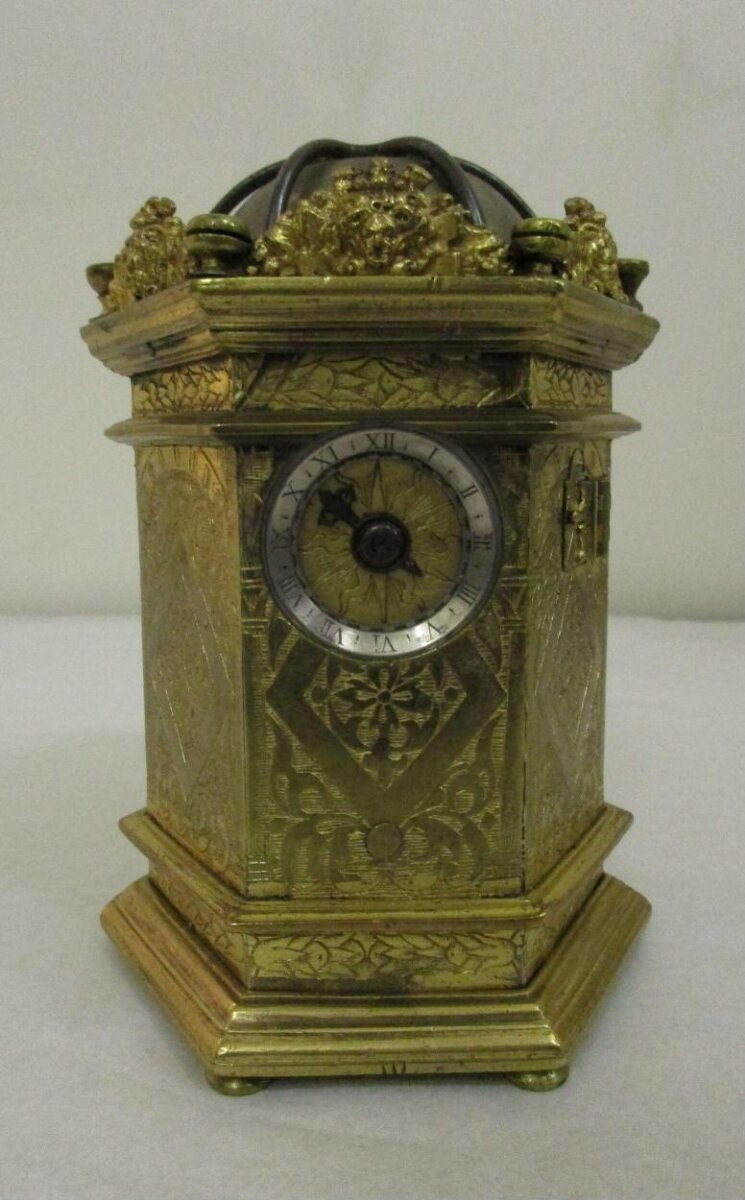
This French hexagonal table clock, crafted from engraved gilt brass, is attributed to the maker Jacques Borlion and dates to the late 16th century, specifically between 1580 and 1600. The clock features a removable base supported by six feet—with one foot currently missing—decorated with lozenges, foliated scrolls, and lion mask relief castings. Time is displayed on a small silvered dial set into the side of the case, using a single steel hand to track hours in Roman numerals. The internal movement is powered by a gut fusee, visible through a side access door, and utilizes a verge escapement with a balance wheel. The upper section includes a bell protected by iron arches. While the movement and main case structure are primary, the bell, bell-straps, and finial are documented as later additions. It is part of a larger collection of timepieces gifted to the institution in 1938.

Side view of the hexagonal table clock showing the dial and access door.
Side view of the hexagonal table clock showing the dial and access door. — V&A Museum. Rights pending — permission not yet requested. Original source

Catalogue identity

Source
collections.vam.ac.uk
Category
Clock · Table clock
Maker / attribution
Jacques Borlion
Reference
M.173-1938
Catalogue / lot identifier
M.173-1938
Source-reported date
1580-1600
Source-reported place
France

Source-reported attribution and specifications are not independent authentication. A listing does not establish present ownership, current display, availability or permission to reproduce.

Object description

Case and Dial Construction

The clock is housed in an hexagonal gilt-brass case, which is engraved with a decorative pattern of lozenges and foliated scrolls arranged between arcading. The structural integrity of the case is supported by a removable base resting on six small feet, though the current condition shows that one foot is missing. The top of the assembly features relief castings of six lion masks and scrollwork, providing ornamentation to the primary vessel.

The time-telling function is facilitated by a silvered dial, measuring 3.2 cm in diameter, which is affixed directly to the movement. This dial features Roman numerals for the hours and smaller markings for the half-hour intervals. A single steel hand with a short tail indicates the time. A small door located on the side of the case provides direct access to the gut fusee mechanism for inspection purposes.

Evidence for this section
  • “An hexagonal gilt-brass table clock, with removable base on six small feet (one missing) engraved with lozenges and foliated scrolls between arcading”
  • “Silvered dial, attached to a movement, 3.2 cm diameter, with Roman numerals for the hours and dashes at half hours.”
  • “The gut fusee may be inspected through a door in the side of the case.”

Movement and Mechanical Details

The internal mechanics of the clock are constructed around three horizontal brass plates held by turned iron pillars. The power source is a gut fusee, which includes a slim fusee with 26 turns. Most of the internal wheel train is constructed from steel, with the notable exception of the contrate wheel in the going train, which is manufactured from brass. The motion work utilizes an 8T pinion coaxial with the fusee to drive the 8T contrate wheel, while a 6-T pinion connects to the 48T hour-wheel.

The timing mechanism relies on a verge escapement and a balance wheel. The striking train is of the locking-plate type and utilizes a going barrel. An outside count-wheel is present, featuring 78 internal teeth and sliding inside curved brass arcs, which are not pivoted at the centre. A bell is positioned above the movement, caged by three intersecting iron arches and topped with a moulded finial.

Evidence for this section
  • “Three horizontal brass plates, turned iron pillars.”
  • “Going train, in top compartment, with slim fusee of 26 turns, gut line. Verge escapement, balance wheel.”
  • “Locking-plate striking train with going barrel; with outside count-wheel with 78 internal teeth and sliding inside curved brass arcs, not pivoted at centre.”

Signatures and History

The interior of the removable base is stamped with the signature 'JACQUES BORLION PARIS', attributing the work to this maker. The clock arrived at the institution as part of a significant acquisition in 1938, which consisted of fourteen clocks and sundials donated by W.E. Miller FSA.

While the majority of the object dates to the late 16th century, the documentation provided by the institution notes that specific components are not original to the clock. The bell, the bell-straps, and the finial that are mounted above the movement have been identified as later additions to the piece.

Evidence for this section
  • “The inside of the removable base stamped: JACQUES BORLION PARIS”
  • “The bell-straps, bell and finial mounted above are later additions.”
  • “This is one of group of fourteen sun dials and clocks given by W.E.Miller FSA in 1938.”

Open research questions

  • What is the specific provenance of the clock prior to the 1938 donation?
  • Are there other extant clocks by Jacques Borlion that demonstrate similar construction of the locking-plate striking train?

Source evidence

Recorded claims and source quotations for Hexagonal table clock by Jacques Borlion
FieldSource-reported valueSource quotation
MakerJacques Borlion“JACQUES BORLION PARIS”
OriginParis, France“French, late 16th century”
Date1580-1600“1580-1600”
MaterialsGilt brass, iron, silver“engraved gilt brass”
DialSilvered dial, 3.2 cm diameter“Silvered dial, attached to a movement, 3.2 cm diameter, with Roman numerals for the hours and dashes at half hours.”
MovementVerge escapement, fusee“Verge escapement, balance wheel.”
Accession NumberM.173-1938“M.173-1938”

Visible details

  • Engraved gilt brass case with lozenges and foliated scrolls
  • Silvered dial with Roman numerals
  • Access door on the side of the case for gut fusee inspection
  • Removable base stamped with the maker's name

Research qualifications

  • One of the six base feet is missing
  • The bell, bell-straps, and finial are later additions

Photograph identity and source facts were screened before import; rights clearance remains pending.

Consulted source

An hexagonal table clock, engraved gilt brass, French, late 16th century

Reviewed 2026-11-02 · Record fabbc10395

Terms in this record

Glossary explanations for terms named in this object’s record.