
Skip to content
The Encyclopedia of Horology

Pocket watch · Pivoted detent chronometer

Harry van Zwoll School Watch

Partially verified

This pocket chronometer is described as a graduate's masterpiece from the École d'horlogerie Le Locle, manufactured circa 1900. It features a silver case with a gold crown and an enamel dial. The movement is a bridge-type construction, identified as Calibre-ecole 20'', and incorporates a pivoted detent chronometer escapement. Further technical specifications include a Guillaume gold screw compensation balance and a balance spring with two terminal curves by Phillips. The watch is associated with Harry van Zwoll, a German watchmaker and musical instrument dealer. This object belongs to the class of 'school watches' (Montres École) produced by the technical training institution in Le Locle, Switzerland. The auction description reports that the object is in very good condition across its case, dial, and movement, and that the watch is capable of running, although cleaning is recommended.

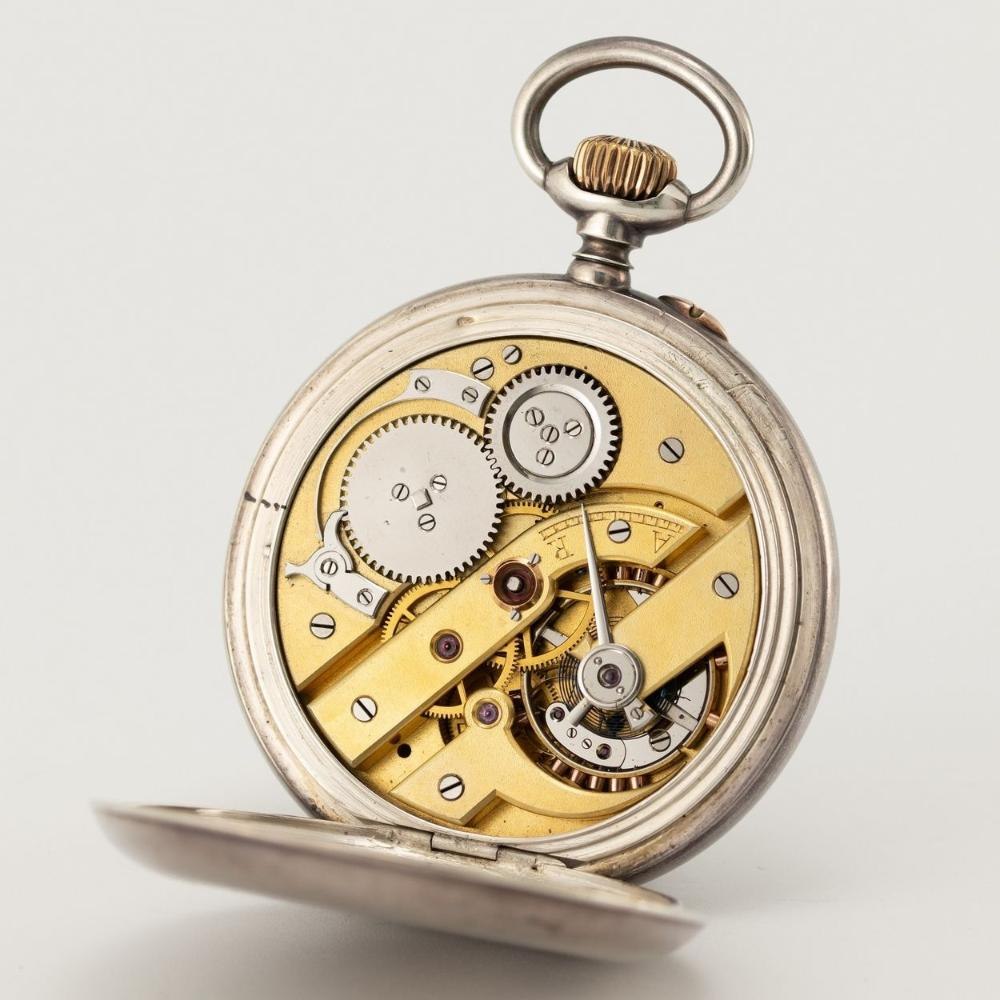
The movement of the Harry van Zwoll pocket chronometer, showing the bridge construction and compensation balance.
The movement of the Harry van Zwoll pocket chronometer, showing the bridge construction and compensation balance. — Invaluable. Rights pending — permission not yet requested. Original source

Catalogue identity

Source
www.invaluable.com
Category
Pocket watch · Pivoted detent chronometer
Maker / attribution
Harry van Zwoll / École d'horlogerie Le Locle
Reference
Calibre-ecole 20''
Catalogue / lot identifier
133
Source-reported date
circa 1900
Source-reported place
Switzerland
Source-reported serial
161

Source-reported attribution and specifications are not independent authentication. A listing does not establish present ownership, current display, availability or permission to reproduce.

Object description

Case and Dial Construction

The pocket watch is housed in a silver case, which is finished with a gold crown.

The dial is composed of enamel, featuring standard Roman numeral indices and a subsidiary seconds dial positioned at the six o'clock mark.

Evidence for this section
  • “Case: Silver, gold crown.”
  • “Dial: Enamel.”
  • “Case: very good. Dial: very good.”

Movement and Technical Features

The movement is a bridge-type configuration designed as a 'Calibre-ecole 20''', reflecting the instructional nature of the piece. It utilizes a pivoted detent chronometer escapement, a mechanism synonymous with high-precision timekeeping. The regulation is managed through a Guillaume gold screw compensation balance paired with a balance spring featuring two terminal curves according to the Phillips design.

The movement, numbered 161, corresponds with the case number, indicating the components were kept together as a set. The overall mechanical condition is reported as very good, noting that the watch remains capable of running, though professional cleaning is advised for future performance.

Evidence for this section
  • “Movm.: Bridge movement, Guillaume gold screw compensation balance, balance spring with 2 terminal curves by Phillips.”
  • “Movm. No. 161, Cal. Calibre-ecole 20''”
  • “Movm.: very good, capable of running, cleaning recommended.”

Provenance and Historical Context

This object is identified as a graduate's masterpiece from the École d'horlogerie Le Locle. The school, located in the Canton of Neuchâtel, was founded in the 1830s to foster expertise for the Swiss precision watch industry. By 1901, the institution expanded into the Technicum Le Locle, a central hub for technical watchmaking education.

The watch is attributed to Harry van Zwoll, a German watchmaker and dealer based in Bunde.

Evidence for this section
  • “A very fine Swiss pocket chronometer with pivoted detent chronometer escapement - graduate's masterpiece”
  • “Manufactured at the Le Locle Watchmaking School.”
  • “The term is now mainly used in connection with rare, highly complex ‘school watches’ (Montres École).”

Open research questions

  • Was Harry van Zwoll a specific student at the Technicum du Locle around 1900?
  • Are there specific archival records at the Le Locle museum linking serial number 161 to a graduation year?

Source evidence

Recorded claims and source quotations for Harry van Zwoll School Watch
FieldSource-reported valueSource quotation
MakerHarry van Zwoll - Ècole d'horlogerie Le Locle“Harry van Zwoll - Ècole d'horlogerie Le Locle”
Movement Number161“Movm. No. 161”
Case MaterialSilver with gold crown“Case: Silver, gold crown.”
EscapementPivoted detent“pivoted detent chronometer escapement”
BalanceGuillaume gold screw compensation balance“Guillaume gold screw compensation balance”
Dimensions56 mm“Dimensions 56 mm”
Weight144 g“Weight 144 g”
OriginSchweiz“Origin Schweiz”

Visible details

  • Silver case with gold-colored crown
  • Bridge-type movement with gilded plates
  • Guillaume balance with gold timing screws
  • Enamel dial with subsidiary seconds

Research qualifications

  • Cleaning of the movement is recommended for optimal function
  • Historical attribution to Harry van Zwoll as a graduate is based on auction documentation

Photograph identity and source facts were screened before import; rights clearance remains pending.

Consulted source

Harry van Zwoll - Ècole d'horlogerie Le Locle

Reviewed 2026-10-26 · Record 084e449e70