
Skip to content
The Encyclopedia of Horology

Clock · Longcase regulator

Hampston, Prince & Cattles longcase regulator clock

Partially verified

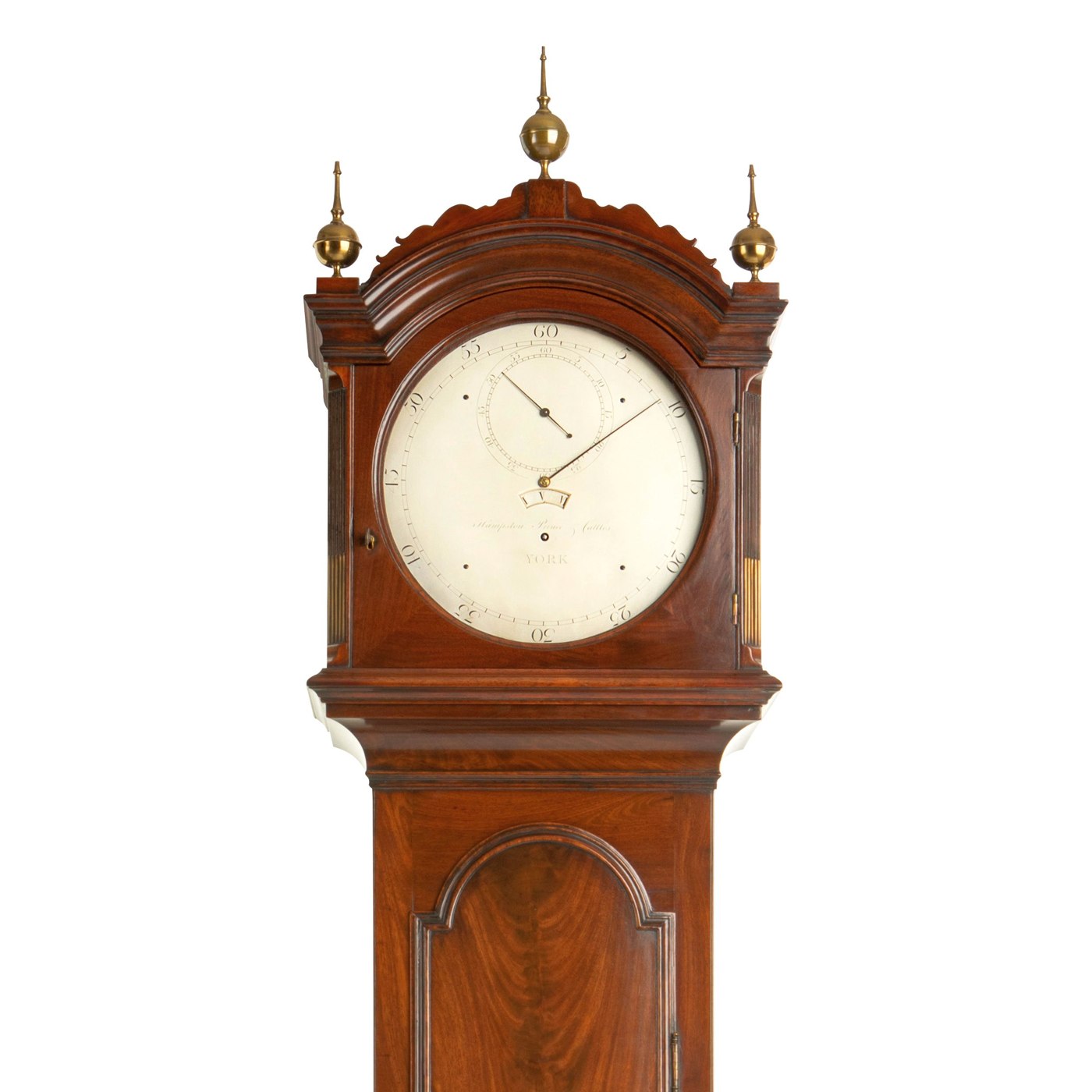
This longcase regulator clock is constructed of mahogany with flame mahogany veneers and features an arched hood with brass finials and inlay. The hood includes a round glazed aperture for the dial. The trunk houses an eight-day movement featuring six pillars, maintaining power, and a Graham deadbeat escapement with wheels running in screwed end caps. The regulation system consists of a wood rod pendulum with a large brass bob and a silvered calibrated sphere for fine adjustment. The dial is signed for the York-based firm Hampston, Prince & Cattles, who were active between 1777 and 1810. The inside of the trunk door displays a printed equation table with various handwritten inscriptions dating back to approximately 1826. The clock stands at a height of 209cm.

Full view of the mahogany longcase regulator
Full view of the mahogany longcase regulator — Dorset Antique Clocks. Rights pending — permission not yet requested. Original source

Catalogue identity

Source
www.dorsetantiqueclocks.co.uk
Category
Clock · Longcase regulator
Maker / attribution
Hampston, Prince & Cattles
Reference
Not recorded
Catalogue / lot identifier
Source URL identifies the listing
Source-reported date
circa 1790
Source-reported place
England

Source-reported attribution and specifications are not independent authentication. A listing does not establish present ownership, current display, availability or permission to reproduce.

Object description

Case and Dial

The clock is housed in a mahogany case with flame mahogany veneers on the trunk and base. The arched hood is finished with a small cresting, brass finials, and canted corners featuring brass inlay. A full-length opening door provides access to the trunk, which is framed by strong moulding and features an equation table printed on the interior surface.

The dial is circular and viewed through a glazed aperture in the hood. It is signed by the makers and features a large minute chapter ring, a smaller sub-seconds dial positioned below the 12 o'clock mark, and an hour aperture located below the center arbor.

Evidence for this section
  • “The case with arched top surmounted by a small cresting, has canted and brass inlaid corners and an opening front door with a round glazed aperture for the round dial.”
  • “The inside of the trunk door has a printed equation table with various inscriptions marked on it in pen, the earliest from about 1826.”
  • “The dial has a cutout below the centre arbor for the hours, a large minute chapter ring and a smaller seconds ring below 12 o’clock.”

Movement and Pendulum

The eight-day movement is engineered with six shaped pillars and features maintaining power. The timekeeping is regulated by a Graham deadbeat escapement, with the wheels running within screwed end caps.

The pendulum uses a wood rod supporting a large brass bob. Beneath this bob, a silvered, calibrated sphere serves as a secondary mechanism for fine adjustment of the clock's rate.

Evidence for this section
  • “The eight-day movement is of fine quality with six nicely shaped pillars, maintaining power and a Graham deadbeat escapement.”
  • “The wheels run within screwed end caps.”
  • “The clock employs a wood rod pendulum with a massive brass bob with a calibrated rating nut below which is a large silvered calibrated sphere which can be screwed up or down for further fine adjustment.”

Provenance and Maker History

The clock is signed by the firm Hampston, Prince & Cattles, who were active in York from 1777 to 1810.

Information regarding the firm and its members is documented in "Yorkshire Clockmakers" by Brian Loomes. The clock is currently sourced from a private collection in the U.K.

Evidence for this section
  • “Hampston, Prince & Cattles are recorded as working in York between 1777 and 1810.”
  • “The company, Hampston, Prince & Cattles, were also jewellers and goldsmiths.”
  • “Further details can be found in “Yorkshire Clockmakers” by Brian Loomes.”
  • “Provenance: Private collection U.K.”

Open research questions

  • What is the specific nature of the manuscript inscriptions on the equation table beyond the date of 1826?
  • Are there any specific service records or modifications documented from the 19th century regarding the movement?

Source evidence

Recorded claims and source quotations for Hampston, Prince & Cattles longcase regulator clock
FieldSource-reported valueSource quotation
MakerHampston, Prince & Cattles“Hampston, Prince & Cattles, York.”
Datingcirca 1790“CIRCA. 1790”
Height209 cm“Height: 82″ or 209cm (To top of finial)”
EscapementGraham deadbeat“Graham deadbeat escapement”
Movement duration8-day“The eight-day movement is of fine quality”
Case materialMahogany“mahogany longcase regulator”
ProvenancePrivate collection U.K.“Provenance: Private collection U.K.”

Visible details

  • The hood is topped with three brass finials.
  • The dial features a large minute chapter ring and a sub-seconds dial.
  • The trunk door contains a printed equation table.
  • The pendulum assembly includes a wood rod, brass bob, and silvered sphere.

Research qualifications

  • The exact birth and death dates for John Prince remain unclear.
  • The provenance is limited to a generic 'Private collection U.K.' description.

Photograph identity and source facts were screened before import; rights clearance remains pending.

Consulted source

EARLY & SMALL MAHOGANY LONGCASE REGULATOR – HAMPSTON PRINCE & CATTLES OF YORK

Reviewed 2026-11-02 · Record cdc4a0ad26

Terms in this record

Glossary explanations for terms named in this object’s record.