
Skip to content
The Encyclopedia of Horology

Marine chronometer · Gimballed marine chronometer

Hamilton Model 21 Marine Chronometer

Partially verified

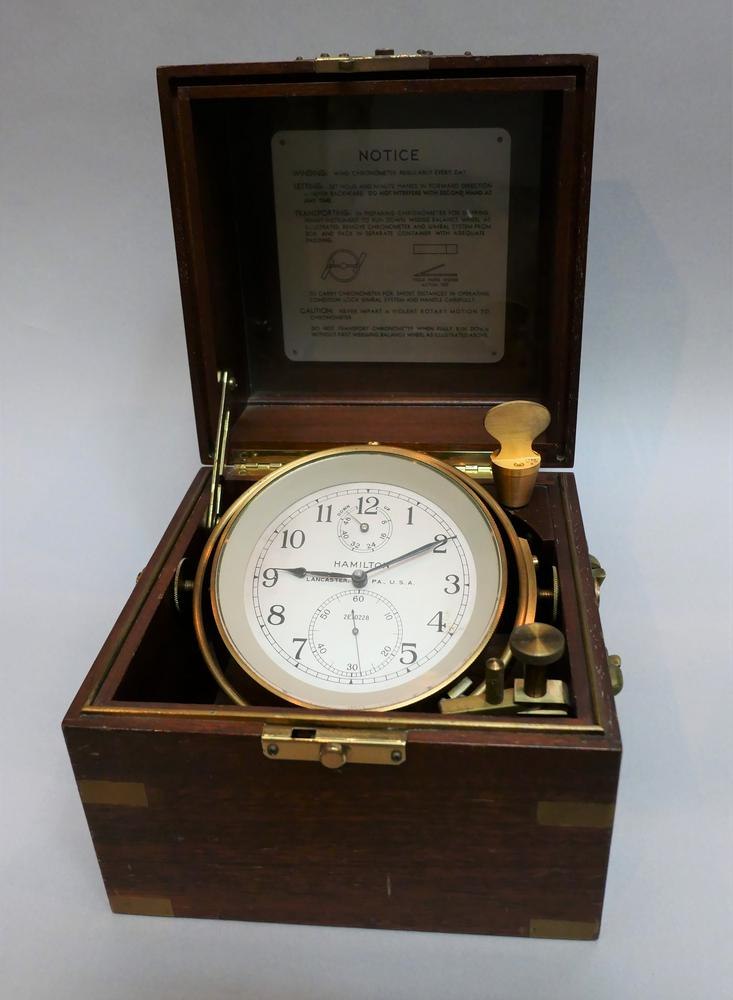
This Hamilton Watch Company marine chronometer features an Earnshaw spring detent escapement housed in a brass bowl suspended within a gimbal system inside a brass-bound mahogany box. The silvered dial has black-painted brass hour and minute hands, a blued steel seconds hand, an up-and-down indicator below 12 o'clock, and a subsidiary seconds dial above 6 o'clock inscribed with serial number 2E10228. Sourced by the British Museum in 1988 from Raymond Mellor, former Managing Director of Hamilton's U.K. branch, source notes report the chronometer was assembled specifically for him from the factory's final available parts.

Hamilton Model 21 marine chronometer in mahogany box with open lid, British Museum
Hamilton Model 21 marine chronometer in mahogany box with open lid, British Museum — British Museum. Rights pending — permission not yet requested. Original source

Catalogue identity

Source
www.britishmuseum.org
Category
Marine chronometer · Gimballed marine chronometer
Maker / attribution
Hamilton Watch Company
Reference
Model 21
Catalogue / lot identifier
1988,0410.2
Source-reported date
1959-1965
Country
United States
Source-reported serial
2E10228

Source-reported attribution and specifications are not independent authentication. A listing does not establish present ownership, current display, availability or permission to reproduce.

Object description

Construction and Housing

The movement is housed in a brass bowl mounted within a gimbal system, secured inside a brass-bound mahogany box. The box features continuous piano hinges, cast carrying handles that are not recessed, and a glazed panel in the top lid, which includes a brass signature plate. A tipsy key is stored in a corner gusset.

Internal components include a nickel-silver frame with straight-line wave decoration. The architecture includes a three-pillar back plate design, where the fourth pillar position is omitted. The brass bowl utilizes a spring-loaded cover to protect the winding aperture.

Evidence for this section
  • “The movement contained in a brass bowl.”
  • “The brass bound mahogany box has a glazed panel in the top under the hinged lid.”
  • “The back plate unusual, being supported by three pillars only, the plate being cut away where it would normally be supported by the fourth pillar.”

Dial and Escapement Mechanics

The flat, silvered dial features black-painted brass hour and minute hands alongside a blued steel seconds hand. An up-and-down indicator is located in the top half, with a subsidiary seconds dial at the bottom. The movement utilizes an Earnshaw-type spring detent escapement, incorporating a ruby impulse pallet with a radial face.

The balance assembly consists of an ovalising uncut balance with a stainless steel rim and invar arm. It is powered by a Ni-Span-C spring comprising 14 full turns, with fine adjustment achieved through timing nuts set to the side of the balance arm.

Evidence for this section
  • “Flat silvered dial, the markings produced by etching and filling black.”
  • “The reserve of going in the top half of the dial, the seconds in the lower.”
  • “Escapement: Spring detent escapement of the Earnshaw type but with some continental features.”

Provenance and Documentation

The chronometer was acquired by the British Museum in 1988. Information regarding its specific assembly history is based on claims by the seller, Raymond Mellor, former Managing Director of the Hamilton Watch Company's U.K. branch, who stated the unit was finished for him using final parts available at the U.S. factory.

Catalogue documentation from the British Museum places the production of the instrument within the 1959–1965 timeframe, with specific notes suggesting a date of circa 1962.

Evidence for this section
  • “According to the seller Mr Raymond Mellor, one-time Managing Director of Hamiltons U.K. Branch, the chronometer was finished especially for him from the last parts available at the factory in the U.S.A.”
  • “Production date 1959-1965”
  • “Made by Hamilton Watch Company, c. 1962”

Open research questions

  • Does any surviving Hamilton factory correspondence corroborate the supply of remaining Model 21 parts to Raymond Mellor?
  • To what extent do the 'continental features' of the escapement differ from standard wartime-era Hamilton Model 21 specifications?

Source evidence

Recorded claims and source quotations for Hamilton Model 21 Marine Chronometer
FieldSource-reported valueSource quotation
Museum Number1988,0410.2“Museum number 1988,0410.2”
MakerHamilton Watch Company“Made by: Hamilton Watch Company”
Production PlaceLancaster (Pennsylvania)“Made in: Lancaster (Pennsylvania)”
EscapementEarnshaw spring detent“Escapement earnshaw spring detent”
Jewel Count14 jewels“Jewelling: 14 jewels in all”
Acquisition Year1988“Acquisition date 1988”
Serial Number2E10228“On the dial 'HAMILTON LANCASTER P.A., U.S.A.' and the number '2 10228 '”
Jewel Count14“14 jewels in all”

Visible details

  • Silvered dial with black Arabic numerals and railway minute track
  • Up-and-down indicator subdial positioned below 12 o'clock
  • Gimballed brass bowl mounted inside an open brass-bound mahogany box
  • Printed instruction plaque titled 'NOTICE' affixed to the inside of the lid
  • Brass winding tipsy key resting in the upper right corner fitting

Research qualifications

  • Internal nickel-silver frame, fusee mechanism, and balance assembly are fully enclosed and not directly visible in the image
  • Assembly from final factory parts is source-reported by seller Raymond Mellor
  • Production date is catalogued broadly as 1959–1965, with catalogue text proposing circa 1962

Photograph identity and source facts were screened before import; rights clearance remains pending.

Consulted source

marine chronometer; clock-case; box | British Museum

Reviewed 2026-10-25 · Record 7084a3c756

Terms in this record

Glossary explanations for terms named in this object’s record.