
Skip to content
The Encyclopedia of Horology

Clock · Wall regulator clock

Gustav Becker late 19th-century Vienna-style walnut regulator

Partially verified

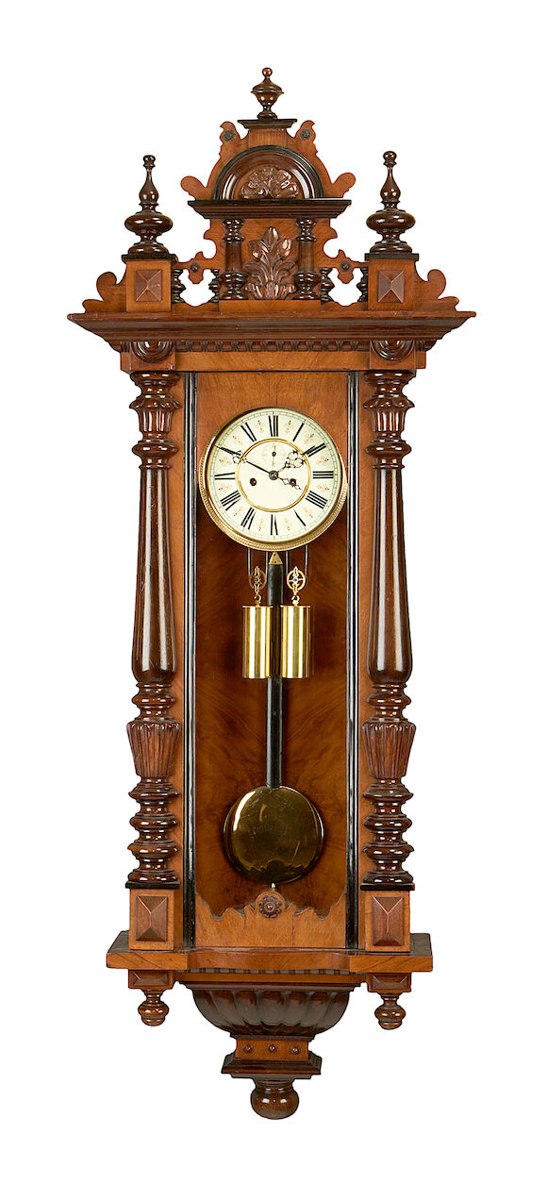
This late 19th-century German Vienna-style wall regulator is cased in walnut and measures 136 cm in height. The architectural case features a carved pediment topped with knopped finials and flanked by turned, fluted pilasters. The white enamel dial is marked with black Roman hour numerals and a subsidiary dial. Power is provided by a twin weight-driven movement stamped with the Gustav Becker anchor trademark. The mechanism incorporates maintaining power, a deadbeat escapement with adjustable pallets, and beat adjustment linked to a wooden rod pendulum with a brass bob.

Front view of the walnut Vienna-style regulator clock with weights and pendulum visible
Front view of the walnut Vienna-style regulator clock with weights and pendulum visible — Bonhams. Rights pending — permission not yet requested. Original source

Catalogue identity

Source
www.bonhams.com
Category
Clock · Wall regulator clock
Maker / attribution
Gustav Becker
Reference
Not recorded
Catalogue / lot identifier
333
Source-reported date
late 19th century
Country
Germany

Source-reported attribution and specifications are not independent authentication. A listing does not establish present ownership, current display, availability or permission to reproduce.

Object description

Architectural Case Construction

The clock is described as a walnut regulator in the Vienna style, measuring 136 cm in height. The case features a carved pediment decorated with a pair of knopped finials and is constructed with a pair of pilasters.

The case design incorporates a glazed front door. The source description of the case includes elements such as the carved pediment and pilasters.

Evidence for this section
  • “walnut Regulator”
  • “136cm high”
  • “the carved pediment with a pair of knopped finials”
  • “the case with a pair of pilasters”

Dial and Timekeeping Mechanism

The regulator features an enamel dial with Roman numerals. Power is supplied by a twin weight-driven movement that bears the anchor Gustav Becker stamp.

Reported technical components of the movement include maintaining power and a deadbeat escapement with adjustable pallets. The timekeeping system utilizes a wooden rod pendulum with beat adjustment.

Evidence for this section
  • “the enamel dial with Roman numerals”
  • “the twin weight driven movement with the anchor Gustav Becker stamp”
  • “maintaining power and deadbeat escapement with adjustable pallets and beat adjustment to a wooden rod pendulum”

Provenance and Attribution

The clock is attributed to the maker Gustav Becker. This information and the detailed specifications of the internal mechanism are provided by the auction cataloguing.

The current condition of the rear backboard and internal mounting hardware is not recorded in the source material.

Evidence for this section
  • “Regulator by Gustav Becker”

Open research questions

  • What is the specific archival basis for the late 19th-century dating assigned by the auction house?
  • Are there visible marks or identifiers on the rear of the clock that could further confirm the provenance beyond the movement stamp?

Source evidence

Recorded claims and source quotations for Gustav Becker late 19th-century Vienna-style walnut regulator
FieldSource-reported valueSource quotation
MakerGustav Becker“Regulator by Gustav Becker”
OriginGermany“German Vienna style”
DateLate 19th century“late 19th century”
Case materialWalnut“walnut Regulator”
Movement stampAnchor Gustav Becker stamp“anchor Gustav Becker stamp”
EscapementDeadbeat escapement with adjustable pallets“deadbeat escapement with adjustable pallets”
PendulumWooden rod pendulum with beat adjustment“beat adjustment to a wooden rod pendulum”
Height136 cm“136cm high”

Visible details

  • Carved pediment featuring turned knopped finials and relief leaf carving.
  • Twin brass cylindrical driving weights suspended via pulleys beneath the dial.
  • White enamel dial displaying Roman hour numerals and a subsidiary seconds dial.
  • Glazed front door flanked by turned and fluted wooden pilasters.
  • Lower case terminates in a fluted drop finial base.

Research qualifications

  • Internal movement stamp and mechanism details are not directly visible in the frontal photograph and rely on auction cataloguing.
  • Rear case backboard and mounting hardware are obscured.

Photograph identity and source facts were screened before import; rights clearance remains pending.

Consulted source

Bonhams : A late 19th century German Vienna style walnut Regulator by Gustav Becker

Reviewed 2026-10-21 · Record 4b7ea93d6e

Terms in this record

Glossary explanations for terms named in this object’s record.