
Skip to content
The Encyclopedia of Horology

Clock · Wall clock

Grande Sonnerie Striking Vienna Regulator

Partially verified

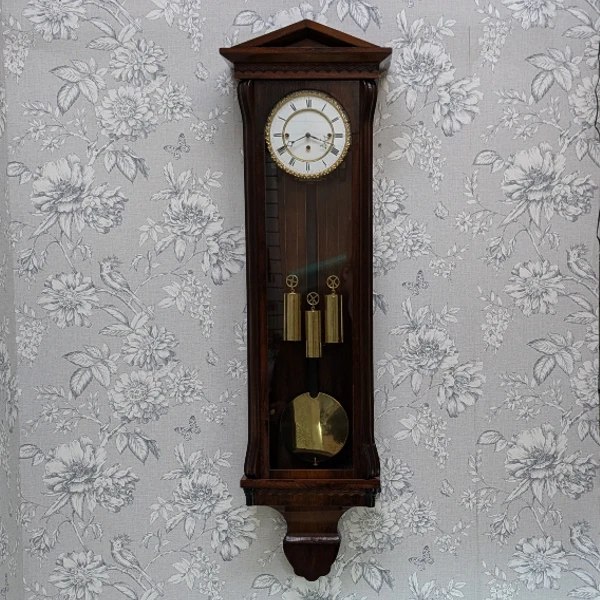
This wall-mounted Vienna regulator clock dates to approximately 1860. The timepiece is powered by an eight-day, key-wound, triple-weight-driven German movement featuring an anchor escapement and rack striking. It is designed to perform a grande sonnerie strike on two gongs, signaling both the quarter hours and the full hours on each quarter. The clock is housed in a fruitwood case with an original glazed door. The circular white porcelain dial includes Roman numerals, a brass piecrust trim, and blued steel hands. Components include the original brass weights and a brass pendulum bob. The clock measures 122 cm in height, 36 cm in width, and 14 cm in depth, with a dial diameter of 14 cm. It is currently offered by W J Morris Clocks.

Full view of the triple-weight Grande Sonnerie Vienna regulator clock.
Full view of the triple-weight Grande Sonnerie Vienna regulator clock. — W J Morris Clocks. Rights pending — permission not yet requested. Original source

Catalogue identity

Source
wjmorrisclocks.co.uk
Category
Clock · Wall clock
Maker / attribution
Not established
Reference
Not recorded
Catalogue / lot identifier
Source URL identifies the listing
Source-reported date
circa 1860
Source-reported place
Germany

Source-reported attribution and specifications are not independent authentication. A listing does not establish present ownership, current display, availability or permission to reproduce.

Object description

Case and Dial

The clock is presented in a fruitwood case characterized by its tall, vertical design and original glazed door that protects the dial and movement components.

The dial is a circular white porcelain piece featuring Roman numerals and blued steel hands. It is framed by a decorative brass piecrust trim. The dial is described as unmarked, and its diameter measures 14 cm. The overall dimensions of the case are 122 cm in height, 36 cm in width, and 14 cm in depth.

Evidence for this section
  • “Fine fruitwood case, original glazed door.”
  • “Unmarked white porcelain dial, brass piecrust trim, Roman numerals, blued steel hands.”
  • “Height 122cm Width 36 cm Depth 14cm Diameter of Face 14cm”

Movement and Function

The timekeeping and striking functions are powered by an eight-day, key-wound movement of German origin. The mechanism utilizes a triple-weight-driven system and incorporates an anchor escapement for regulation.

The clock is configured for a grande sonnerie strike, which produces an acoustic signal on two gongs for both the quarter hours and the full hours. The movement employs rack striking to execute these sequences.

Evidence for this section
  • “Quality German 8 day key wound triple weight driven movement, anchor escapment, rack striking.”
  • “Grande Sonnerie strike on two gongs (strikes the quarter hours and the hours on each quarter).”

Components and Attribution

The clock retains original components, specifically the brass weights and the brass bob attached to the pendulum rod. These elements are visible through the glazed section of the case, suspended alongside the movement's drive trains.

The listing attributes the manufacture of the clock to Germany and assigns a date of approximately 1860.

Evidence for this section
  • “Original brass weights, brass bob to pendulum.”
  • “Triple Weighted Grande Sonnerie Striking Vienna Regulator, circa 1860.”
  • “Quality German 8 day key wound triple weight driven movement”

Open research questions

  • Does the movement contain any hidden stamps or maker's marks not visible on the exterior?
  • Can the specific style of the fruitwood case be linked to a known regional workshop in 19th-century Germany?

Source evidence

Recorded claims and source quotations for Grande Sonnerie Striking Vienna Regulator
FieldSource-reported valueSource quotation
Datecirca 1860“circa 1860”
Movement type8 day key wound triple weight driven movement“Quality German 8 day key wound triple weight driven movement”
Escapementanchor escapement“anchor escapment”
Striking mechanismGrande sonnerie on two gongs“Grande Sonnerie strike on two gongs (strikes the quarter hours and the hours on each quarter).”
Case materialFruitwood“Fine fruitwood case”
DialWhite porcelain with Roman numerals“Unmarked white porcelain dial, brass piecrust trim, Roman numerals”
Dimensions122cm x 36cm x 14cm“Height 122cm Width 36 cm Depth 14cm”
Dial diameter14cm“Diameter of Face 14cm”

Visible details

  • Fruitwood case with glazed door
  • Brass piecrust trim surrounding the porcelain dial
  • Triple brass weight-driven configuration
  • Blued steel hands on white dial

Research qualifications

  • Movement not pictured or verified
  • Maker not specified beyond regional origin

Photograph identity and source facts were screened before import; rights clearance remains pending.

Consulted source

Grande Sonnerie Striking Vienna Regulator

Reviewed 2026-11-02 · Record afe9538b2e

Terms in this record

Glossary explanations for terms named in this object’s record.