
Skip to content
The Encyclopedia of Horology

Clock · Skeleton clock

Gioachino Alberti brass skeleton clock with constant force escapement

Partially verified

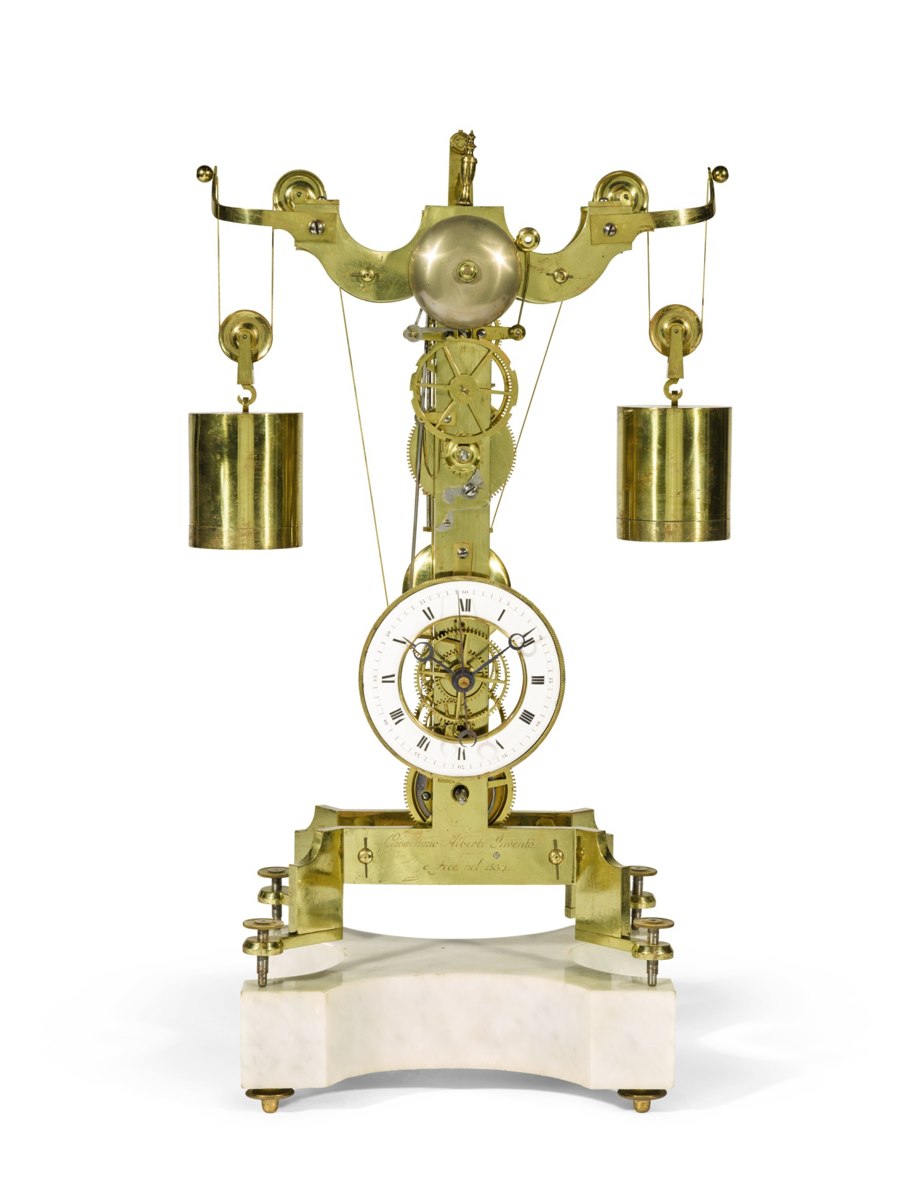
This Italian brass skeleton clock is documented as invented and made by Gioachino Alberti in Milan, dated 1834. The frame is engraved 'Gioachimo Alberti Invento, e Fece nel 1834' and mounted via four levelling screws on a shaped marble base. According to the catalogue description, the two-train movement features a striking train with a spring barrel, outside count wheel, and bell, while the going train is powered by two suspended brass weights operating on a single barrel. The mechanism includes a weight-driven constant force escapement with a four-leg escape wheel acting on a five-bar gridiron half-seconds pendulum.

Front view of the Gioachino Alberti brass skeleton clock on marble base with weights suspended
Front view of the Gioachino Alberti brass skeleton clock on marble base with weights suspended — Sotheby's. Rights pending — permission not yet requested. Original source

Catalogue identity

Source
www.sothebys.com
Category
Clock · Skeleton clock
Maker / attribution
Gioachino Alberti
Reference
Not recorded
Catalogue / lot identifier
136
Source-reported date
1834
Country
Italy

Source-reported attribution and specifications are not independent authentication. A listing does not establish present ownership, current display, availability or permission to reproduce.

Object description

Identity and Inscription

Catalogued as the work of Gioachino Alberti in Milan and dated to 1834, the clock is catalogued as the 'Property of a distinguished Italian collector'. The brass skeleton frame is inscribed on its lower structure.

The inscription identifies the maker and date, reading 'Gioachimo Alberti Invento, e Fece nel 1834' on the substantial but simple frame.

Evidence for this section
  • “Property of a distinguished Italian collector”
  • “Gioachino Alberti, Milan, dated 1834”
  • “signed Gioachimo Alberti Invento, e Fece nel 1834”
  • “The lower horizontal frame member bears the engraved inscription 'Gioachimo Alberti Invento, e Fece nel 1834'.”

Frame, Base, and Dimensions

The clock mechanism is built within an open brass skeleton frame that rests upon four knurled levelling screws over a shaped white marble plinth.

According to the auction catalogue, the clock itself measures 55 cm (21¾ inches) high, and is accompanied by a modern glazed display cover measuring 62 cm (24¼ inches) high.

Evidence for this section
  • “The clock mechanism rests on four knurled levelling screws over a shaped white marble plinth.”
  • “with four levelling screws and marble base; together with a modern glazed display cover”
  • “Clock 55cm. 21¾in. high; Glazed cover 62cm. 24¼in. high”

Catalogue-Documented Movement and Front Observations

Visual observation confirms a white enamel chapter ring with Roman numerals and an open centre displaying the wheelwork, along with two large cylindrical brass weights suspended via pulleys from upper horizontal brackets.

The catalogue states the two-train movement has a spring barrel, outside count wheel, and bell for the striking train, while the going train operates with two weights to a single barrel. It also records a four-leg escape wheel giving locking and impulse to a five-bar grid-iron half-seconds pendulum, with a spring escape detent mounted on the pendulum.

Evidence for this section
  • “A white enamel chapter ring with Roman numerals displays an open centre revealing the wheelwork.”
  • “Two large cylindrical brass weights are suspended via pulleys from horizontal upper brackets.”
  • “the two train movement with spring barrel, outside count wheel and bell to the striking train, the going train with two weights to a single barrel, the four-leg escape wheel providing locking and impulse to the five bar grid-iron half-secondspendulum, the spring escape detent mounted on the pendulum”

Open research questions

  • What are the precise arrangement and geometry of Alberti's constant force escapement and spring escape detent when viewed from the side and rear?
  • Are there municipal or exhibition records from Milan documenting Gioachino Alberti's horological work or patents around 1834?
  • How does the modern glazed cover seat relative to the shaped marble base?

Source evidence

Recorded claims and source quotations for Gioachino Alberti brass skeleton clock with constant force escapement
FieldSource-reported valueSource quotation
Maker and DateGioachino Alberti, Milan, dated 1834“Gioachino Alberti, Milan, dated 1834”
SignatureSigned Gioachimo Alberti Invento, e Fece nel 1834“Gioachimo Alberti Invento, e Fece nel 1834”
Dial4¼-inch dial with open centre and centre seconds“4¼-inch dial with open centre, centre seconds”
DimensionsClock 55 cm (21¾ inches) high“Clock 55cm. 21¾in. high”
Dial Specification4¼-inch dial with open centre, centre seconds“4¼-inch dial with open centre, centre seconds”
Display Cover Height62 cm (24¼ inches) high“Glazed cover 62cm. 24¼in. high”

Visible details

  • Two large cylindrical brass weights are suspended via pulleys from horizontal upper brackets.
  • A white enamel chapter ring with Roman numerals displays an open centre revealing the wheelwork.
  • The lower horizontal frame member bears the engraved inscription 'Gioachimo Alberti Invento, e Fece nel 1834'.
  • The clock mechanism rests on four knurled levelling screws over a shaped white marble plinth.

Research qualifications

  • The modern glazed display cover mentioned in the catalogue text is not shown in this photograph.
  • The escapement geometry, pendulum, and striking components positioned to the rear are mostly obscured in this front view.

Photograph identity and source facts were screened before import; rights clearance remains pending.

Consulted source

A brass skeleton clock with weight-driven constant force escapement,

Reviewed 2026-10-21 · Record 4956d0d58d

Terms in this record

Glossary explanations for terms named in this object’s record.