
Skip to content
The Encyclopedia of Horology

Clock · Table clock

German alarm table clock

Partially verified

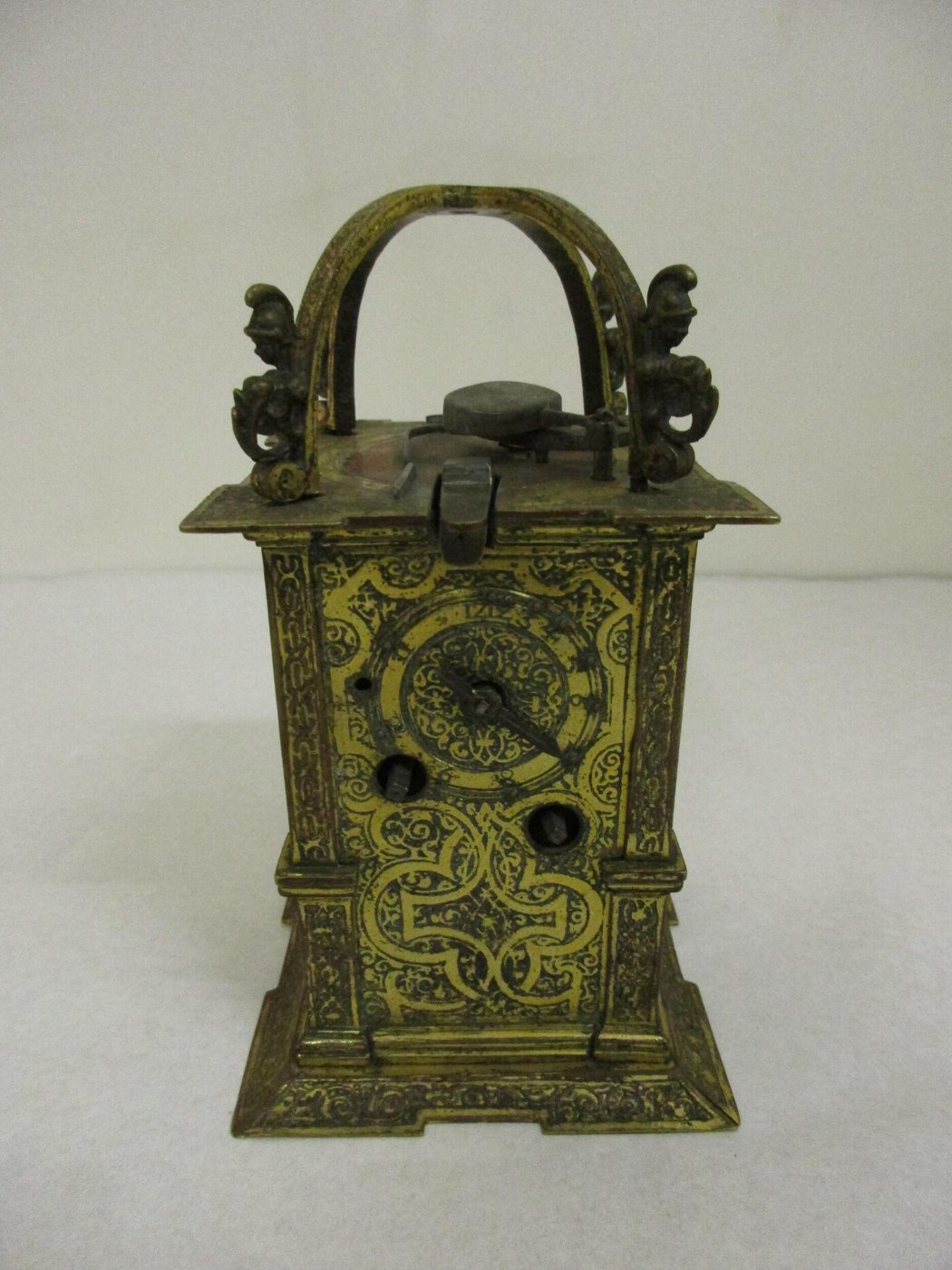
This small German table clock, dating to approximately 1550, is constructed from gilded brass, with iron components used in its internal movement. The rectangular case features projecting cornices, a footed base, and decorative angle pilasters. The sides and base are finished with engraved and painted strapwork and arabesque foliage. The top is surmounted by a bell frame adorned with human-headed brackets and topped with a figure of a musician beating cymbals. The brass dial includes an applied chapter ring marked with Roman numerals for the hours and Arabic numerals for a 24-hour cycle, alongside a central alarm disc. The internal mechanism includes a going train with a fusee, an iron striking train, and a steel alarm train, all housed within a frame of steel plates and square pillars. One pillar bears the stamped mark 'AI'. The clock was bequeathed to the Victoria and Albert Museum by J.G. Joicey in 1919.

Front view of the German table clock showing the dial, gilt-brass case, and top-mounted bell with cymbal player.
Front view of the German table clock showing the dial, gilt-brass case, and top-mounted bell with cymbal player. — Victoria and Albert Museum. Rights pending — permission not yet requested. Original source

Catalogue identity

Source
collections.vam.ac.uk
Category
Clock · Table clock
Maker / attribution
Not established
Reference
Not recorded
Catalogue / lot identifier
M.259-1919
Source-reported date
ca.1580
Source-reported place
Germany
Source-reported serial
AI

Source-reported attribution and specifications are not independent authentication. A listing does not establish present ownership, current display, availability or permission to reproduce.

Object description

Case and Dial Construction

The clock is housed in a rectangular gilt-brass case characterized by a projecting cornice and foot. The surfaces are decorated with engraved and painted arabesque foliage and strapwork designs. Four angle pilasters reinforce the vertical structure of the case. The top section consists of a bell enclosed within a double arch, which is supported by human-headed brackets and topped by a male figure beating cymbals.

The dial assembly features an applied brass chapter ring, 0.6 cm in breadth, engraved with Roman numerals I through XII, supplemented by half-hour marks. A sunken interior ring displays Arabic numerals 13 to 24 for a 24-hour reading, while a central disc with a diameter of 2.5 cm features Arabic numerals 1 through 12 for setting the alarm function. The current clock hand is identified as a modern, crude replacement.

Evidence for this section
  • “Small table clock with gilt-brass case of rectangular form with angle pilasters and projecting foot and cornice”
  • “bell above enclosed within double arch ornamented with human-headed brackets and surmounted by a male figure beating cymbals”
  • “the brass dial has an applied chapter ring 0.6 cm broad with Roman numerals I to XII and half-hour marks.”

Movement and Mechanism

The movement is constructed predominantly of iron and is mounted within a frame of steel plates and square pillars. It incorporates a going train located at the front, equipped with a fusee and a verge escapement. While the primary components are iron, the contrate and crown wheels have been replaced with brass. The strike train is located at the rear and utilizes a count-wheel driven by reduction gearing.

An independent alarm train, constructed entirely of steel, is positioned at the right rear of the movement. This mechanism is wound through an aperture located on the lower side plate of the case. The original bob pendulum associated with the escapement is currently missing from the mechanism, and the going train is reported as being loose.

Evidence for this section
  • “The iron movement has a verge escapement and steel hands”
  • “Going train at front with fusee and train (now completely loose) and verge escapement.”
  • “Alarm train, all of steel, at right rear of movement, wound through a hole low in right side plate of case.”

Provenance and Marks

The clock was part of a larger collection bequeathed to the Victoria and Albert Museum by John George Joicey in 1919.

The piece is identified by a stamp on one of the internal vertical steel pillars. The mark consists of the letters 'AI' enclosed within an escutcheon. Little documentation regarding the original maker or specific origin remains beyond the general attribution to mid-16th century South Germany.

Evidence for this section
  • “The clock was one of two beqeathed by J.G.Joicey in 1919”
  • “One vertical pillar stamped AI in escutcheon”
  • “South German, mid-16th century.”

Open research questions

  • What is the significance of the 'AI' stamp in relation to potential South German clockmakers of the mid-16th century?
  • Can the original form of the replaced hand be determined through comparative analysis of similar 16th-century German table clocks?

Source evidence

Recorded claims and source quotations for German alarm table clock
FieldSource-reported valueSource quotation
MakerUnknown“Maker: Unknown”
Accession numberM.259-1919“Accession number: M.259-1919”
Dateca.1550“Date: ca.1550”
Place of originGermany“Place of origin: Germany (made)”
DimensionsHeight: 7.2 in; Width: 3.3 in“Height: 7.2 in; Width: 3.3 in”
MaterialsGilded brass, iron“Gilded brass, engraved and enamelled, the movement and hands of iron.”
MarksAI“One vertical pillar stamped AI in escutcheon”

Visible details

  • Gilt-brass case with strapwork and arabesque engraving
  • Dial with Roman hour numerals and Arabic 24-hour cycle
  • Surmounted by a bell-housing frame with cymbal-playing figure
  • Stamped mark 'AI' on a vertical movement pillar

Research qualifications

  • The modern clock hand is described as a crude replacement
  • The bob pendulum is broken off and missing

Photograph identity and source facts were screened before import; rights clearance remains pending.

Consulted source

Clock

Reviewed 2026-10-26 · Record c0b48313f7

Terms in this record

Glossary explanations for terms named in this object’s record.