
Skip to content
The Encyclopedia of Horology

Pocket watch · Pair case quarter repeater

George Strigel 20K Yellow Gold Pair Case Quarter-Hour Repeater Pocket Watch

Partially verified

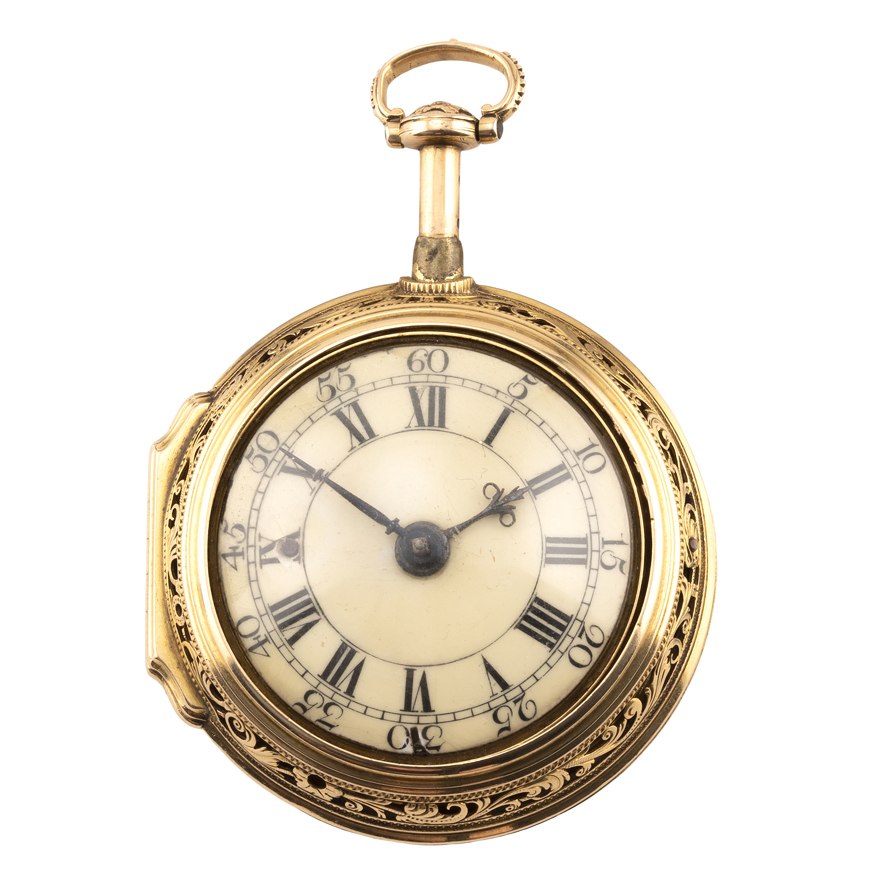
This early English pocket watch features a quarter-hour repeater mechanism and is housed in a 20K yellow gold pair case, dated circa 1740. According to the source, the movement is signed Strigel of London and employs a key-wound, chain-driven fusee with a diamond endstone. The outer and inner cases feature pierced and engraved borders. A cream-colored dial with a convex crystal displays Roman numerals for the hours and an outer chapter of Arabic numerals at five-minute intervals, with time-setting accomplished via an arbor at the center of the dial.

Front view of the 20K yellow gold pair case pocket watch displaying the dial and pierced outer case
Front view of the 20K yellow gold pair case pocket watch displaying the dial and pierced outer case — Renaissance Antiques. Rights pending — permission not yet requested. Original source

Catalogue identity

Source
www.renaissanceantiques.com
Category
Pocket watch · Pair case quarter repeater
Maker / attribution
George Strigel
Reference
Not recorded
Catalogue / lot identifier
JROS 2233
Source-reported date
Circa 1740
Country
United Kingdom

Source-reported attribution and specifications are not independent authentication. A listing does not establish present ownership, current display, availability or permission to reproduce.

Object description

Case Construction

The watch features a pair case design, which includes an outer hinged shell intended to protect the pocket watch. Both the inner and outer cases feature pierced and engraved decoration along the bezel rims.

The case material is described by the source as 20K yellow gold. The watch is topped with a long cylindrical neck and pendant bow, with hinged construction visible on the left side.

Evidence for this section
  • “The watch has a 20K yellow gold pair case.”
  • “An outer hinged case serves to protect the actual pocket watch.”
  • “This outer case is decoratively pierced and engraved.”
  • “The same fine piercing and engraving likewise enhance the watch case.”
  • “Yellow gold pair case with pierced and engraved scrollwork along the bezel rim”

Dial and Visual Features

The watch face consists of a cream-colored dial protected by a convex crystal. It features black Roman numerals for the hours and an outer chapter of Arabic numerals at five-minute intervals.

Winding and time-setting are performed using a key on an arbor located at the center of the dial. The watch also displays pierced decorative hands.

Evidence for this section
  • “A cream color dial displays Roman and Arabic numerals.”
  • “A convex crystal protects the dial.”
  • “The time set also utilizes the same key on an arbor in the middle of the dial.”
  • “Central winding/setting arbor with pierced decorative hands”

Mechanism and Provenance

The movement is signed 'Strigel of London'. According to the source, the mechanism is a key-wound, chain-driven fusee featuring a diamond endstone. The watch functions as a quarter-hour repeater, triggered by a button on the case.

The item is dated to circa 1740. Documentation attributed to Alex Smith of Inverury is noted by the source as being present in the bottom of the outer case.

Evidence for this section
  • “The movement is signed Strigel of London.”
  • “The movement employs a key wind chain-driven fusee with a diamond endstone.”
  • “This early English quarter-hour repeater pocket watch represents an amazing time-keeping technology.”
  • “Within the bottom of the outer case appears to be later paperwork attributed to Alex Smith of Inverury.”
  • “Circa 1740”

Open research questions

  • Are there visible hallmarks on the gold cases to verify the claimed 20K fineness?
  • Does the 'Strigel of London' signature correlate with horological records for the circa 1740 period?
  • What is the physical condition and legibility of the watch paper attributed to Alex Smith?

Source evidence

Recorded claims and source quotations for George Strigel 20K Yellow Gold Pair Case Quarter-Hour Repeater Pocket Watch
FieldSource-reported valueSource quotation
Case Material20K yellow gold“The watch has a 20K yellow gold pair case.”
MakerStrigel of London“The movement is signed Strigel of London.”
Movement MechanismKey wind chain-driven fusee with diamond endstone“The movement employs a key wind chain-driven fusee with a diamond endstone.”
ComplicationQuarter-hour repeater“This early English quarter-hour repeater pocket watch represents an amazing time-keeping technology.”
DateCirca 1740“Circa 1740”
MechanismKey wind, chain-driven fusee with diamond endstone“The movement employs a key wind chain-driven fusee with a diamond endstone.”

Visible details

  • Cream dial with black Roman hour numerals and outer five-minute Arabic numerals
  • Yellow gold pair case with pierced and engraved scrollwork along the bezel rim
  • Central winding/setting arbor with pierced decorative hands
  • Long cylindrical neck and pendant bow at the top
  • Hinged case construction visible on the left side

Research qualifications

  • Movement and interior case are not visible in the provided image; movement signature, fusee mechanism, and diamond endstone are source-reported
  • Watch paper attributed to Alex Smith of Inverury inside the outer case is reported by source but not visible

Photograph identity and source facts were screened before import; rights clearance remains pending.

Terms in this record

Glossary explanations for terms named in this object’s record.