
Skip to content
The Encyclopedia of Horology

Clock · Bracket clock

George III miniature table clock by Recordon

Partially verified

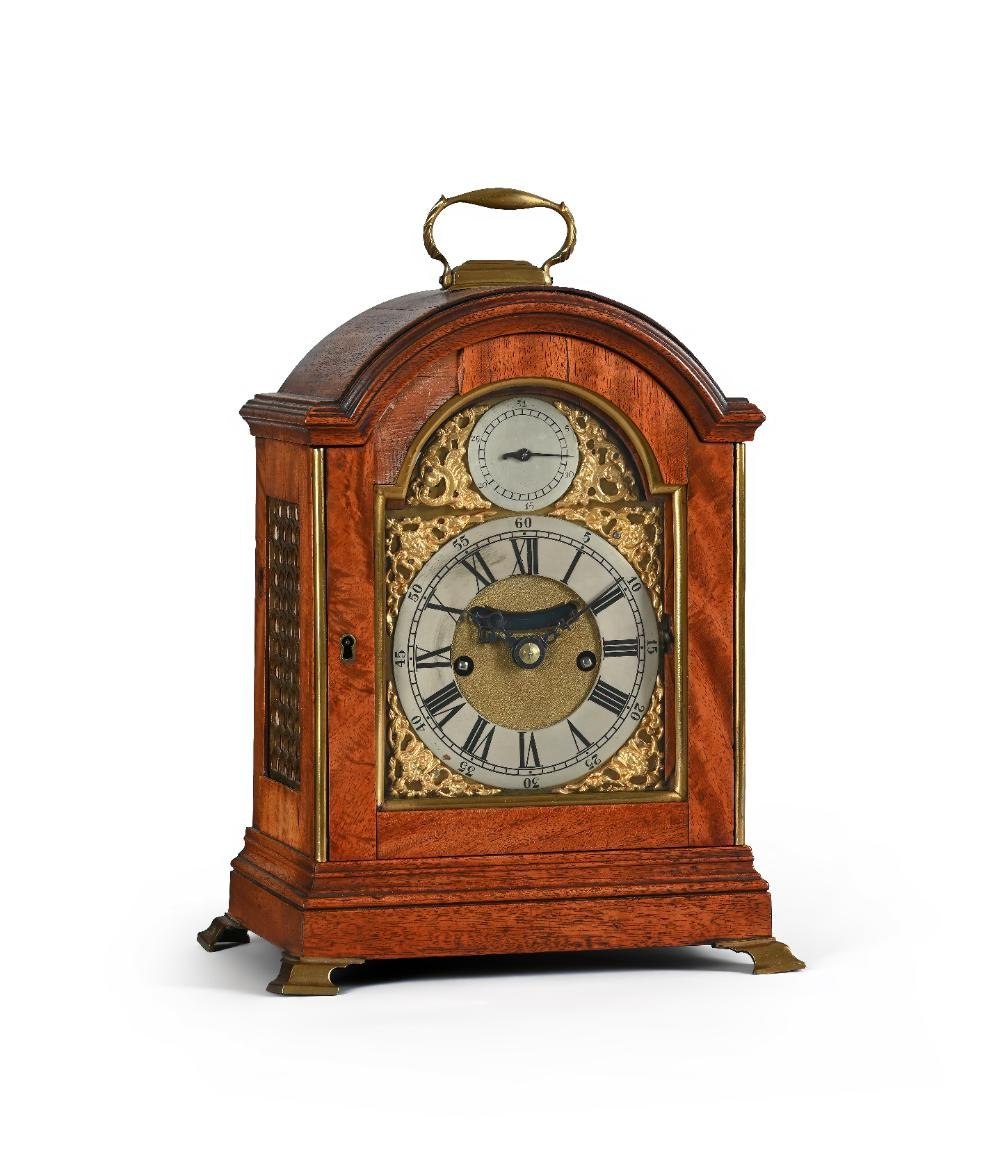
This George III miniature bracket clock, dating to approximately 1790, is a timepiece by the London maker Louis Recordon. The clock is contained within a mahogany break-arch case, which features a hinged brass carrying handle and brass fish scale sound frets on the side panels. The base is finished with a cavetto moulded skirt and rests on brass ogee bracket feet. The 4.5-inch brass dial is of the break-arch type, featuring a matted centre, an applied silvered Roman numeral chapter ring, and scroll-pierced blued steel hands. The arch section includes a silvered calendar disk and decorative gilt grotesque mask and scroll mounts. The movement is a five-pillar twin fusee type, utilizing a verge escapement regulated by a short bob pendulum. The backplate is engraved with leafy scrolls and a cartouche containing the maker's name, 'Recordon, London', and the serial number 9405.

View of the Recordon miniature bracket clock showing the mahogany case, brass dial, and silvered chapter ring.
View of the Recordon miniature bracket clock showing the mahogany case, brass dial, and silvered chapter ring. — Auction house “Dreweatts 1759 Fine Sales”, via Invaluable. Rights pending — permission not yet requested. Original source

Catalogue identity

Source
orbiscollectibles.com
Category
Clock · Bracket clock
Maker / attribution
Recordon
Reference
Not recorded
Catalogue / lot identifier
Source URL identifies the listing
Source-reported date
c. 1790
Source-reported place
London
Source-reported serial
9405

Source-reported attribution and specifications are not independent authentication. A listing does not establish present ownership, current display, availability or permission to reproduce.

Object description

Case and Exterior

The clock is housed in a mahogany case designed with a break-arch silhouette. The exterior architecture incorporates several brass elements, including a hinged carrying handle mounted to the top and fish scale sound frets fitted to the sides, which allow for the transmission of sound from the internal bell. The case stands on a cavetto moulded skirt base, supported by four brass ogee bracket feet.

The dial measures 4.5 inches and retains a brass break-arch configuration. It features a matted centre and an applied silvered chapter ring with Roman numerals. The dial arch is decorated with gilt grotesque mask and scroll mounts and contains a silvered calendar disk. Blued steel, scroll-pierced hands indicate the time.

Evidence for this section
  • “mahogany break-arch case, featuring a hinged brass carrying handle, brass fish scale sound frets on the sides, and a cavetto moulded skirt base raised on brass ogee bracket feet.”
  • “4.5-inch brass break-arch dial incorporates a matted centre, an applied silvered Roman numeral chapter ring, and scroll-pierced blued steel hands.”

Movement and Technical Features

The clock is powered by a five-pillar twin fusee movement. This mechanism employs a verge escapement and is regulated by a short bob pendulum. The striking train is configured to strike on an internal bell.

The backplate of the movement serves as a location for the maker's signature and serial number. It is decorated with an engraving of leafy scrolls and a basket of fruit, surrounding a central cartouche inscribed with the maker's name, 'Recordon, London'.

Evidence for this section
  • “five-pillar twin fusee movement utilizes a verge escapement regulated by a short bob pendulum.”
  • “backplate displays an intricate engraving of delicate leafy scrolls surrounding a central cartouche inscribed with the maker's name, 'Recordon, London', accompanied by a serial number.”

Condition and Attribution

The auction description reports that while the movement and the main dial plate are original to the clock, certain specific components have been replaced. The chapter ring and the spandrels are identified as 20th-century additions rather than original 18th-century parts.

The object is attributed to the London-based clockmaker Louis Recordon. The listing notes that the clock dates to approximately 1790, within the George III period.

Evidence for this section
  • “While the movement and dial plate are original, components such as the chapter ring and spandrels are considered later 20th-century additions.”

Open research questions

  • What is the specific nature of the 20th-century modifications to the dial and spandrels?
  • Does the serial number 9405 align with known output records for Louis Recordon from the 1790s?

Source evidence

Recorded claims and source quotations for George III miniature table clock by Recordon
FieldSource-reported valueSource quotation
MakerRecordon“Recordon, London”
Datec. 1790“dating to approximately 1790”
Case materialMahogany“mahogany break-arch case”
Movement typeFive pillar twin fusee“five-pillar twin fusee movement”
EscapementVerge“verge escapement”
Dimensions28cm high“Measuring approximately 28cm high”

Visible details

  • Silvered calendar disk in the dial arch
  • Brass fish scale sound frets on side panels
  • Gilt grotesque mask and scroll mounts on dial
  • Hinged brass carrying handle on case top

Research qualifications

  • Chapter ring is reported as a 20th-century addition
  • Spandrels are reported as 20th-century additions

Photograph identity and source facts were screened before import; rights clearance remains pending.

Terms in this record

Glossary explanations for terms named in this object’s record.