
Skip to content
The Encyclopedia of Horology

Clock · Longcase clock

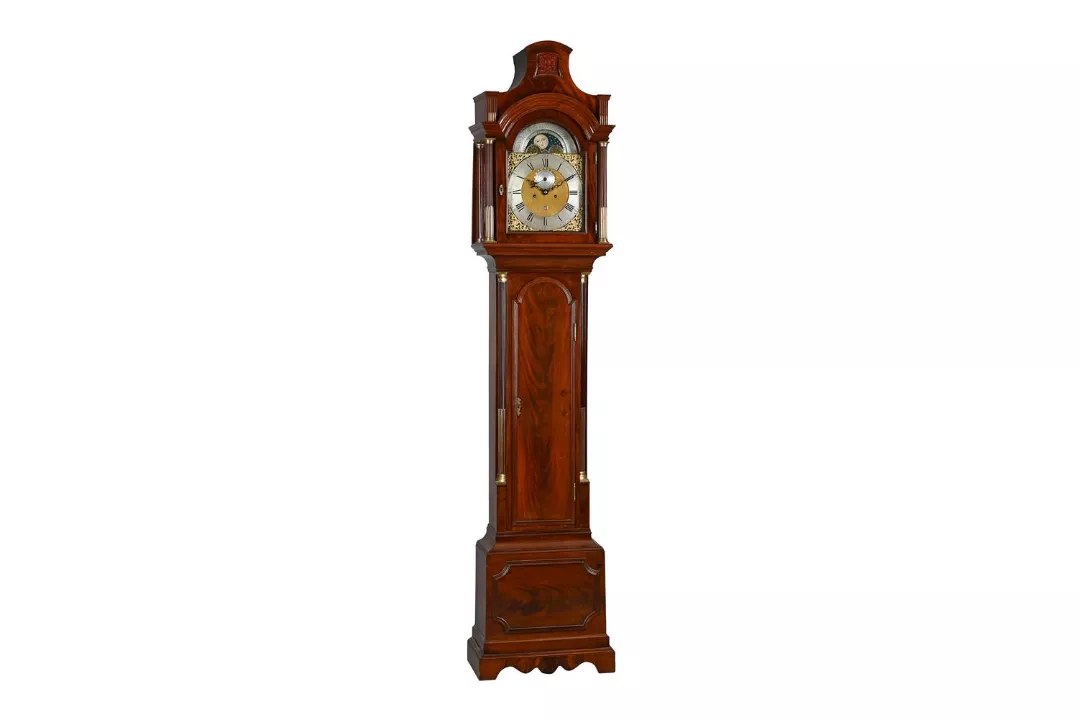
George III mahogany eight-day longcase clock with moonphase, James De Lasalle

Partially verified

According to the auction catalogue, this George III longcase clock features an eight-day movement with five pillars, two trains, rack and bell striking, an anchor escapement, and a seconds pendulum. Its 12-inch brass break-arch dial incorporates a matted centre, calendar aperture, silvered subsidiary seconds ring, rococo spandrels, and an arch rolling moonphase inscribed with 'Ja's De Lasalle, London'. The flame-figured mahogany case features a concave-sided pagoda hood, brass stop-fluted columns, an arched trunk door, and a plinth base with a raised shaped panel.

Full-length view of the George III mahogany longcase clock
Full-length view of the George III mahogany longcase clock — Dreweatts 1759. Rights pending — permission not yet requested. Original source

Catalogue identity

Source
www.the-saleroom.com
Category
Clock · Longcase clock
Maker / attribution
James De Lasalle
Reference
Not recorded
Catalogue / lot identifier
175
Source-reported date
circa 1775
Country
United Kingdom

Source-reported attribution and specifications are not independent authentication. A listing does not establish present ownership, current display, availability or permission to reproduce.

Object description

Dial and Mechanism

The clock houses a five-pillar, two-train movement featuring a rack and bell striking mechanism, regulated by a seconds pendulum and an anchor escapement. The 12-inch brass break-arch dial includes a matted center, a calendar aperture, and a recessed bright-cut bordered silvered subsidiary seconds dial. It features an applied silvered Roman numeral chapter ring with Arabic five-minute markers.

The arch displays a rolling moonphase with an engraved age-of-the-moon scale, lunar disc, and lunettes featuring a sunburst mask and terrestrial globes. The dial is signed 'Ja's De Lasalle, London' along the upper margin. Observations note witness marks from calendar ring pulleys, a detent pivot in the matting, and a filled pin-prick hole above the calendar aperture.

Evidence for this section
  • “The five pillar two train rack and bell striking movement with anchor escapement regulated by seconds pendulum”
  • “12 inch brass break-arch dial with calendar aperture and recessed bright-cut bordered silvered subsidiary seconds dial”
  • “beneath signature Ja's De Lasalle, London to upper margin”

Case Construction

The mahogany case features a concave-sided 'pagoda' superstructure with a shaped foliate pierced fret, a cavetto cornice, and brass stop-fluted columns flanking the glazed dial aperture. The sides include rectangular windows and quarter columns. The trunk door is veneered in flame mahogany and framed by complex moldings and further brass stop-fluted quarter columns.

The plinth base has a concave top molding, a raised shaped panel, and a molded double skirt. Condition reporting notes that the lower skirt and its shaped apron are a restoration or replacement, and the hood top contains three empty socket holes where finials are missing. A stable crack is noted on the rear left-hand carcass edge.

Evidence for this section
  • “concave-sided 'pagoda' superstructure fronted with a shaped foliate pierced fret”
  • “the lower skirt (with shaped apron) is a restoration/replacement”
  • “top of the hood has three empty socket holes from finials which are no longer present”

Provenance and Attribution

James De Lasalle is recorded in F.J. Britten's 'Old Clocks and Watches and Their Makers' as working from Brookers Row, Moorfields in 1780, and later at 42 St. Catherine's, Tower Hill between 1800 and 1818.

Specialist assessment suggests the movement and dial are original to the case, as they rest on an seatboard mounted directly onto the cheek uprights.

Evidence for this section
  • “James De Lasalle is recorded in Britten, F.J. OLD CLOCKS AND WATCHES AND THEIR MAKERS as working from Brookers Row, Moorfields, London in 1780 and then 42 St. Catherine's, Tower Hill 1800-18.”
  • “it is therefore most probable that the movement and dial are original to the case”

Open research questions

  • Does the serial number or maker's mark on the movement internal plates confirm the De Lasalle attribution beyond the dial signature?
  • Can the date of the lower skirt restoration be estimated through material analysis of the apron replacement?

Source evidence

Recorded claims and source quotations for George III mahogany eight-day longcase clock with moonphase, James De Lasalle
FieldSource-reported valueSource quotation
EscapementAnchor escapement“movement with anchor escapement regulated by seconds pendulum”
Dial Size12 inch“the 12 inch brass break-arch dial with calendar aperture”
Dimensions243cm high, 53cm wide, 26cm deep“243cm (95.75ins) high, 53cm (21ins) wide, 26cm (10.25ins) deep.”
Dial SignatureJa's De Lasalle, London“beneath signature Ja's De Lasalle, London to upper margin”

Visible details

  • Arched hood features a pagoda top with foliate fret insert and flanking fluted brass-accented columns
  • Rolling moonphase disc shows a painted lunar face, stars, and scale above terrestrial hemispheres
  • Long trunk door and lower base exhibit flame mahogany grain

Research qualifications

  • Source notes the lower skirt with shaped apron is a restoration/replacement
  • Source condition report notes three empty socket holes on the hood top for missing finials
  • Movement interior is not visible in the provided exterior photographs

Photograph identity and source facts were screened before import; rights clearance remains pending.

Terms in this record

Glossary explanations for terms named in this object’s record.