
Skip to content
The Encyclopedia of Horology

Clock · Table clock

George II burr walnut table clock by John Ellicott

Partially verified

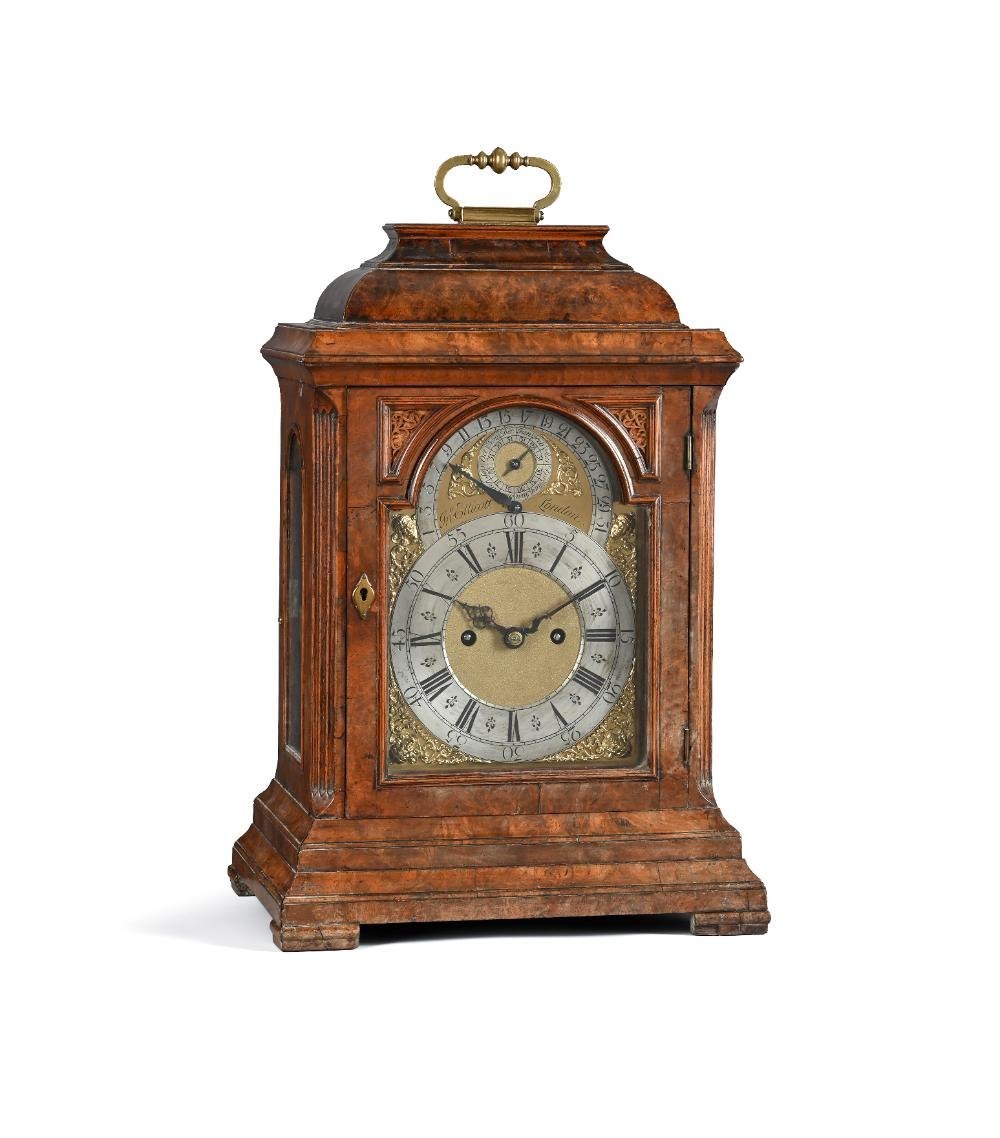
This George II table clock by John Ellicott of London, dating to circa 1745, features a burr walnut veneer case with an inverted bell-top design, fluted canted angles, and a brass carrying handle. The clock stands on a double cross-grain molded skirt with feet. It is equipped with a five-pillar twin fusee movement featuring a verge escapement and bell strike. The rear of the clock houses a backplate engraved with foliated scrollwork and a basket of fruit. The 7-inch brass break-arch dial incorporates a matted center, a silvered Roman numeral chapter ring with fleur-de-lys markers, and scroll-pierced blued steel hands. Functional indicators include an upper curved silvered plate for a fly-back date-of-the-month and a central subsidiary dial for the month of the year. The ensemble includes a George III brass-mounted mahogany wall bracket dating to approximately 1760.

Front view of the George II burr walnut table clock by John Ellicott showing the dial, hands, and calendar indicators.
Front view of the George II burr walnut table clock by John Ellicott showing the dial, hands, and calendar indicators. — Dreweatts 1759 Fine Sales, via Invaluable. Rights pending — permission not yet requested. Original source

Catalogue identity

Source
orbiscollectibles.com
Category
Clock · Table clock
Maker / attribution
John Ellicott
Reference
Not recorded
Catalogue / lot identifier
Source URL identifies the listing
Source-reported date
c. 1745
Source-reported place
London, England

Source-reported attribution and specifications are not independent authentication. A listing does not establish present ownership, current display, availability or permission to reproduce.

Object description

Case and Dial Design

The clock is housed in a case constructed from burr walnut veneer. It is designed with an inverted bell-top and features fluted canted angles. A brass carrying handle is mounted to the top, and the base consists of a double cross-grain molded skirt supported by feet.

The 7-inch brass break-arch dial features a matted center and Indian mask and scroll cast spandrels. The silvered chapter ring displays Roman numerals with fleur-de-lys markers. Time is indicated by scroll-pierced blued steel hands. An upper curved silvered plate facilitates a fly-back date-of-the-month indicator, accompanied by a central subsidiary month-of-the-year dial.

Evidence for this section
  • “The case is constructed from burr walnut veneer with an inverted bell-top design, fluted canted angles, and a brass carrying handle.”
  • “The 7-inch brass break-arch dial has a matted center, a silvered Roman numeral chapter ring with fleur-de-lys markers, and scroll-pierced blued steel hands.”
  • “Notably, the dial includes an upper curved silvered plate for a fly-back date-of-the-month indicator and a central subsidiary month-of-the-year dial.”

Movement and Backplate

The clock movement is a five-pillar twin fusee configuration. It operates with a verge escapement and includes a bell strike mechanism.

The rear of the movement is protected by a backplate. This component displays engraved foliated scrollwork and a decorative depiction of a basket of fruit.

Evidence for this section
  • “The clock features a five-pillar twin fusee movement with verge escapement and bell strike.”
  • “The backplate displays intricate engraved foliated scrollwork with a basket of fruit.”

Accompanying Components and Dimensions

The clock is accompanied by a brass-mounted mahogany wall bracket which the source dates to circa 1760. This bracket serves as a mounting for the clock, increasing the total height of the piece when displayed.

The clock itself measures 49 cm in height. When positioned on the mahogany wall bracket, the combined height of the arrangement is 82.5 cm.

Evidence for this section
  • “The clock is accompanied by a George III brass-mounted mahogany wall bracket from circa 1760.”
  • “Measuring 49 cm in height alone, this piece showcases the high level of craftsmanship associated with the celebrated London clockmaker John Ellicott.”

Open research questions

  • What is the specific mechanical method by which the fly-back calendar function resets at the end of the month?
  • Is there evidence linking the production of the mahogany wall bracket to the same period as the clock's movement overhaul or sale?

Source evidence

Recorded claims and source quotations for George II burr walnut table clock by John Ellicott
FieldSource-reported valueSource quotation
MakerJohn Ellicott“John Ellicott, London”
Movementfive-pillar twin fusee, bell striking“five-pillar twin fusee movement with verge escapement and bell strike”
Escapementverge“verge escapement”
Dial size7 inches“7-inch brass break-arch dial”
Clock height49 cm“Measuring 49 cm in height alone”

Visible details

  • Case features burr walnut veneer with an inverted bell-top
  • Dial has an upper curved silvered plate for fly-back date indication
  • Backplate contains engraved scrollwork and a basket of fruit
  • Features cast Indian mask and scroll spandrels

Research qualifications

  • The included mahogany wall bracket dates to c. 1760, suggesting it may not be contemporary to the clock
  • The source describes the clock as being accompanied by the bracket but does not specify if they were originally sold as a set

Photograph identity and source facts were screened before import; rights clearance remains pending.

Terms in this record

Glossary explanations for terms named in this object’s record.