
Skip to content
The Encyclopedia of Horology

Clock · Carriage clock

French One-Piece Brass Cased Carriage Clock

Partially verified

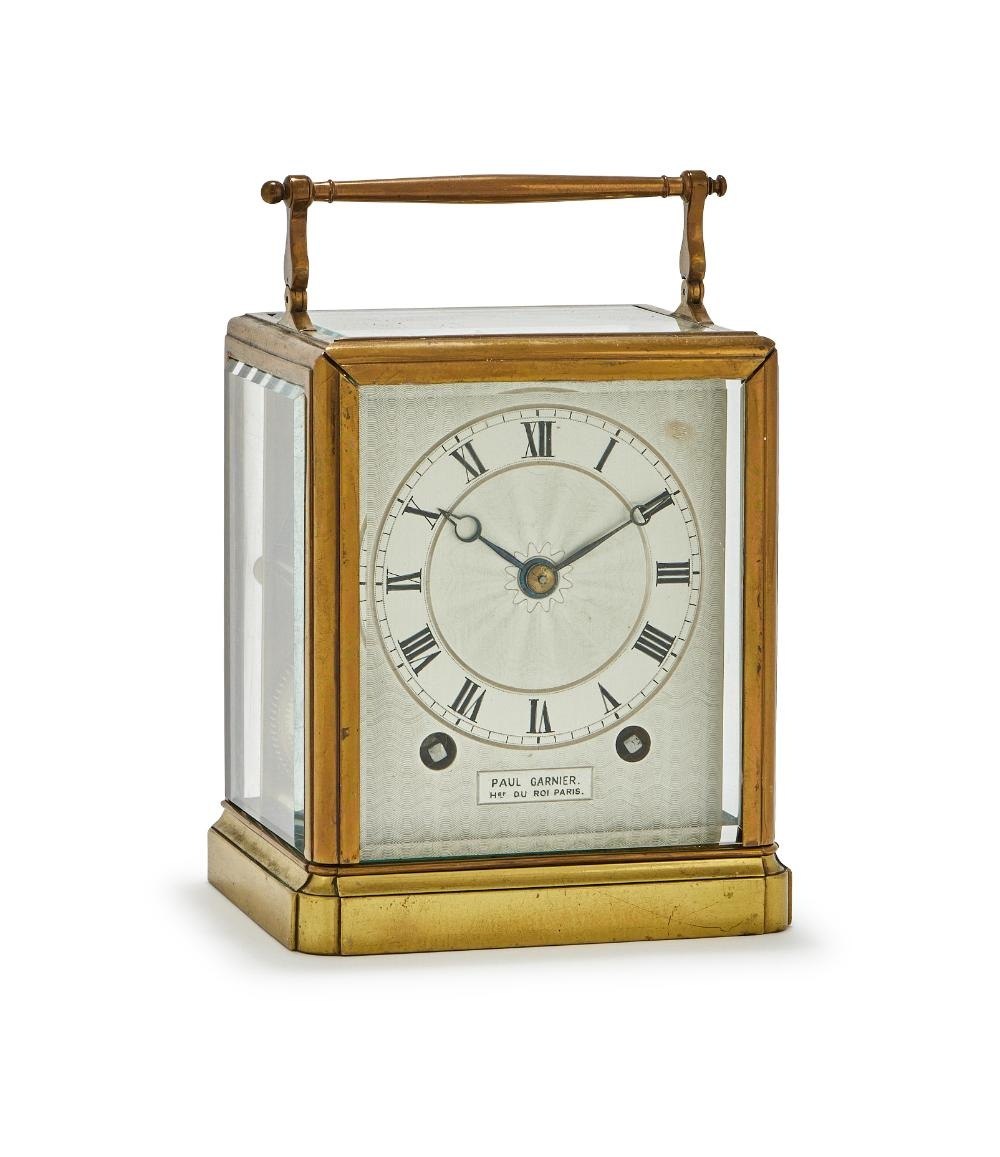
This French brass-cased carriage clock, dating to approximately 1835, is attributed to the maker Paul Garnier. The clock features a distinctive 'one-piece' case construction that incorporates a wooden block insert on the underside. Its movement is equipped with a two-plane 'chaffcutter' escapement, a design derived from the frictional rest watch and chronometer escapements created by Sully and Debaufre. The dial is finished with an engine-turned 'watered-silk' pattern, providing a specific visual texture. The overall case geometry and technical features align with the 'Series I' classification of carriage clocks defined by Charles Allix. This timepiece represents an early phase in the standardisation of the portable carriage clock, combining internal technical complexity with a specific structural form.

Front view of the Paul Garnier brass-cased carriage clock showing the engine-turned dial and glass case panels.
Front view of the Paul Garnier brass-cased carriage clock showing the engine-turned dial and glass case panels. — Dreweatts 1759 Fine Sales / Invaluable. Rights pending — permission not yet requested. Original source

Catalogue identity

Source
orbiscollectibles.com
Category
Clock · Carriage clock
Maker / attribution
Paul Garnier
Reference
Not recorded
Catalogue / lot identifier
205843798
Source-reported date
circa 1835
Source-reported place
France

Source-reported attribution and specifications are not independent authentication. A listing does not establish present ownership, current display, availability or permission to reproduce.

Object description

Case and Dial Design

The clock is housed in a brass case designed with a 'one-piece' structure, a feature associated with early portable timepieces. A functional design element of this specific case is the inclusion of a wooden block insert located on the underside of the clock. The dimensions of the object are recorded as 15cm in height with the handle down, 12cm in width, and 10cm in depth.

The dial is decorated with an engine-turned pattern described as 'watered-silk', which serves as the backdrop for the hour markers and the signature plate. The dial features two prominent winding squares positioned towards the lower section, necessary for the operation of the movement. This visual layout is consistent with the established design patterns documented for the maker's early carriage clock series.

Evidence for this section
  • “the design of the squat one-piece case (incorporating a wooden block insert to underside)”
  • “provision of an engine turned 'watered-silk' dial”

Movement and Escapement

The mechanical operation of the clock is defined by the use of a two-plane 'chaffcutter' escapement. This mechanism draws its design lineage from the frictional rest escapements originally developed for watches and marine chronometers by Sully and Debaufre. The integration of this escapement in a portable carriage clock indicates an attempt to apply precision horological components into a compact format.

The movement's technical architecture is attributed to Paul Garnier, who is credited with the standardisation of the 'petit pendule portative'.

Evidence for this section
  • “The current lot utilises Garnier's 'chaffcutter' escapement - the design of which is based on Sully and Debaufre's frictional rest watch/chronometer escapements.”

Attribution and Classification

The identification of this object as a 'Series I' carriage clock is supported by the descriptive research of Charles Allix. The attribution to Paul Garnier is based on the technical conformity of the escapement and the case design to the records published in 'CARRIAGE CLOCKS Their history and development'. The clock is categorized within the context of early 19th-century French production, specifically around 1835.

The auction records acknowledge that while this classification is supported by expert literature, it remains subject to independent type verification. The documentation provided confirms the object as a brass-cased carriage clock, with its specific series designation derived from academic comparison with documented works by Garnier.

Evidence for this section
  • “conforms to Paul Garniers 'Series I' carriage clocks as described by Charles Allix (see CARRIAGE CLOCKS Their history and development pages 56-7).”

Open research questions

  • Does the movement contain any hidden maker marks or serial numbers consistent with Paul Garnier's workshop records?
  • Are there variations in the wooden base insert across other known examples of the 'Series I' carriage clock?

Source evidence

Recorded claims and source quotations for French One-Piece Brass Cased Carriage Clock
FieldSource-reported valueSource quotation
Dimensions15cm high, 12cm wide, 10cm deep“15cm (6ins) high with handle down, 12cm (4.75ins) wide, 10cm (4ins) deep.”
EscapementTwo-plane chaffcutter“The current lot utilises Garnier's 'chaffcutter' escapement”
Maker AttributionPaul Garnier“conforms to Paul Garniers 'Series I' carriage clocks”
DatingCirca 1835“CIRCA 1835”
Case constructionOne-piece brass with wooden block“the design of the squat one-piece case (incorporating a wooden block insert to underside)”

Visible details

  • Engine-turned 'watered-silk' dial surface
  • Two visible winding squares at the bottom of the dial
  • Brass carrying handle attached to the top
  • One-piece brass case construction with visible glass panels

Research qualifications

  • The attribution to Paul Garnier and the 'Series I' classification rely on secondary literature by Charles Allix rather than internal hallmarks.
  • The precise dating to circa 1835 is a source-attributed estimate rather than an verified fact from documentation.

Photograph identity and source facts were screened before import; rights clearance remains pending.

Consulted source

FRENCH ONE-PIECE BRASS CASED CARRIAGE CLOCK

Reviewed 2026-11-02 · Record 09a1593e3d

Terms in this record

Glossary explanations for terms named in this object’s record.